Clear Sky Science · en
Design and development of a novel instrument for characterizing the mechanical properties of ex vivo human skin
Why the feel of your skin matters
We all notice when our skin sags, tightens, or scars, but behind those sensations lies a complex mechanical fabric of fibers and fluids. How skin stretches, bounces back, and slowly changes with age or disease is not just a cosmetic concern—it affects wound healing, surgical outcomes, and how well creams or medical treatments actually work. This study presents a new laboratory instrument designed specifically to measure how pieces of real human skin behave when gently pulled and released over time, opening a window onto the hidden physics of our body’s largest organ.
Skin as a living shield
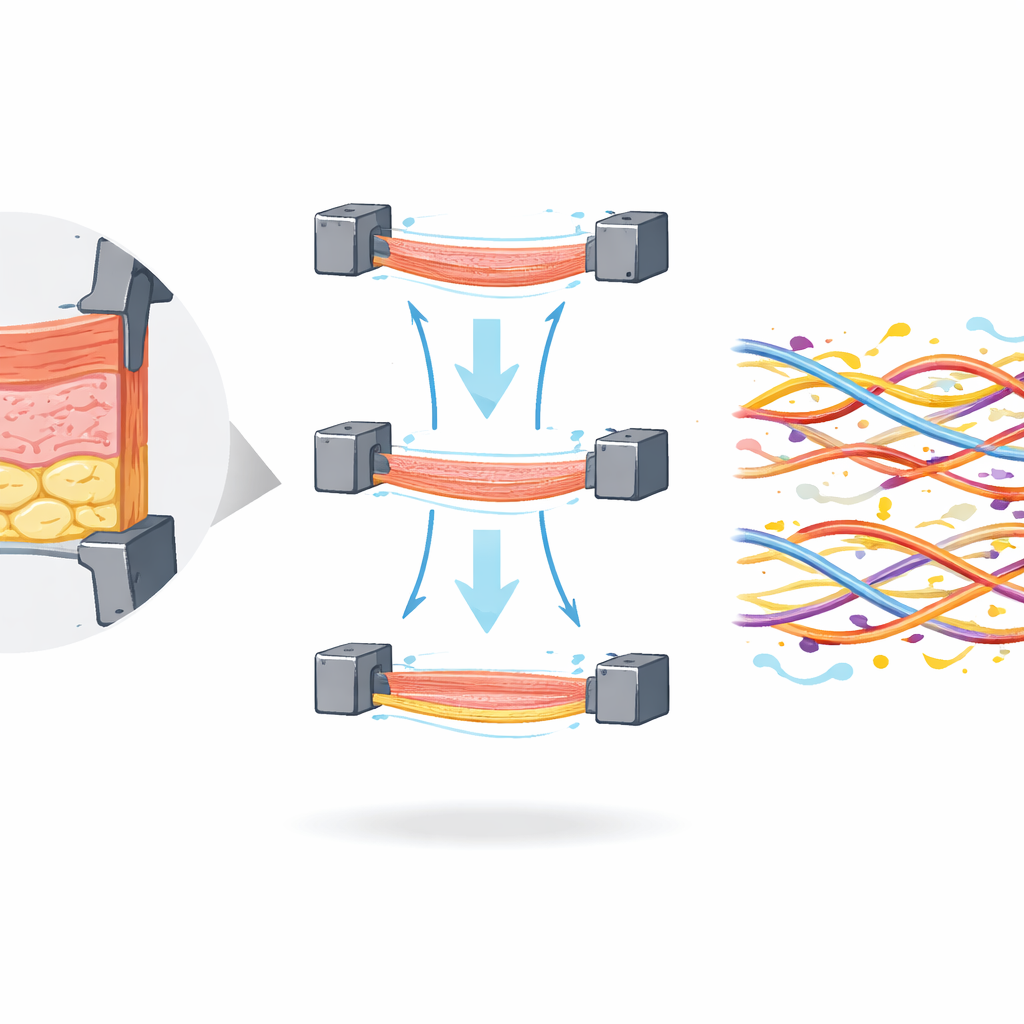
The authors begin by explaining why skin mechanics are so important. Skin must be tough enough to protect us from everyday bumps and scrapes, yet flexible enough to move freely and then return to shape. This balance is largely governed by the dermis, the middle layer of skin packed with collagen fibers that provide strength and elastic fibers that allow stretch and recoil. Together, these fibers and the gel-like material around them give skin a behavior that is far from simple: it is uneven from place to place, stretches differently in different directions, and reacts both like a spring and like a thick fluid that slowly dissipates energy.
Limits of current tools
Existing ways of probing skin mechanics each show only part of the picture. Techniques such as pulling, suction, or indentation can be used directly on volunteers, but they are hard to standardize, influenced by where on the body they are performed, and limited in the types of loads they can safely apply. Because they are done on living people, they usually cannot involve strong or destructive tests, and they often measure only how elastic the skin is, not how it gradually dissipates energy. In contrast, tests on isolated skin samples—taken after surgery and kept alive in nutrient solutions—offer more control and can be repeated under different chemical, biological, or mechanical stresses, but until now there has been no dedicated, versatile tool optimized for such ex vivo samples.
A new way to stretch living skin samples
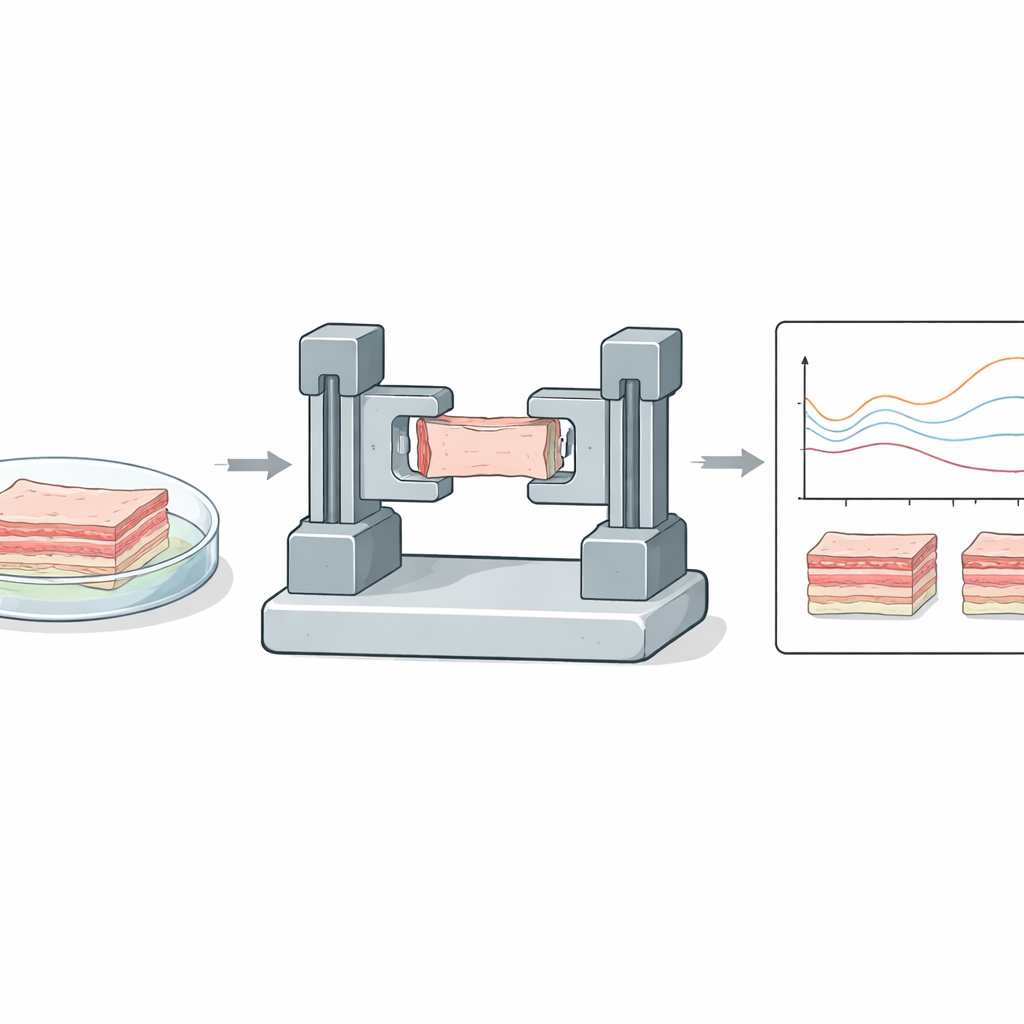
To bridge this gap, the researchers designed a compact instrument that can pull on small circular pieces of human skin while they are kept in culture for up to seven days. The sample sits on a motorized holder bathed in a nourishing medium, and two tiny metal studs are glued to its surface. These studs are attached to precision translation arms driven by piezoelectric stages and monitored by force and position sensors. This setup allows classic tensile tests, where the skin is stretched at a constant speed, as well as dynamic tests, where it is gently oscillated at different frequencies. Because the movements are finely controlled and the geometry of the skin pieces is standardized, the team can separate the skin’s spring‑like elasticity from its energy‑dissipating behavior over a wide range of loading times.
Proving the tool is trustworthy
Before using the device for detailed science, the authors had to show that it gives consistent results. They ran repeatability tests, stretching the same skin sample several times in a row, and found that the stress–strain curves from both slow pulls and dynamic oscillations almost perfectly overlapped. They then tested reproducibility by completely removing and replacing the skin between measurements, mimicking real experimental workflows. Even with this extra handling, variation stayed below about 5% for simple tensile measurements and 10% for dynamic stiffness, indicating that both the instrument and the mounting procedure are robust. Importantly, the skin remained undamaged at modest stretch levels, allowing many measurements over days on the same piece of tissue.
What the skin reveals when pulled and held
Using the new setup, the team performed a full mechanical portrait of a typical human skin sample. In slow stretching, the skin first deformed easily and then stiffened rapidly, forming the characteristic J‑shaped curve linked to elastic fibers taking up the initial load and collagen fibers aligning and bearing more force at higher strains. In dynamic tests, the elastic component of stiffness was always higher than the dissipative component and increased with loading frequency, showing that the tissue feels stiffer when it is deformed more quickly. Cyclic loading and unloading revealed hysteresis loops and a measurable amount of energy lost as heat, while stress‑relaxation tests—in which the skin is suddenly stretched and held—showed a marked drop in internal stress over tens of seconds as fibers slowly rearranged and the material relaxed toward a new equilibrium.
What this means for skin health
Seen through this instrument, skin emerges as a finely tuned, viscoelastic fabric whose behavior changes with how fast and how far it is stretched. The authors conclude that their device, by combining precise tensile tests with spectromechanical analysis on living human skin samples, provides a powerful new way to follow how treatments, aging, or disease alter both the elasticity and the energy‑dissipating capacity of the tissue. For non‑specialists, the key message is that we now have a sensitive "mechanical stethoscope" for skin: a tool that can track subtle changes in firmness and resilience over days, helping researchers and clinicians design better cosmetics, improve medical therapies, and deepen our understanding of how our protective outer layer copes with the stresses of daily life.
Citation: Blanchard, B., Ehrenfeld, F., Laffore, A. et al. Design and development of a novel instrument for characterizing the mechanical properties of ex vivo human skin. Sci Rep 16, 12960 (2026). https://doi.org/10.1038/s41598-026-42371-9
Keywords: skin mechanics, viscoelasticity, dermatology, biomechanical testing, ex vivo skin