Clear Sky Science · en
Availability and spatial distribution of crop and forest biomass residues for biochar production in Kenya
Why Farm Waste Matters for Everyday Life
Across Kenya, piles of leftover stalks, husks and sawdust are often seen as waste to be burned or discarded. This study shows that these scraps could instead fuel a cleaner future—turning farm and forest leftovers into biochar, a charcoal-like material that can improve soils and provide low-smoke fuel. By asking how much of this material exists, where it is, and how reliably it can be supplied, the researchers lay the groundwork for new rural industries, better harvests and reduced pressure on forests.
Turning Leftovers into a Useful Resource
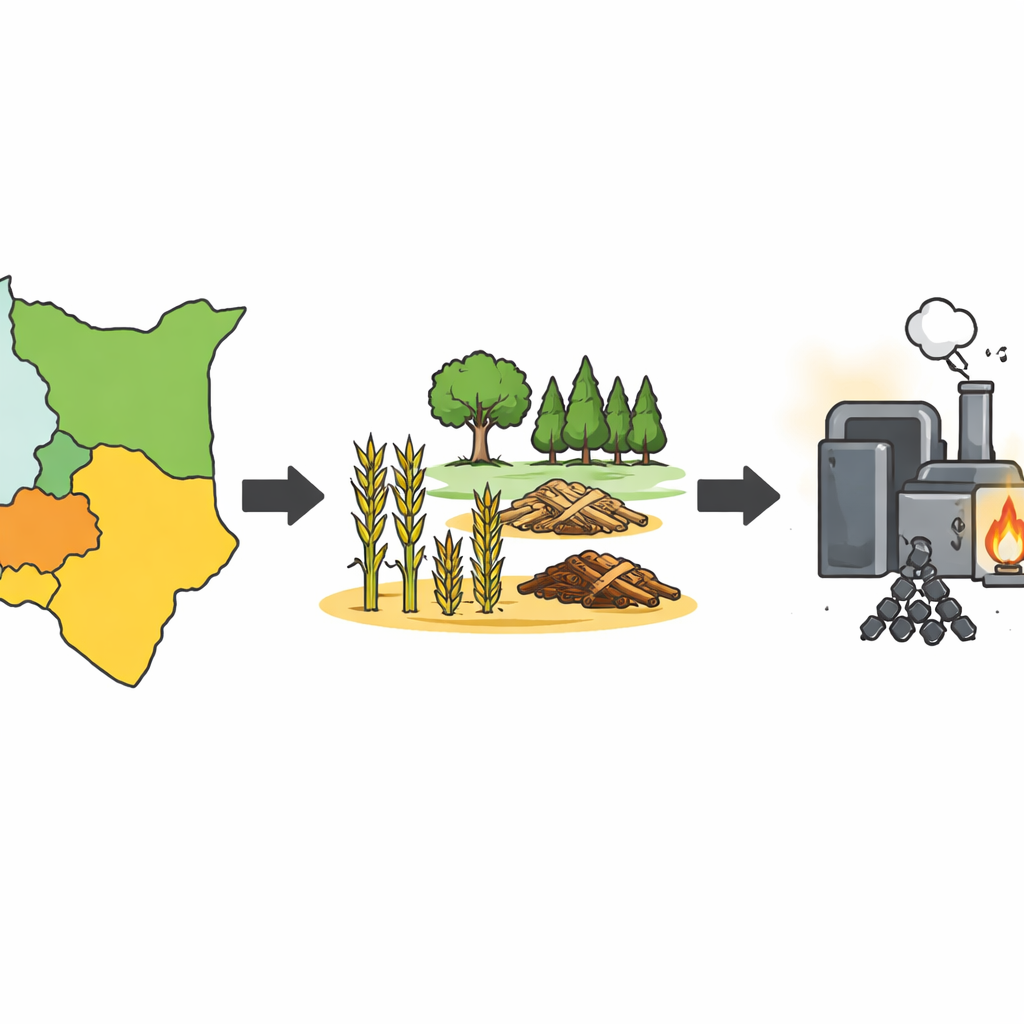
The authors set out to measure how much crop and forest residue Kenya produces and how it is spread across the country. They focused on material that remains after harvest or timber processing—such as maize stalks, bean stems, rice husks and sawdust—that could realistically be collected without disrupting animal feed, household fuel or soil protection. Using official production data from 2021 and 2022 for all 47 counties, along with international studies on how much residue each crop typically leaves behind, they calculated a range of plausible residue quantities and how much of that could be accessed economically.
How the Team Estimated Hidden Supplies
To avoid overly optimistic numbers, the researchers applied several filters. First, they linked each tonne of harvested grain or wood to an expected amount of residue. Next, they reduced this total to account for competing uses—such as feeding livestock or mulching fields—leaving only the “surplus” that could be diverted to biochar. Finally, they considered how much of that surplus could actually be collected and transported at reasonable cost, given poor roads, scattered farms and difficult terrain. By combining low, middle and high assumptions for each of these steps, they generated a range of estimates and used a sensitivity analysis to see which factors mattered most.
Where the Residues Are
The analysis suggests that Kenya generates on the order of tens of millions of tonnes of crop residues and hundreds of thousands of tonnes of forest residues each year that could, in principle, feed biochar production. Most of the crop residues are concentrated in the western, central and southern counties, where rainfall and soils support intensive farming. Maize stalks dominate everywhere, reflecting the crop’s role as the national staple, but each county also has a mix of other residues—such as sugarcane, wheat, beans and sisal—providing a diverse supply. Forest residues, mainly solid wood offcuts and sawdust from local sawmills, offer a smaller but still meaningful contribution, especially where logging and processing are active.
Balancing Abundance, Density and Certainty
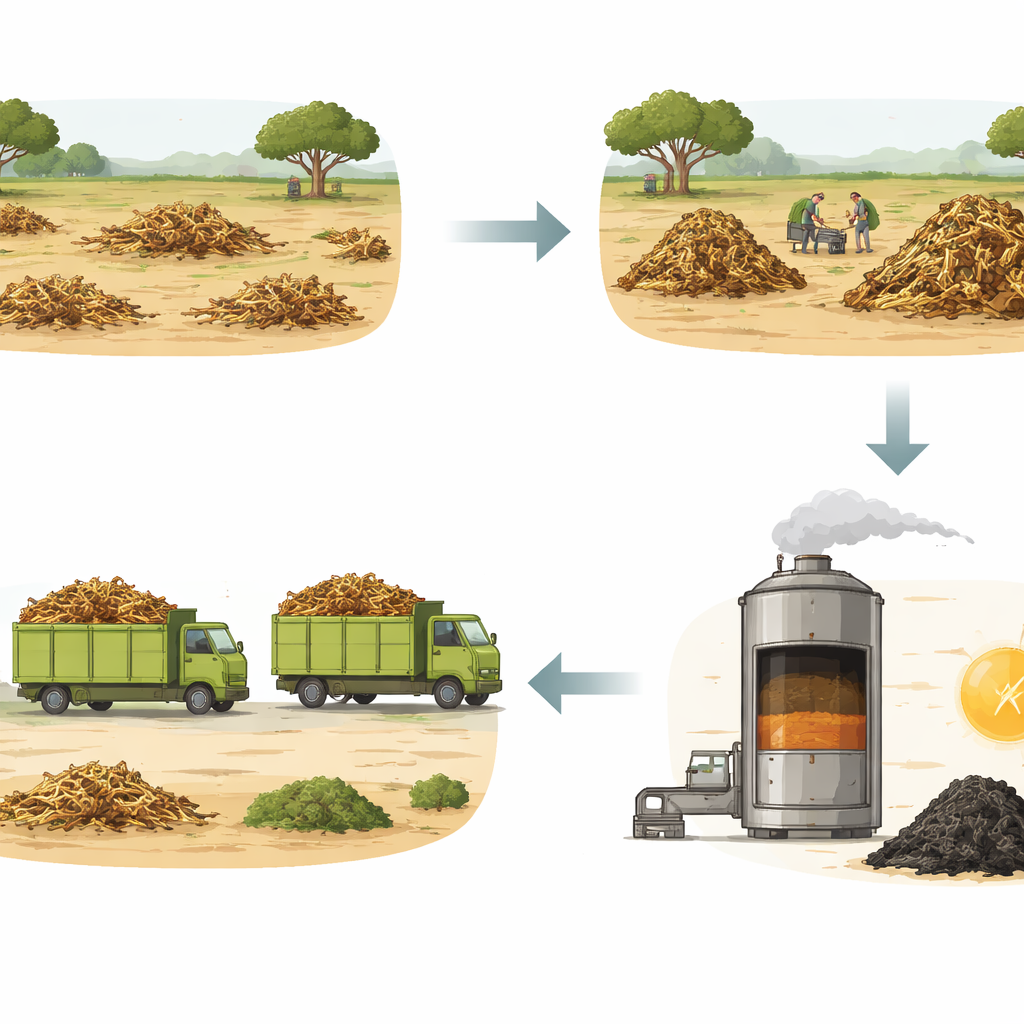
Although several counties produce very large total amounts of residues, none offers the perfect combination of high quantity, high residue per square kilometre and low year-to-year uncertainty. Some areas, like parts of the Rift Valley, have dense residues but variable supply, making it risky to size a large stationary plant there. Others have more stable but more thinly spread residues, which would raise collection and transport costs. The study therefore argues that planners will have to choose between siting plants where residues are dense but less predictable, or where they are more reliable but more scattered, and to consider options like small mobile kilns and community-scale units to complement larger factories.
What This Means for Farmers and the Climate
For non-specialists, the main message is that Kenya is already producing enough farm and forest leftovers to support a serious biochar sector without cutting extra trees or diverting food. If technologies and policies can be tuned to turn this steady stream of residues into high-quality biochar and briquettes, the country could improve soil health, boost crop yields, replace some firewood and charcoal, and trap more carbon in the ground. The catch is that new plants must be carefully located and supported by smarter transport, storage and local data, rather than assuming that “waste” is free and always nearby.
Citation: Namaswa, T., Burslem, D.F.R.P., Smith, J. et al. Availability and spatial distribution of crop and forest biomass residues for biochar production in Kenya. Sci Rep 16, 11764 (2026). https://doi.org/10.1038/s41598-026-42350-0
Keywords: biochar, biomass residues, Kenya agriculture, renewable energy, soil improvement