Clear Sky Science · en
Fuzzy-logic-controlled DVR for enhancing the fault resilience of wind energy conversion systems
Keeping the Lights On When the Wind Blows
As more of our electricity comes from wind farms, keeping them online during grid disturbances becomes critical for avoiding blackouts. Sudden drops in grid voltage, caused by faults such as short circuits, can force wind turbines to disconnect just when their power is most needed. This paper explores a smarter electronic safeguard that helps modern wind turbines ride through these rough moments, stay connected to the grid, and deliver steady power without relying on bulky external batteries.
Why Voltage Dips Threaten Wind Power
Wind turbines do not work in isolation; they feed power into a vast and sometimes fragile grid. When a serious fault occurs, the voltage at the connection point can fall sharply for a fraction of a second. Grid codes around the world now insist that wind farms must stay connected through such events, a requirement known as low-voltage ride-through. Meeting this demand is especially important for turbines that use permanent magnet generators and full power converters. These machines offer high efficiency and low maintenance, but their electronics are sensitive to sudden voltage changes. Without special support, deep voltage sags can destabilize the turbine’s converter, threaten synchronization with the grid, and force protective shutdowns that reduce overall grid reliability.
A Smart Voltage “Bodyguard” for Wind Turbines
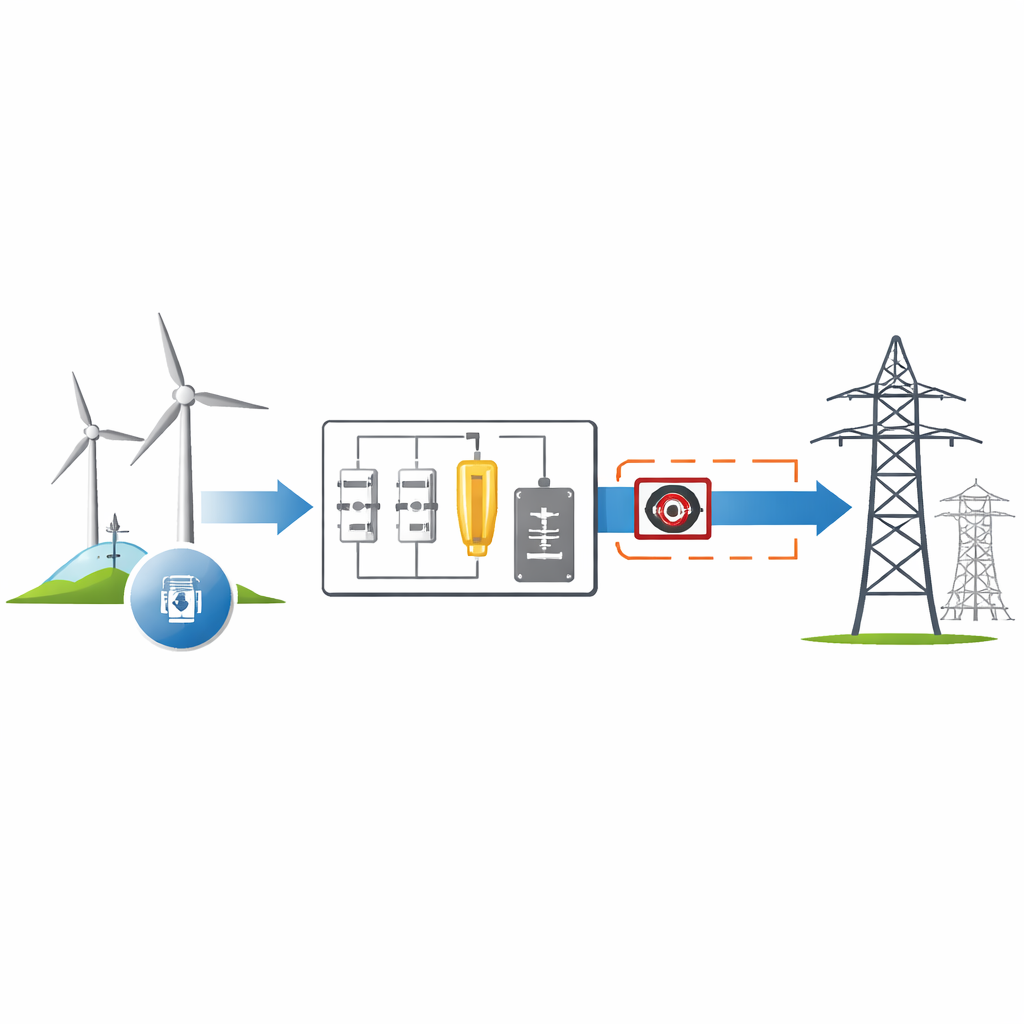
The device at the heart of this study is a dynamic voltage restorer, or DVR. Think of it as a bodyguard that steps in only when the grid voltage misbehaves. Installed in series with the line between the wind farm and the grid, the DVR injects a carefully shaped voltage to cancel out sags and keep the turbine’s terminals close to their rated level. A key innovation here is how the DVR is powered. Instead of drawing energy from a separate battery system, it taps directly into the existing direct-current link that already connects the machine-side and grid-side converters in the turbine. This shared DC link makes the solution cheaper and simpler, while a braking chopper—essentially a controllable resistor—dissipates any excess energy to keep the DC-link voltage within safe limits during faults.
Adding “Fuzzy” Intelligence to the Protection
Controlling such a fast-acting device is not trivial. Traditional proportional–integral controllers, while simple, struggle when conditions change quickly or nonlinearly, as happens during real faults. The authors replace this with a fuzzy logic controller, which encodes expert knowledge into a set of rules rather than relying solely on precise equations. The controller continuously evaluates how far the terminal voltage has drifted from its target and how fast that error is changing, then decides how strongly the DVR should react. This rule-based approach naturally adapts to different fault depths and patterns, providing strong correction when the voltage collapses and gentler action as it recovers, reducing overshoot and oscillations.
Testing the System in Virtual Faults
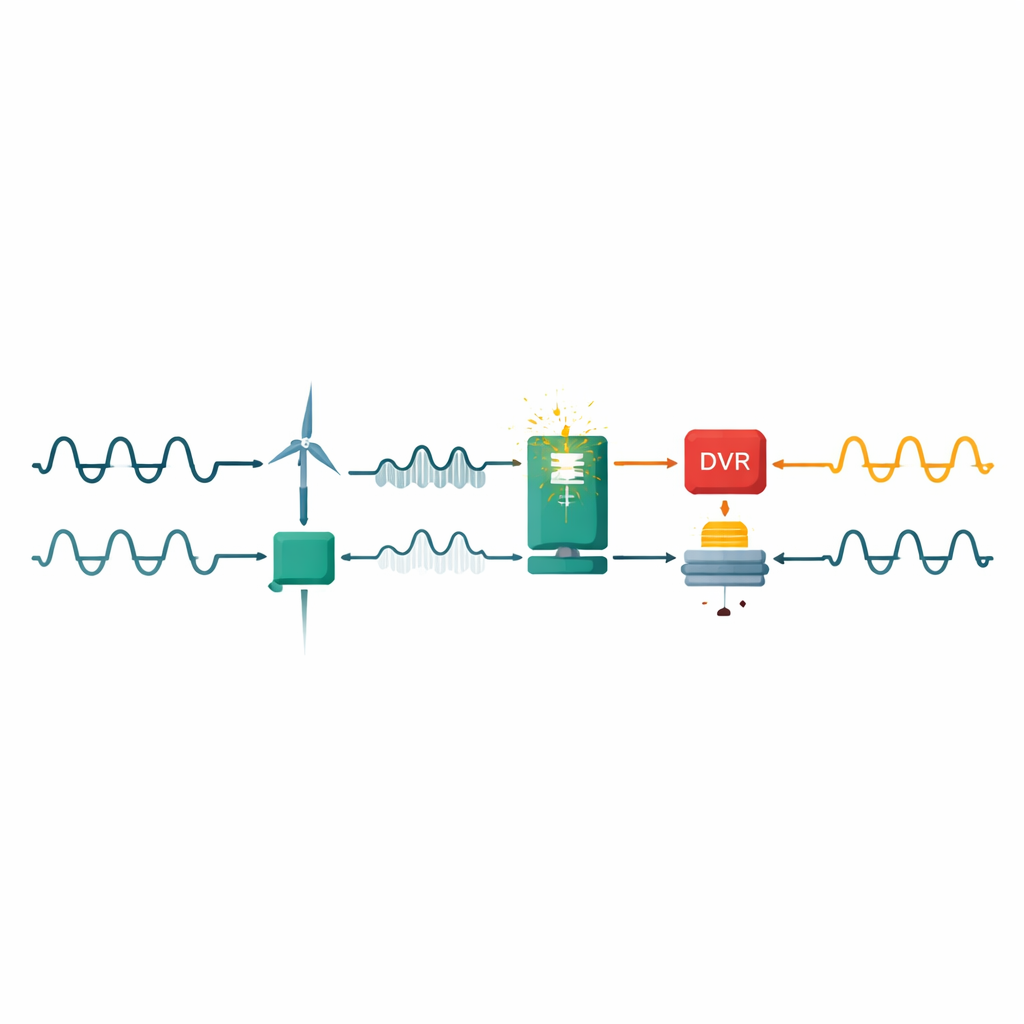
To assess the concept, the researchers built a detailed computer model of a 2-megawatt wind turbine connected to a medium-voltage grid. They simulated a range of realistic faults: balanced three-phase short circuits that cause 50% and 100% voltage drops, as well as more common unbalanced faults affecting one or two phases. In each case, they compared three scenarios: no protection, a DVR controlled by a conventional controller, and a DVR controlled by fuzzy logic, always with the shared DC link and braking chopper in place. Without protection, the turbine terminal voltage simply collapsed with the grid, violating ride-through requirements. With the DVR active, the terminal voltage was restored close to its rated value within about 0.15 seconds, comfortably within the limits set by strict grid codes such as those in Germany.
Smoother Recovery and Stronger Fault Resilience
The fuzzy logic controller consistently outperformed the traditional approach. It restored voltage faster, with shorter settling times and smaller overshoots, across all fault types. Generator currents remained nearly sinusoidal and within safe levels, while the braking chopper successfully prevented the shared DC link from overcharging when power could not flow into the weakened grid. The mechanical side of the turbine—its speed and torque—was barely disturbed, indicating that the added electronics improved ride-through without upsetting the turbine’s normal operation.
What This Means for Future Wind Farms
In practical terms, the study shows that a cleverly controlled DVR, powered from hardware already present in modern wind turbines, can make wind farms more fault-resilient without expensive extra storage systems. By combining a shared DC link, a simple braking element, and a fuzzy logic brain, the proposed scheme keeps turbine voltages steady through both balanced and unbalanced faults, helping operators meet grid-code rules and keep renewable power flowing. As grids lean more heavily on wind, such intelligent protection schemes could play a quiet but crucial role in making our electricity supply cleaner and more dependable.
Citation: Nori, A.M., Abdulabbas, A.K., Al Garni, H.Z. et al. Fuzzy-logic-controlled DVR for enhancing the fault resilience of wind energy conversion systems. Sci Rep 16, 11924 (2026). https://doi.org/10.1038/s41598-026-42325-1
Keywords: wind energy, grid faults, voltage sag, fuzzy control, dynamic voltage restorer