Clear Sky Science · en
Articulating while listening supports the emerging perception-production link in early infancy
Babies Who Move Their Tongues While Listening
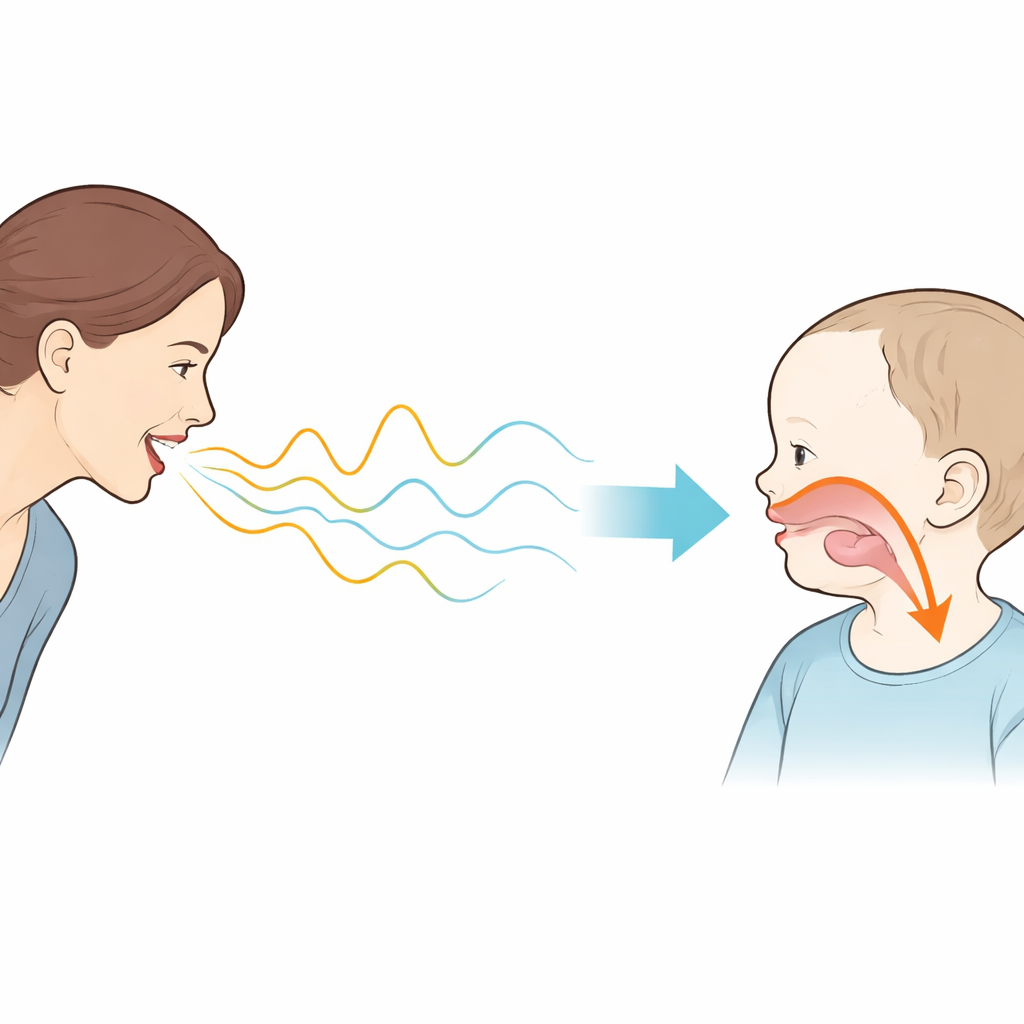
Parents often marvel at how quickly babies seem to pick up language, long before they can say real words. This study explores a surprisingly early step in that journey: at just six months old, babies may already move their tongues in ways that mirror the speech sounds they hear. Understanding these hidden mouth movements can shed light on how listening and speaking become tightly linked in the very first stages of life.
How Early Listening Shapes Future Talking
From birth, babies are not passive listeners. They prefer human speech over other sounds and gradually tune in to the patterns of their native language. Researchers have long suspected that even young infants don’t just hear speech; they also engage the parts of the brain and body used to produce it. Earlier work showed that speech sounds can activate motor areas in infants’ brains and that babies can match what they hear with what they see on a speaker’s face. Yet it was still unclear whether infants actually move their own speech organs, such as the tongue, in response to the sounds they hear, even when they are not babbling out loud.
Watching Tiny Tongues in Action
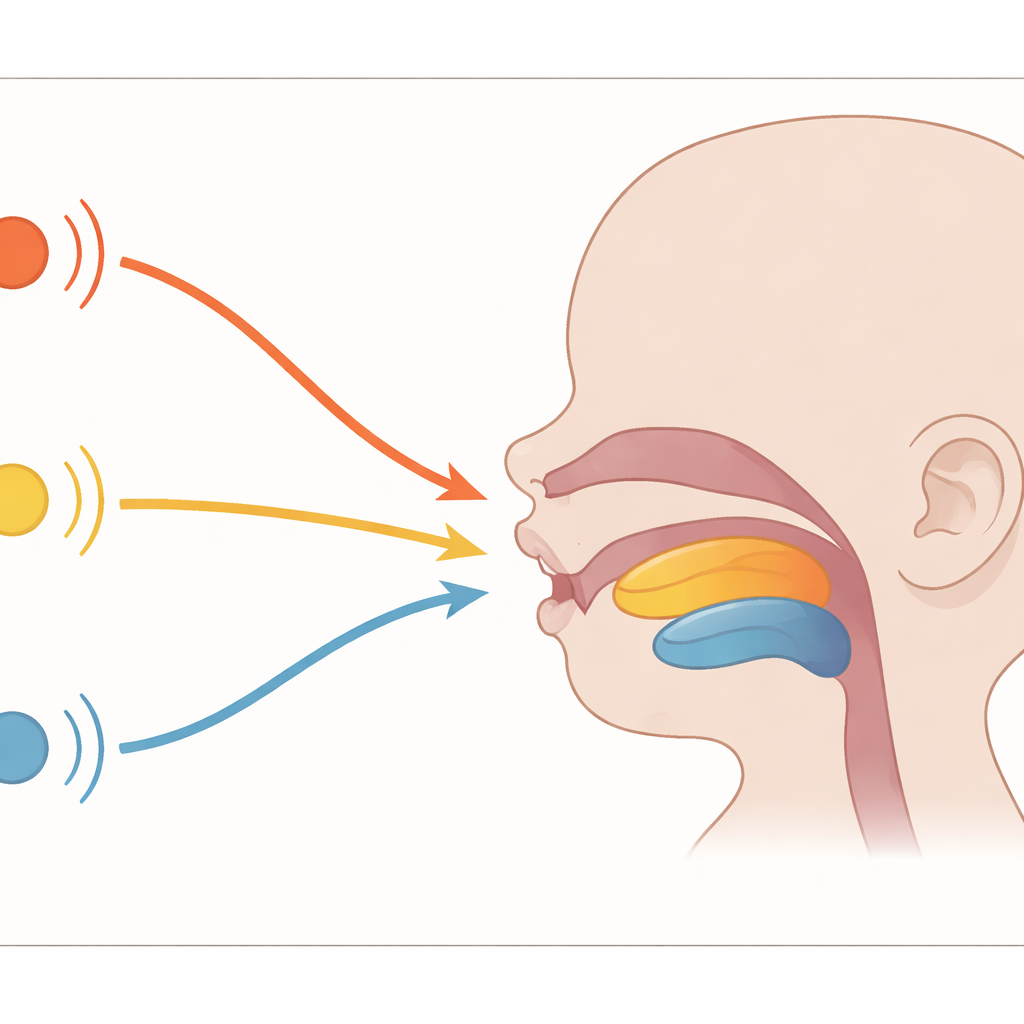
To investigate this question, the researchers used ultrasound imaging, a safe technique similar to that used in prenatal scans, to watch tongue movements inside the mouths of 13 six‑month‑old babies. While the babies sat comfortably and quietly, they listened to simple sound sequences made of a vowel–consonant–vowel pattern, like "/apa/", "/ata/", and "/aka/". These sequences were chosen because they differ in how the consonant is produced: one uses the lips, while the others involve the tongue either toward the front or the back of the mouth. Crucially, most of the infants in the study were not yet able to produce these kinds of syllables themselves, especially those requiring precise tongue positions.
Matching Sounds With Mouth Positions
The key question was whether the babies’ tongue shapes changed depending on which sequence they heard, even though they were not asked to speak or imitate. For each sound, the team measured how far forward or back the tongue was during the brief silent moments right after the sound was played. They found a clear pattern: after listening to the sequence with the front‑of‑the‑mouth consonant, the babies’ tongues tended to rest in a more forward position. After listening to sequences involving the back‑of‑the‑mouth consonant or only the lips, the tongues shifted relatively backward. These differences appeared quickly, after the very first repetitions, and remained consistent over several presentations of each sound type, suggesting a direct link between what babies heard and how their mouths quietly responded.
Beyond General Excitement
One alternative explanation was that speech sounds might simply make babies more alert or wiggly overall, without any specific tie between sound and tongue position. However, the results did not support this idea. The tongue changes were not random or uniform; they aligned with where in the mouth each consonant would normally be formed. Moreover, the sequences that did not require the tongue for their consonant showed a less clear pattern, in line with the fact that the tongue is not the main player in making those sounds. This points to a targeted, sound‑specific mouth response rather than a general movement caused by excitement or fussiness.
Why These Hidden Movements Matter
The study’s findings suggest that six‑month‑old infants are already “articulating while listening”: their mouths respond in subtle, sound‑specific ways even before they can talk. This offers a missing piece in our understanding of how listening and speaking become intertwined so early. If hearing a sound automatically nudges the tongue toward the right position, then the brain may be building a map between incoming speech and the movements needed to produce it. Over time, as babies begin to babble and then talk, these early hidden responses could help them learn how to shape their own speech. Although the study involved a small number of infants and more work is needed across ages and languages, it points to a powerful idea: long before babies say their first words, their tongues are already quietly practicing.
Citation: Frota, S., Severino, C., Pejovic, J. et al. Articulating while listening supports the emerging perception-production link in early infancy. Sci Rep 16, 12171 (2026). https://doi.org/10.1038/s41598-026-42240-5
Keywords: infant speech perception, speech motor development, tongue movement, language acquisition, sensorimotor integration