Clear Sky Science · en
Study on the structural characteristics of nitrogen-containing compounds in co-pyrolysis tar of low rank coal using 1H-15N HMBC analysis
Why coal tar chemistry matters to everyday life
Coal tar may sound like a dirty industrial by-product, but hidden inside this dark liquid is a treasure chest of nitrogen-based molecules that underpin medicines, dyes, crop-protection agents and advanced materials. Many of these compounds are hard to make in factories, yet they form naturally when coal breaks down at high temperature. This study shows a new way to quickly map out what kinds of nitrogen-bearing molecules are present in coal tar, opening doors to cleaner fuels, higher-value chemicals and better control of pollution from coal use. 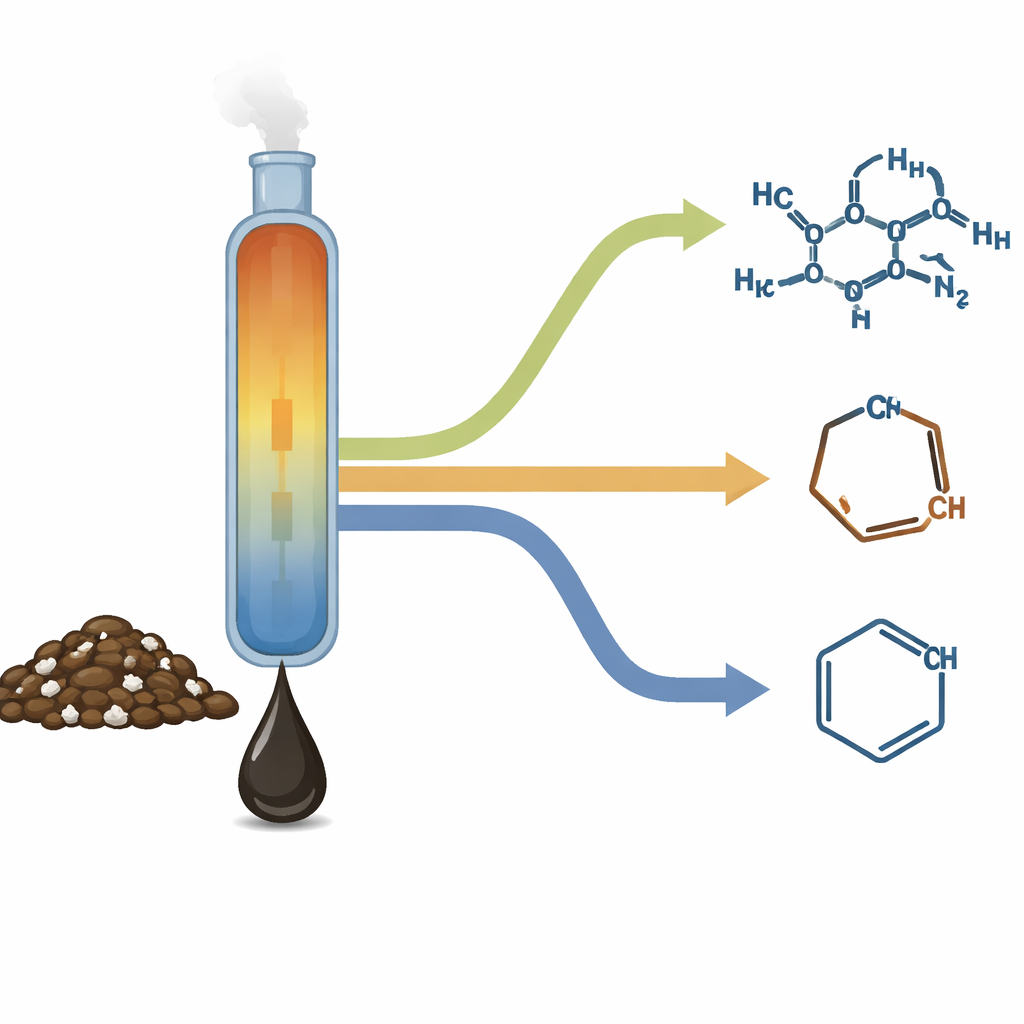
Turning low-rank coal into a rich chemical soup
The researchers started with a low-rank, oil-rich coal from the Hongliulin mining area and heated it together with ammonium chloride in a small tubular reactor, a process known as co-pyrolysis. At 600 °C, the solid coal fragments and reorganizes, releasing vapors that cool into a sticky liquid called tar. By adding both ordinary and isotopically labeled ammonium chloride (a nitrogen source), they deliberately drove nitrogen into the forming molecules, creating a tar especially rich in nitrogen-containing compounds. This approach mimics how nature transforms buried plant matter into complex organic mixtures, but under controlled laboratory conditions that allow the products to be studied in detail.
Listening to nitrogen atoms with advanced magnetic “ears”
Ordinary tools such as gas chromatography–mass spectrometry are powerful for separating and weighing molecules, but they struggle when many look almost identical, as is the case in tar. The team instead leaned on nuclear magnetic resonance (NMR), which detects how atomic nuclei respond in a strong magnetic field. Rather than looking at crowded signals from hydrogen and carbon alone, they used a two-dimensional experiment called 1H–15N HMBC that directly links hydrogen atoms to nitrogen atoms across a few chemical bonds. By feeding the system with 15N-labeled ammonium chloride, they amplified the nitrogen signal, making it possible to “hear” subtle differences between nitrogen sites that would otherwise be drowned out. 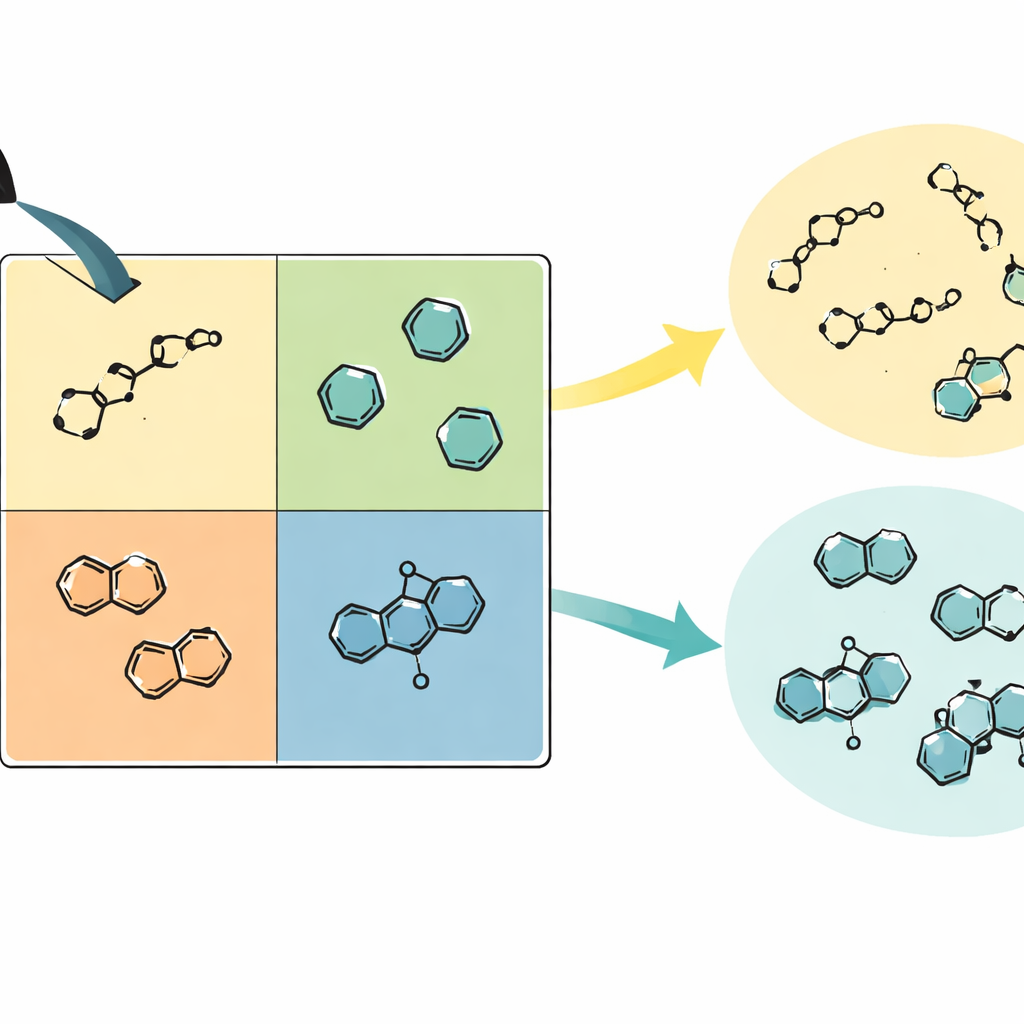
A four-quadrant map for decoding a messy mixture
To make sense of the dense NMR patterns, the scientists created a simple visual map: a two-axis plot of hydrogen and nitrogen signals divided into four quadrants. Before analyzing tar, they measured a set of reference molecules—simple amines, pyridine, quinoline, and others—to learn which regions of the map correspond to which nitrogen environments. When they overlaid the spectrum of nitrogen-rich tar, they could quickly see where most signals clustered. The first quadrant pointed to aliphatic amines and six-membered non-aromatic rings such as piperidine, formed when long coal-derived chains and plant-based rings react with nitrogen radicals at high temperature. The second quadrant revealed smaller amounts of aromatic amines like anilines and naphthylamines, built from benzene and naphthalene rings in the coal.
Uncovering hidden nitrogen rings inside coal tar
The lower half of the map exposed a different story: rings where nitrogen is built into the ring framework itself. Signals that spread across the third and especially the fourth quadrants pointed to five-membered and six-membered nitrogen heterocycles, including pyrrole, pyrroline, pyridine, quinoline and related structures. Many of these rings appeared with extra carbon side chains or oxygen atoms, indicating that they arose from oxygen-bearing plant fragments in the coal—such as cellulose and lignin—that first form furan-like structures and then react with nitrogen radicals. When the team cross-checked their NMR-based assignments against gas chromatography–mass spectrometry data, they identified 27 distinct nitrogen compounds and confirmed that most of the tar’s nitrogen—about 88 percent—resides in such heterocyclic rings, with only a small share in simpler amines.
What this means for cleaner energy and useful chemicals
In plain terms, the authors have built a fast, structural “fingerprinting” method for nitrogen compounds in a notoriously messy material. By using 1H–15N HMBC NMR and a four-quadrant map, they can rapidly tell which broad families of nitrogen molecules are present in coal tar and how abundant they are, without needing to isolate each one. Their findings show that nitrogen in co-pyrolysis tar is dominated by ring-shaped heterocycles derived from the plant matter that originally formed the coal. This knowledge can help engineers tune pyrolysis conditions to favor desirable products, improve removal of problematic nitrogen species from fuels, and tap coal tar as a more sustainable source of complex nitrogen building blocks for pharmaceuticals and materials.
Citation: Zhang, Y., Chen, P., Shi, G. et al. Study on the structural characteristics of nitrogen-containing compounds in co-pyrolysis tar of low rank coal using 1H-15N HMBC analysis. Sci Rep 16, 12314 (2026). https://doi.org/10.1038/s41598-026-41962-w
Keywords: coal tar, nitrogen heterocycles, pyrolysis, NMR spectroscopy, chemical characterization