Clear Sky Science · en
Scenario-driven shifts in future Usutu and West Nile virus outbreak characteristics in the Netherlands
Why this matters for people and nature
Across Europe, warmer weather and changing landscapes are already helping some mosquito-borne diseases spread. This study asks what that future might look like for two bird viruses, Usutu and West Nile, in the Netherlands. Although these viruses primarily circulate between mosquitoes and birds, they can spill over to humans and other animals. By exploring several different futures for Dutch climate, land use, and wildlife, the authors show how outbreak patterns could shift by mid‑century—and what that means for public health and environmental planning.
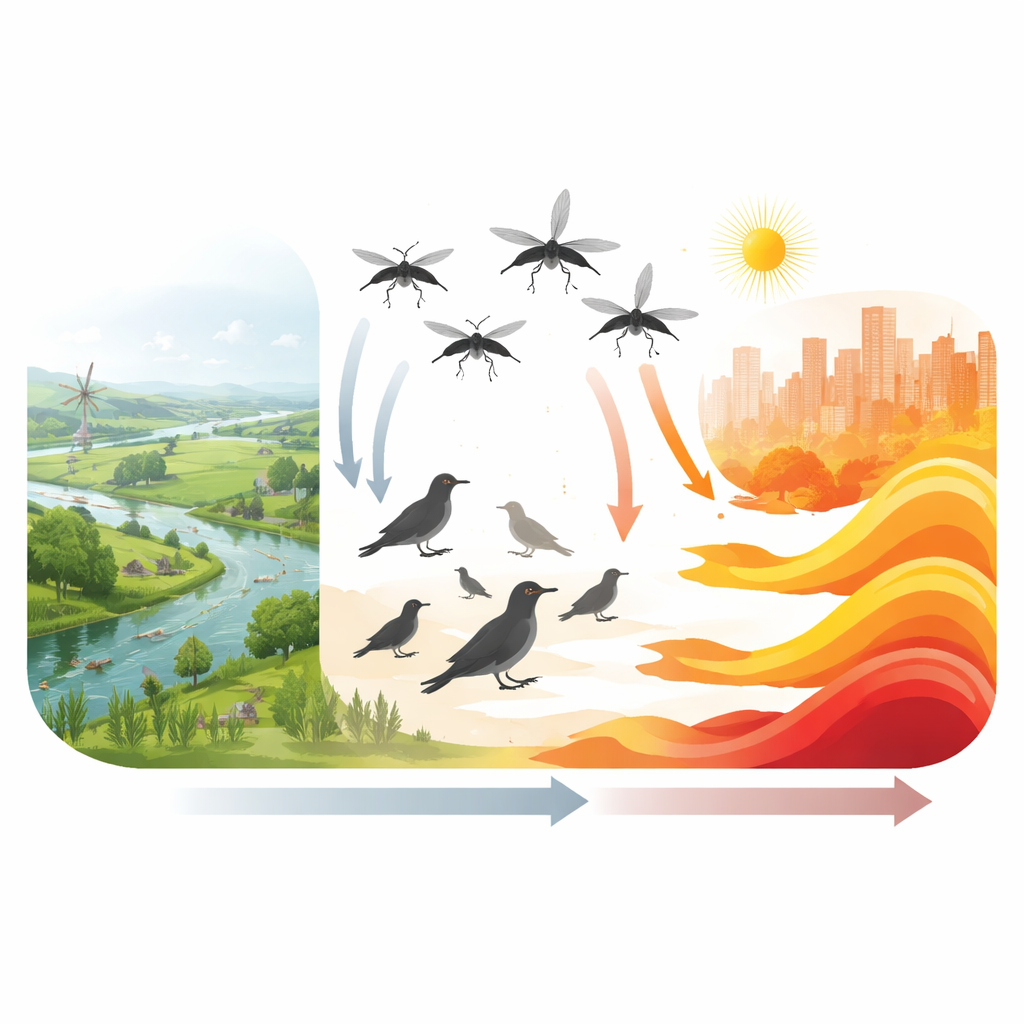
Looking at tomorrow’s Netherlands
The researchers focused on the Netherlands, a low-lying, water-rich country with dense human and animal populations, making it a natural hotspot for mosquito activity. They examined two closely related viruses, Usutu virus (USUV) and West Nile virus (WNV), both of which have recently appeared in Dutch birds and, in the case of WNV, in humans. To explore the future, they used four national “storylines” for the year 2050, built on international socio-economic and climate pathways. These scenarios differ in how society handles climate change, land use, and health systems—from a sustainable, well-prepared future to one with stronger warming, more pollution, and weaker public services.
Building a virtual outbreak machine
To turn these storylines into numbers, the team combined detailed maps of bird populations, mosquito abundance, and temperature for today and for 2050. They divided the country into small 5-by-5‑kilometer squares and, for each day of the transmission season (April to November), calculated how easily the viruses could spread locally. Their model captured the cycle in which Culex pipiens mosquitoes bite infected birds, become infectious themselves, and then pass the virus to new birds. Certain bird species acted as key hosts—blackbirds and a broader reservoir group for Usutu, and house sparrows and mallards for West Nile. Temperature-dependent traits such as mosquito lifespan, biting rate, and how fast the virus multiplies inside the mosquito were all included.
Warmer, longer, faster outbreaks
Across all four future scenarios, the model points in the same direction: both Usutu and West Nile outbreaks are likely to become larger, grow faster, and last longer than they do today. By 2050, average temperatures during the mosquito season rise by about 1 to 1.7 degrees Celsius, and mosquito numbers increase by roughly 5 to 10 percent. These changes push a key outbreak metric—the basic reproduction number, or R0—higher in every scenario, especially those with stronger warming. The season during which the viruses can sustain transmission (when R0 is above 1) becomes up to 17 percent longer, and the time it takes for an outbreak to double in size shortens markedly, particularly in early summer when surveillance and response are most challenging.
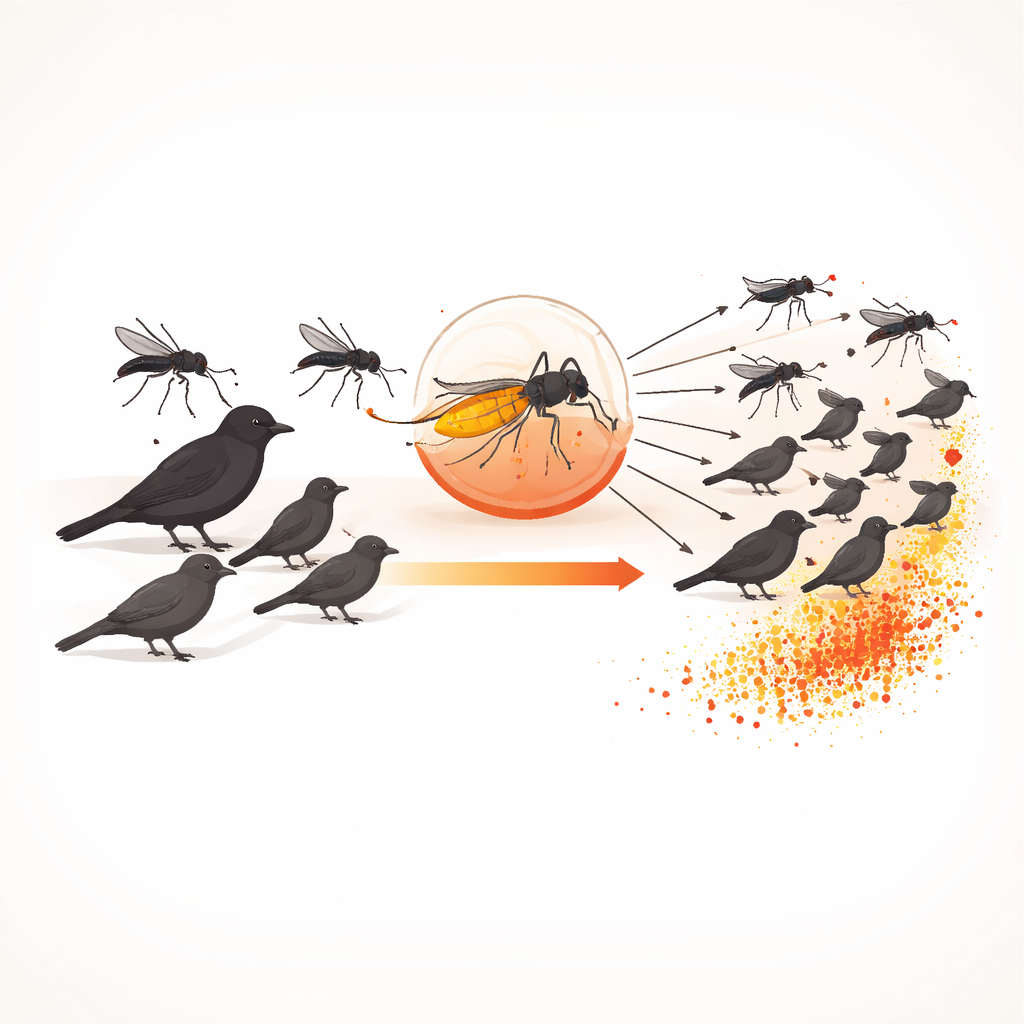
Hotspots on the map
The picture is not uniform across the country. For Usutu virus, the highest present-day risk lies in the south and southeast, where blackbirds are most abundant; those same regions see the biggest future increases. For West Nile virus, risk currently peaks in the south but rises fastest in some areas that are relatively safe today, such as parts of a national park where competent bird hosts are projected to increase. While the national average risk climbs in all scenarios, a few locations in the north and west experience little change or even slight decreases, mainly due to local shifts in bird and mosquito populations. Surprisingly, when the researchers grouped areas by broad land use types—cities, farmland, forest, and other nature—they found only modest differences in transmission potential, because the effects of land use on different species tended to cancel each other out.
What this means for preparedness
Overall, the study concludes that, under a wide range of plausible futures, Usutu and West Nile viruses are likely to pose a greater threat in the Netherlands by mid‑century. Warmer temperatures and more mosquitoes, rather than changes in birds alone, are the principal drivers. That means outbreaks may ignite earlier in the season, expand more quickly, and persist longer, especially in southern and eastern provinces. For the public, this implies that climate policies to limit warming are also health policies, and that investments in early warning, mosquito control, and potential vaccines will become increasingly important. The “greener” future scenario with lower emissions produces the smallest increase in risk, underscoring that climate mitigation and strong health systems can substantially blunt the impact of these emerging mosquito-borne threats.
Citation: de Wit, M.M., Dellar, M., Geerling, G. et al. Scenario-driven shifts in future Usutu and West Nile virus outbreak characteristics in the Netherlands. Sci Rep 16, 12257 (2026). https://doi.org/10.1038/s41598-026-41926-0
Keywords: mosquito-borne viruses, climate change, Usutu virus, West Nile virus, Netherlands