Clear Sky Science · en
Design of a tube lens with a focus tunable lens for optical inspection systems
Sharper Eyes for Tiny Flaws
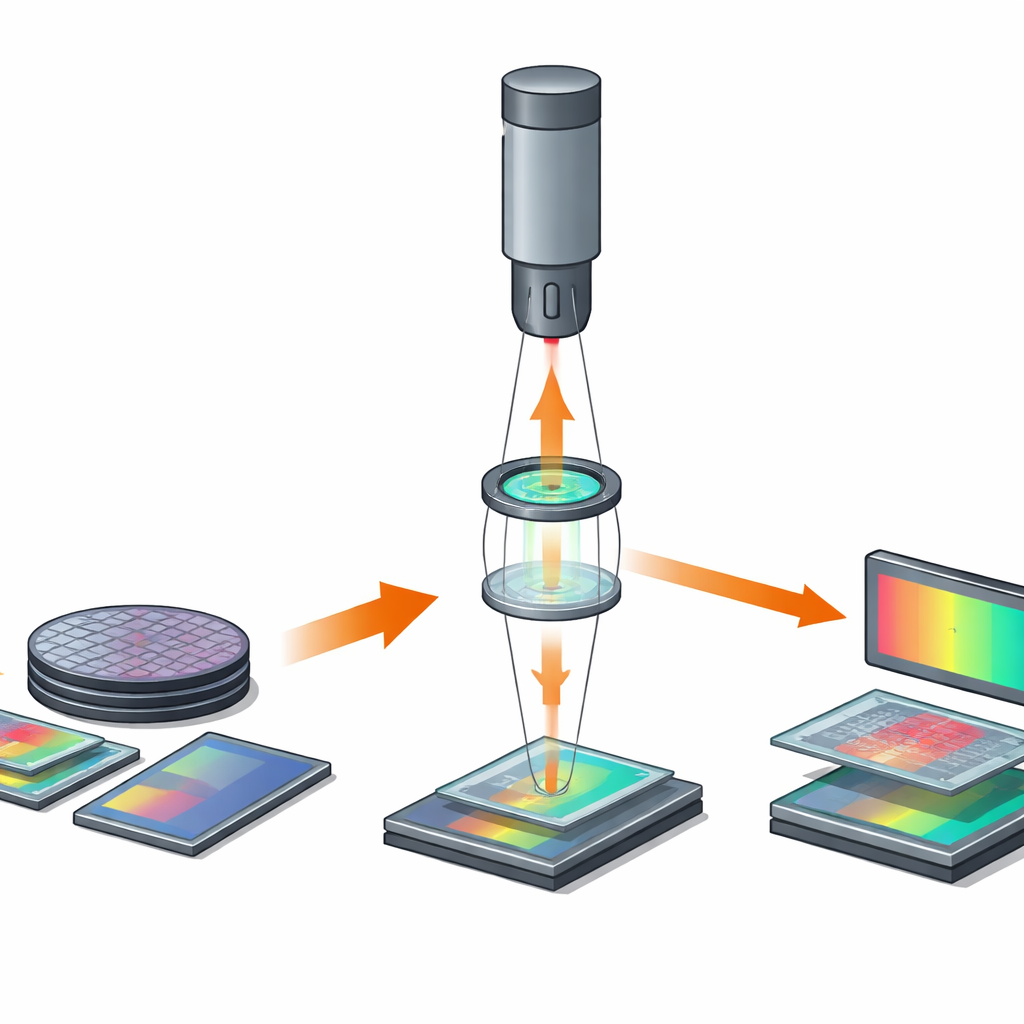
From computer chips to medical devices, modern products are packed with features so small that only powerful microscopes can see them. Yet these same high‑resolution optics have a weakness: they lose focus if a part shifts by just a few thousandths of a millimeter. This paper introduces a new kind of microscope lens system that keeps such images sharp not by moving glass elements back and forth, but by gently reshaping a special liquid lens using electricity.
Why High Detail Usually Means Touchy Focus
Industrial inspection systems are designed to spot minute scratches, dust particles, or pattern errors at factory speeds. To see such tiny details, they use optics with a large light‑gathering angle, similar to opening a camera lens very wide. This boosts resolution but shrinks the “depth of field” – the range over which objects stay in focus. In the systems studied here, the natural in‑focus range is only a few micrometers thick, thinner than most human cells. On a vibrating production line, or if a wafer surface isn’t perfectly flat, this razor‑thin focus band means images blur easily, risking missed defects or false alarms.
Problems with Moving Heavy Glass
Traditional microscopes solve focus shifts by physically moving either the sample, the objective lens, or an internal group of lenses. In a lab, that may be acceptable, but in industrial tools it becomes a headache. Moving optics need precise mechanical stages, fast motors, and careful control of inertia, especially when the lens groups are heavy. This adds size, cost, and complexity, and it can limit how quickly the system responds to changing parts or scanning patterns. As manufacturers push toward faster inspection and ever smaller features, these mechanical solutions start to look like bottlenecks.
A Lens That Changes Shape on Command
The researchers replace much of this machinery with a focus tunable lens—a sealed droplet of optical liquid behind a flexible membrane. By adjusting an electric current, the membrane bulges more or less, changing the curvature and therefore the focal power of the lens. In their design, this tunable element is built into the tube lens, a relay lens that sits behind the objective and in front of the image sensor. Placing it there is a key choice: the tube lens works at a lower light‑gathering angle than the objective, so it is less sensitive to small design changes. That makes it easier to keep the overall magnification and image quality stable while the tunable lens reshapes itself.
Keeping Focus Without Shifting the Image
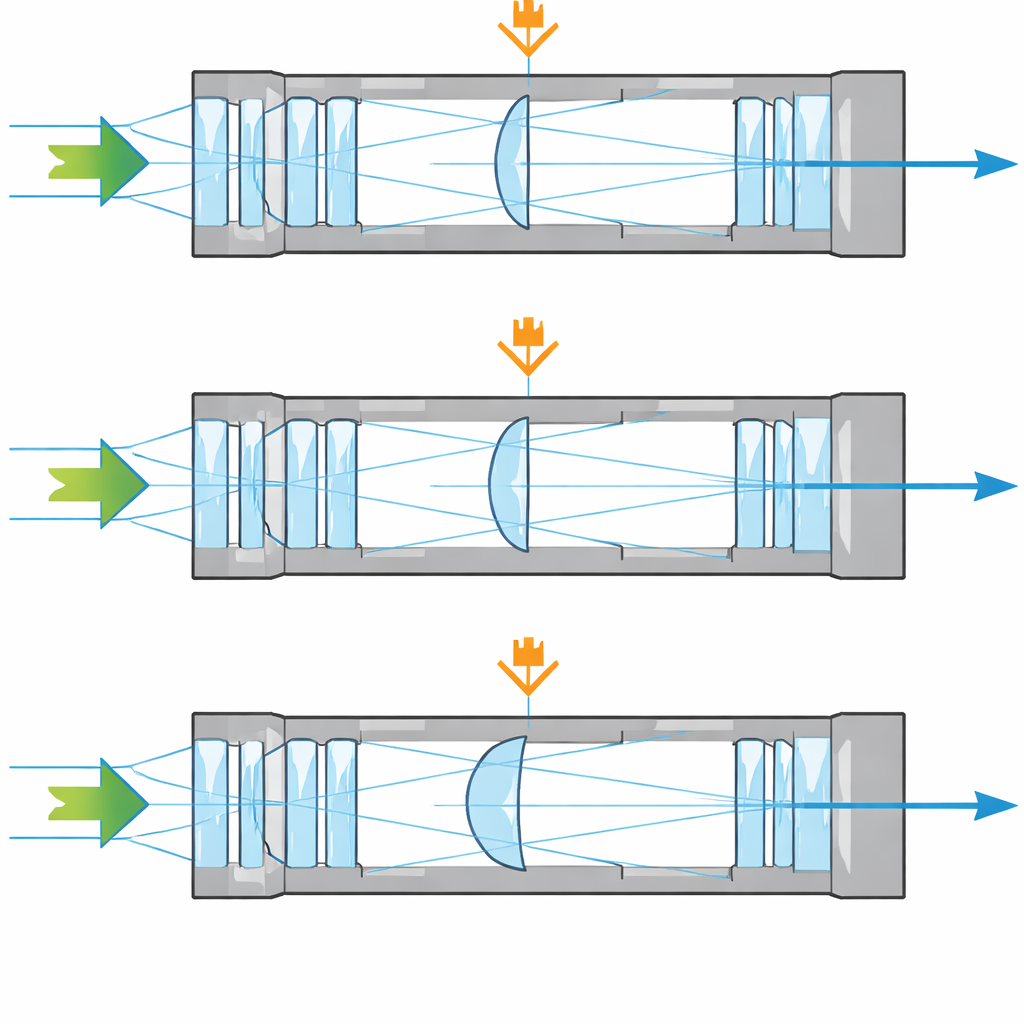
To make this work in practice, the team used optical theory and detailed simulations to calculate exactly how much the tunable lens must bend for different object distances. They modeled the lens shape, its internal liquid, and a thin cover glass, then embedded this model inside a three‑group lens system. With this, they designed two inspection setups: a 10× system for finer details and a 5× system for larger fields of view. In both cases, the tunable lens adjusts to keep the final image sensor in the same place even when the sample moves along the viewing axis by amounts tens of times larger than the natural depth of field.
Testing Image Quality in Virtual Prototypes
Because fabricating such precise optics is expensive, the authors relied on advanced lens design software to run extensive simulations before any hardware is built. They examined how tightly light rays cluster on the sensor compared with the smallest spot allowed by diffraction, and they checked that image shapes are not warped by distortion. For both magnifications, the simulated spot sizes stayed near the diffraction limit over the full focus‑tuning range, and geometric distortion was essentially zero. They also ran thousands of Monte Carlo trials that mimicked real‑world manufacturing errors in glass shapes, spacing, and alignment. Even with these imperfections, most simulated systems kept spot sizes within about twice the theoretical minimum—good enough for demanding inspection tasks.
What This Means for Real‑World Machines
In plain terms, the study shows that a microscope can keep sharp, accurate images while its focus is adjusted purely by changing the shape of a liquid lens, without sliding any glass or moving the sample stage. The new tube lens design handles realistic sample shifts while holding magnification changes to within about one percent and preserving near‑ideal resolution. That combination—fast electronic focusing, compact mechanics, and precise imaging—makes this approach attractive for many high‑end inspection tools, from semiconductor wafer scanners to automated checks of precision parts. It points toward future factory microscopes that focus as quickly and smoothly as a digital camera, yet still resolve the tiniest flaws that matter for modern manufacturing.
Citation: Park, Y., Jo, Y.J., Ryu, J. et al. Design of a tube lens with a focus tunable lens for optical inspection systems. Sci Rep 16, 13067 (2026). https://doi.org/10.1038/s41598-026-41904-6
Keywords: optical inspection, tunable lens, autofocus, machine vision, microscopy