Clear Sky Science · en
Study on rock energy and microscopic failure under different stress states
Why deep rocks matter for safe tunnels
As cities burrow ever deeper for subways, reservoirs, and energy storage, the rocks that surround these underground spaces must safely hold back enormous forces. When that rock fails unexpectedly, the result can be rockbursts, collapses, and costly delays. This study looks inside one common rock type—marble—to see how it stores, uses, and suddenly releases energy under different squeezing conditions, from gentle pressure to the intense three‑dimensional stresses found kilometers below ground. 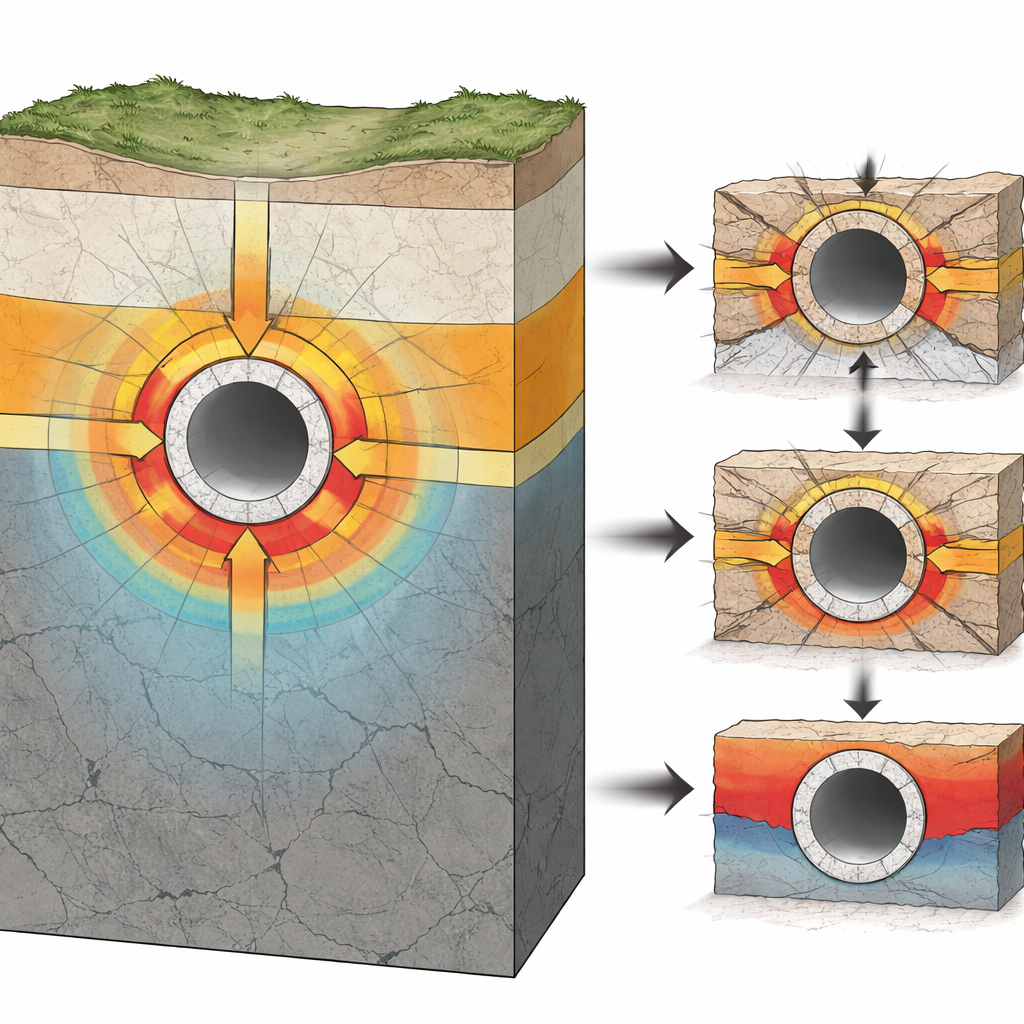
How marble is squeezed in the real world
Deep underground, rock is pressed from all sides, not just from above. To mimic this, the researchers carried out two kinds of laboratory tests on carefully prepared marble blocks. In “conventional” triaxial tests, the rock was squeezed more in one direction while the pressure from the sides was kept equal. In “true” triaxial tests, all three directions of pressure were controlled independently, better reproducing the uneven stress patterns around real tunnels and caverns. Alongside these experiments, the team built detailed computer models in which the marble was represented as countless tiny particles bonded together, allowing them to watch how microscopic cracks appear and spread inside the rock.
From tiny pores to sudden breakage
The tests showed that marble under compression goes through a clear sequence of stages. At first, small pores and flaws close, and the rock deforms elastically—it springs back if the load is removed. As the load rises, permanent distortion sets in, and finally the rock reaches a peak strength and breaks. Under low surrounding pressure, failure is abrupt and brittle, dominated by cracks that open up in tension, splitting the specimen along its length. As the confining squeeze increases, both strength and ductility rise: the rock can carry more load and stretches further before breaking, and the post‑peak drop in strength becomes smoother. Computer simulations reproduced these behaviors, confirming that the chosen microscopic parameters captured the real marble’s response.
Energy in, energy stored, energy released
To understand why the failure style changes, the authors tracked how mechanical work on the rock is converted into different forms of energy. During early loading, most of the input energy is stored as elastic strain and in the tiny bonds between particles. Near failure, stored energy is rapidly converted into new crack surfaces, frictional heating, and damping as particles slide and separate. At low confinement, this release is sharp and sudden, matching brittle splitting. Higher confinement greatly increases how much energy the marble can store and shifts more of it into frictional and damping channels as shear zones form. The result is a transition from tension‑dominated cracking to a mixed mode and eventually more shear‑driven, plastic‑like failure that absorbs energy over a longer interval. 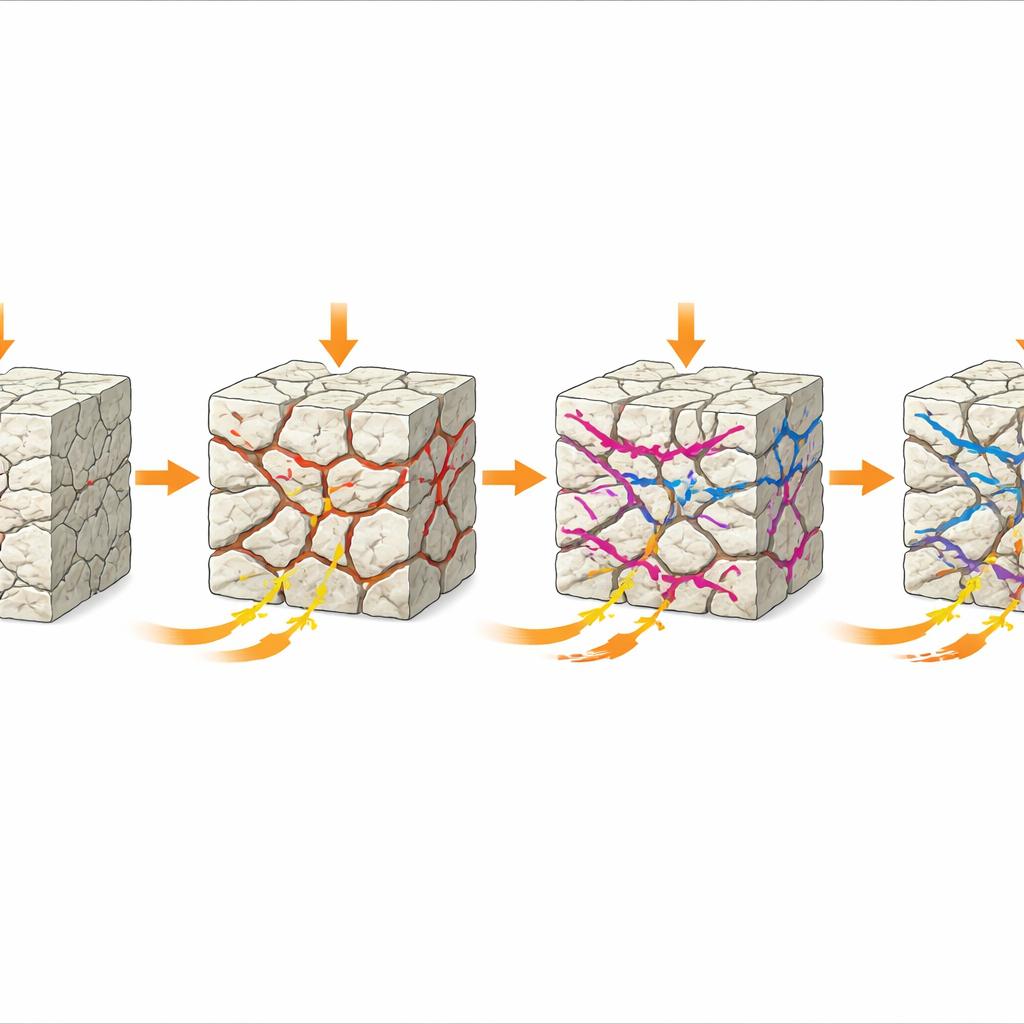
The hidden role of sideways squeezing
A key focus of the study is the “intermediate” stress—the sideways squeeze that is neither the largest nor the smallest. True triaxial tests and simulations revealed that this stress has a non‑linear, double‑edged influence. A moderate increase makes the marble tougher: it strengthens the rock, delays the point where energy dissipation peaks, and encourages localized shear bands rather than wholesale brittle shattering. But if this intermediate stress becomes too high compared with the lowest stress, the system becomes unstable again. Energy release grows more abrupt, new tensile zones appear, and the overall behavior cycles from brittle to shear‑dominated and back to a more brittle style of failure.
What this means for underground safety
Seen through the lens of energy, the study shows that how marble fails is governed not just by how hard it is squeezed, but by the balance among three directions of stress and by the pathways available for energy storage and dissipation. In deep marble formations, higher surrounding pressure can be stabilizing, allowing rocks to absorb more energy before failing—but only up to a point. Beyond that, certain stress combinations can trigger sudden, violent cracking. These insights provide engineers with a more physical basis for judging when deep tunnels and caverns in marble are approaching dangerous conditions, and point toward future monitoring tools that track energy changes, not just stresses, to anticipate instability.
Citation: Xie, L., Li, B., Sun, J. et al. Study on rock energy and microscopic failure under different stress states. Sci Rep 16, 12286 (2026). https://doi.org/10.1038/s41598-026-41844-1
Keywords: rock mechanics, underground excavation, marble, energy dissipation, triaxial stress