Clear Sky Science · en
Interactions between atomic-scale skyrmions in 2D chiral magnets
Magnetic Whirlpools on the Smallest Scales
As our gadgets shrink and computing demands soar, engineers are searching for new ways to store and move information using far less energy. One promising candidate is the magnetic skyrmion—a tiny whirlpool pattern in a magnet that can behave like a robust, movable bit. This study explores how skyrmions that are almost as small as the atoms in a crystal interact with each other, and whether they can still be steered and paired up reliably inside future ultra‑dense memory and brain‑inspired computing devices.
What These Tiny Whirls Are and Why They Matter
Skyrmions are swirling arrangements of atomic magnets that behave like particles: they can be created, moved around and erased. Because their twisted structure is “topologically” protected, they resist being disrupted, making them attractive as data carriers along magnetic tracks or as adjustable weights in artificial synapses. Until now, most research has focused on skyrmions hundreds of nanometers across. But recent experiments have revealed skyrmions just a few nanometers wide—only a handful of atoms across—raising an urgent question: do the same rules of attraction and repulsion between skyrmions still hold when they shrink to nearly atomic size?
Pushing Skyrmions Together and Pulling Them Apart
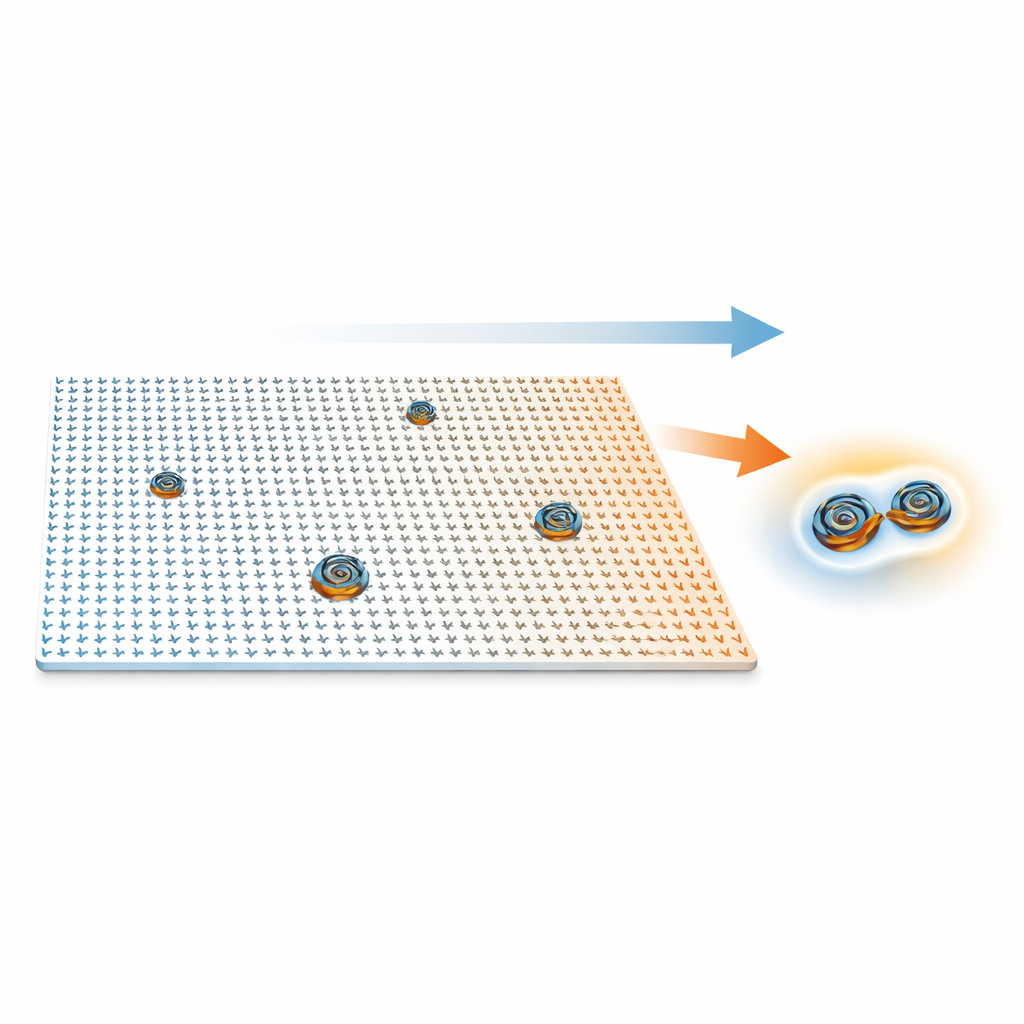
To answer this, the authors used detailed computer simulations of a two‑dimensional magnetic layer where skyrmions sit inside an otherwise uniform background of aligned spins. By changing a few key knobs—the strength and tilt of a magnetic field and a built‑in directional preference of the crystal—they could make skyrmions almost circular or noticeably distorted. For larger skyrmions, earlier work showed a familiar pattern: when two skyrmions are very close they strongly repel, like hard spheres bumping into each other, but at certain distances they can actually attract and form bound pairs. The new simulations reveal that this same mix of short‑range repulsion and longer‑range attraction survives all the way down to atomic‑scale skyrmions.
How Shape and Hidden Domains Create Attraction
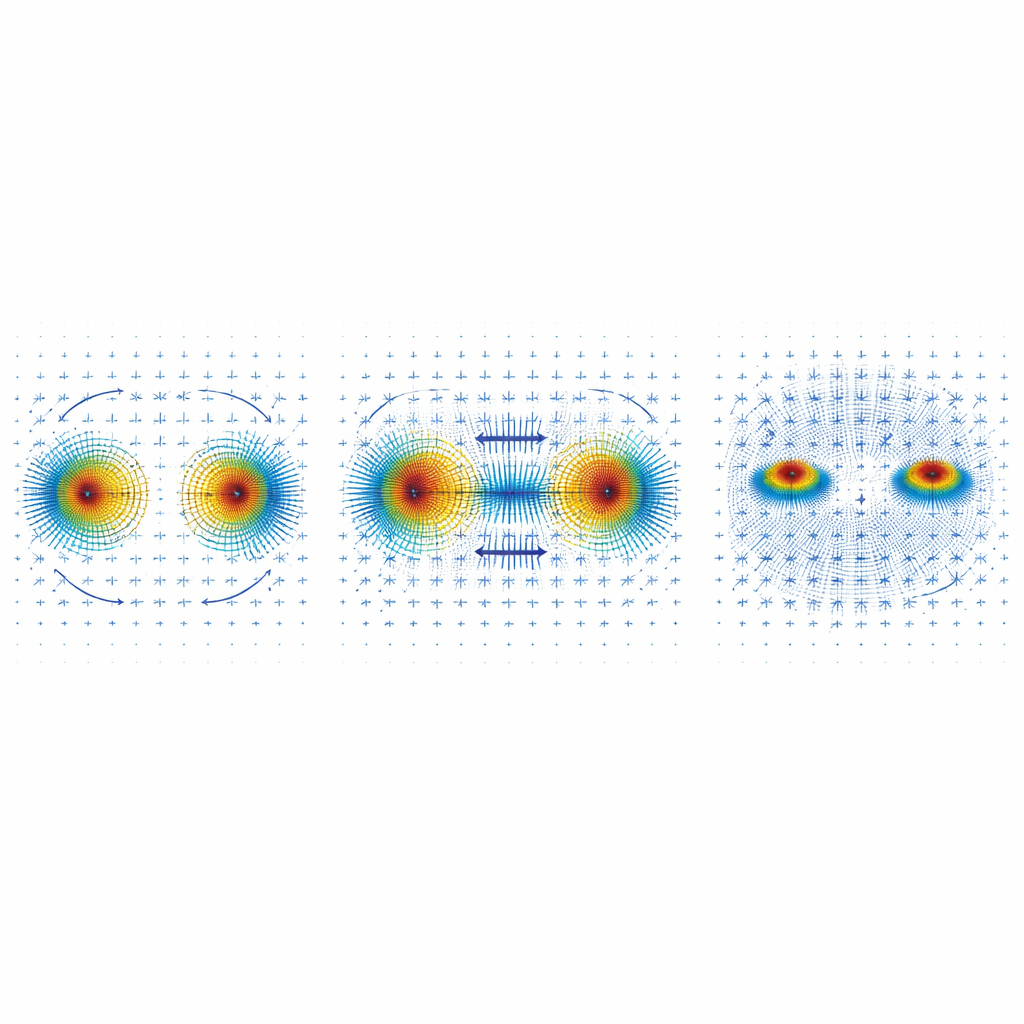
The study identifies two main ways that attraction arises. In the first, tilting the magnetic field or adding a modest crystal preference distorts each skyrmion from a perfect circle. That distortion slightly lowers the system’s energy when skyrmions sit at just the right separation, producing a shallow “sweet spot” at which they prefer to stay together. As the skyrmions shrink, they become stiffer, so the repulsive core expands when distances are measured in units of their own radius, and the attractive dip shifts outward. In the second, more dramatic case, a strong crystal preference causes the region between two skyrmions to flip into a narrow stripe of opposite magnetization—a tiny magnetic domain bounded by a wall. Forming this domain wall costs energy, but sharing it between two skyrmions pays off, generating a deep attractive well whose depth and optimal distance remain almost unchanged even as the skyrmions become atomically small.
When the Crystal Lattice Starts to Take Over
At such tiny scales, the underlying atomic grid of the material itself begins to matter. The simulations show that the energy of a single skyrmion depends subtly on whether its center sits exactly on a lattice site or in between sites, creating a periodic “lattice potential.” Under strong crystal anisotropy this potential grows rapidly as skyrmions shrink, until it rivals or exceeds the attractive pull between skyrmions. In this regime, even though the interaction between skyrmions strongly favors forming a tight pair, the lattice pins each skyrmion to preferred positions, preventing them from sliding all the way to their optimal separation. Skyrmions can end up frozen at spacings larger than the minimum of the attraction curve, or in extreme cases become unstable once this pinning constraint is removed.
What This Means for Future Magnetic Devices
Taken together, these results show that atomic‑scale skyrmions can still form tightly bound pairs with binding energies comparable to fundamental magnetic interactions, potentially stable even at room temperature. The same physical mechanisms that generate attraction for larger skyrmions remain effective down to the smallest sizes, and can be tuned continuously by external magnetic fields and crystal anisotropy. At the same time, the growing influence of the lattice potential at small sizes will tend to immobilize skyrmions and fix their relative positions. For designers of next‑generation memories and neuromorphic hardware, this balance is both a challenge and an opportunity: attractive wells can be used to control how information‑carrying skyrmions cluster, while lattice pinning may help lock those patterns in place against unwanted motion.
Citation: Kameda, M., Kobayashi, K. & Kawaguchi, Y. Interactions between atomic-scale skyrmions in 2D chiral magnets. Sci Rep 16, 12941 (2026). https://doi.org/10.1038/s41598-026-41762-2
Keywords: magnetic skyrmions, spintronics, nanomagnetic memory, topological magnetism, neuromorphic hardware