Clear Sky Science · en
Optimization of broadband metamaterial absorber using twin delayed deep deterministic policy gradient reinforcement learning technique
Teaching Materials to Tame Waves
Modern wireless links, satellite TV, and radar all depend on shaping invisible waves in very precise ways. Engineers now design “metamaterials” – tiny patterned surfaces – that can swallow unwanted signals or twist their polarization for clearer communication and stealth. This paper shows how a form of artificial intelligence, reinforcement learning, can automatically discover high‑performance designs for these intricate structures, doing in hours what might otherwise take weeks of expert trial and error.
Why Shaping Waves Matters
Metamaterials are engineered surfaces built from repeating microscopic patterns that interact with electromagnetic waves in unusual ways. By tuning the shapes and spacings of these patterns, researchers can create ultra‑thin absorbers that soak up almost all incoming radiation, or converters that flip the polarization of a wave—turning, for example, a horizontally oriented signal into a vertical one. Such devices are crucial for reducing radar signatures, cutting interference between channels, and packing more information into crowded frequency bands used by satellite and wireless systems.
Letting an Algorithm Do the Designing
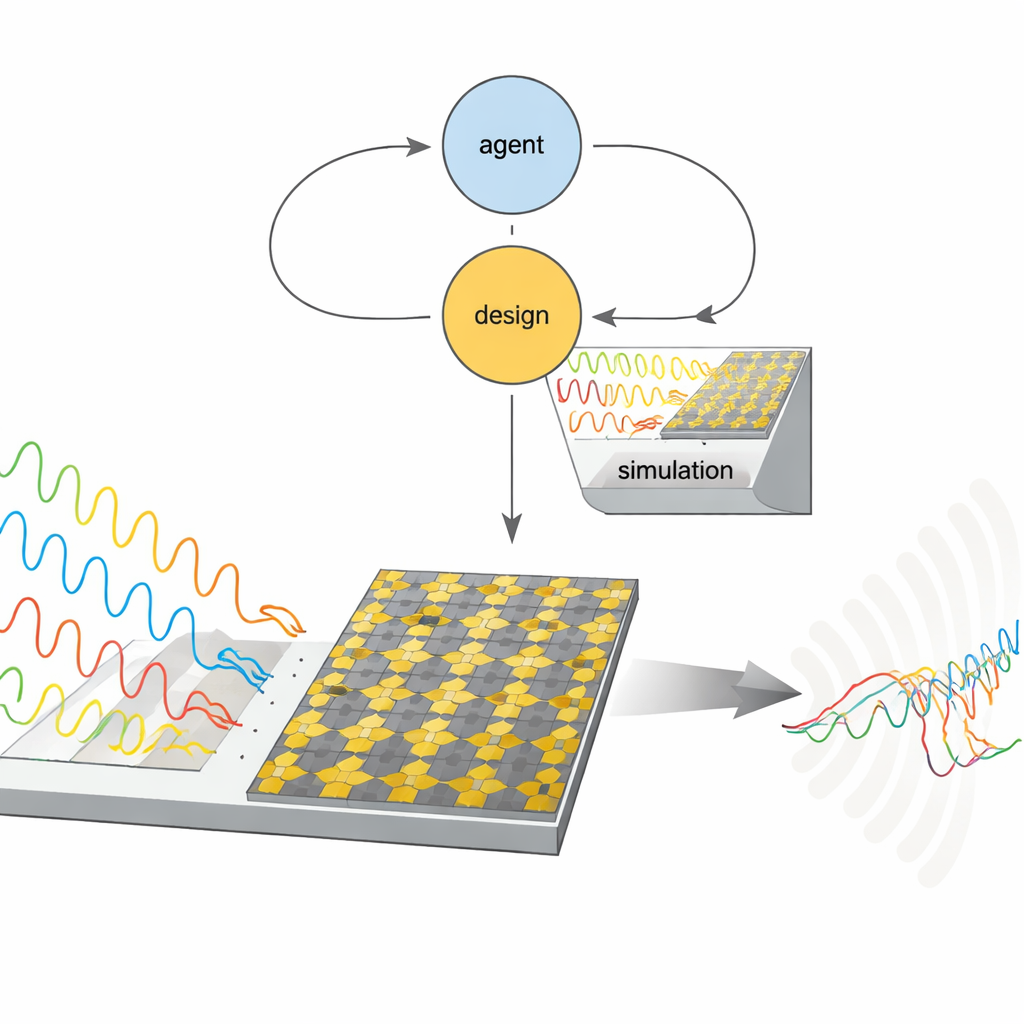
Traditionally, engineers adjust metamaterial designs using manual parameter sweeps or heuristic search methods like genetic algorithms. These approaches can be slow, compute‑hungry, and sensitive to starting guesses, especially when there are many geometric knobs to tune. The authors instead turn to a reinforcement learning method called Twin Delayed Deep Deterministic Policy Gradient (TD3). In this setup, an artificial “agent” proposes a set of geometric dimensions for the metamaterial cell, a physics simulator evaluates how well that design absorbs or converts waves across a target frequency band, and the agent receives a reward score. By iterating this propose‑and‑score loop, the agent gradually learns which patterns work best, without needing explicit formulas or pre‑trained surrogate models.
Building a Better Wave Sponge
The first test bed is an ultrathin microwave absorber built from L‑shaped copper traces above a metal backing, separated by a common circuit board material. The goal is strong absorption—above 90 percent—across as wide a frequency range as possible in the Ku and K bands used for satellite links and radar. The TD3 agent controls four key geometric features of the pattern and interacts directly with a commercial electromagnetic simulator. Remarkably, within only 23 iterations, the algorithm converges on a design that absorbs more than 90 percent of incoming waves from 12.2 to 22.4 gigahertz, a broader band than previous hand‑tuned or algorithmically optimized versions using the same basic layout. Additional tests on a different, all‑dielectric light absorber at optical frequencies show that the same learning framework can also enhance performance there, widening the useful band while raising the average absorption.
Turning Polarization on Its Head
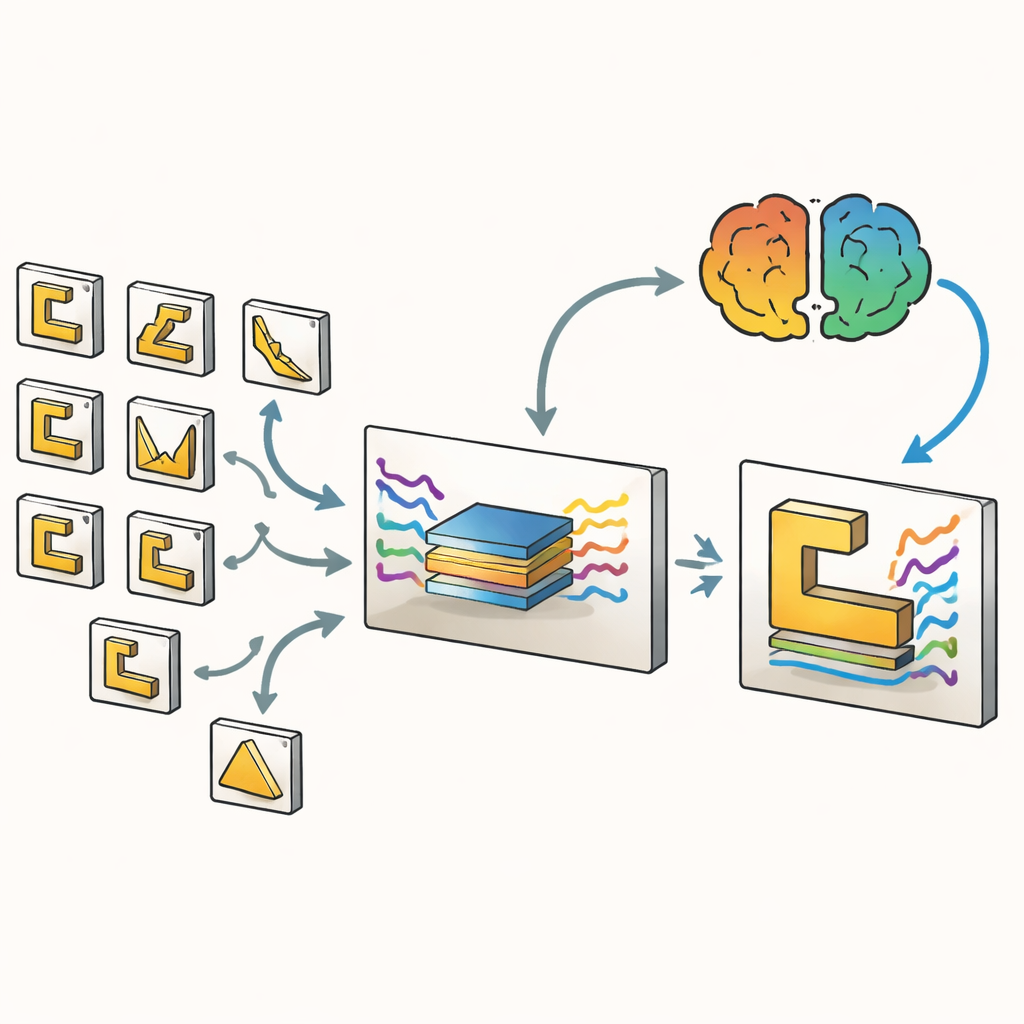
The authors then challenge the method with a more complex task: designing a surface that reflects incoming waves while flipping their polarization over a wide frequency span. They start from a single‑layer pattern combining L‑shaped copper traces with a central triangle atop the same thin substrate and metal backing. Again, the TD3 agent tunes the geometrical details. After about 81 iterations, it finds a configuration that converts more than 90 percent of reflected power into the orthogonal polarization from 11.8 to 24.2 gigahertz—covering the entire Ku band and most of the K band. Simulations also show that this high conversion survives for waves striking the surface at angles up to 50 degrees, a desirable trait for real‑world antennas and stealth coatings.
From Simulation to the Lab Bench
To check that these AI‑discovered designs are practical, the team fabricates the polarization‑converting surface using standard photolithography on a 40‑by‑40 array of unit cells. Measurements with horn antennas and a vector network analyzer confirm strong cross‑polarized reflection over nearly the same band predicted by simulations, with only modest differences due to fabrication tolerances and the finite sample size. Compared with other reported devices, this single‑layer structure achieves comparable or better bandwidth and efficiency while remaining compact and free of added circuit components.
What This Means Going Forward
By showing that a TD3 reinforcement learning agent can rapidly home in on high‑performance, fabrication‑ready metamaterial designs, this work points to a new way of engineering devices that control light and radio waves. Instead of painstakingly exploring design spaces by hand, researchers can define a goal—such as wideband absorption or robust polarization conversion—and let the learning algorithm search the vast landscape of possibilities. The approach is general enough to extend beyond absorbers and polarizers to many other photonic and microwave components, potentially speeding innovation in everything from low‑profile antennas to optical sensors and energy‑harvesting surfaces.
Citation: Mahmoud, B.E., Ali, T.A., Obayya, S.S.A. et al. Optimization of broadband metamaterial absorber using twin delayed deep deterministic policy gradient reinforcement learning technique. Sci Rep 16, 12745 (2026). https://doi.org/10.1038/s41598-026-41716-8
Keywords: metamaterial absorber, polarization converter, reinforcement learning design, broadband microwave devices, photonic optimization