Clear Sky Science · en
Influence of thermal and mechanical properties on surface integrity in CNC turning across multiple engineering materials
Why the smoothness of metal parts matters
Everyday products from car engines to medical implants rely on metal parts that slide, seal, or bear loads without failing. How smooth those metal surfaces are after machining can make the difference between a quiet, efficient machine and one that wears out or leaks. This article explores what controls that smoothness when parts are turned on a computer‑controlled lathe, asking a simple question: if you cut different metals in exactly the same way, which ones end up with better surfaces, and why?
Looking closely at tiny hills and valleys
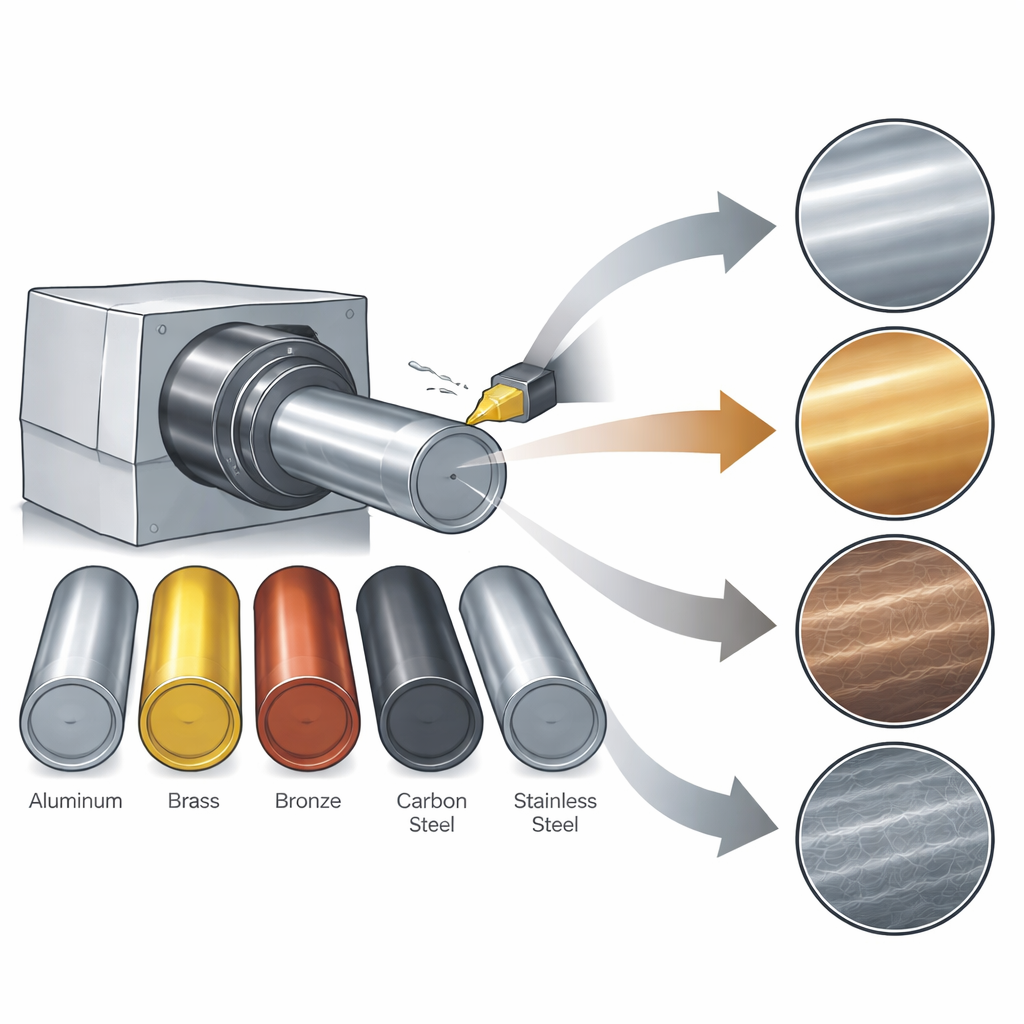
When a metal bar is turned on a lathe, the tool leaves behind a pattern of tiny hills and valleys. The authors distinguish between fine "roughness"—the small tool marks you might feel with a fingernail—and broader "waviness," which are longer ripples caused by vibration or bending. Roughness strongly affects friction, wear, and how easily cracks start, while waviness can ruin a seal, disturb light in an optical system, or cause noise in rotating parts. Instead of reporting only a single average value, the study uses a richer set of statistics that describe not just how big these features are, but how evenly they are spread and whether the surface is dominated by sharp peaks or gentle valleys.
Five familiar metals under identical cutting
To isolate what the metals themselves contribute, the researchers machined five common alloys—aluminum 6061, brass C26000, bronze C51000, carbon steel 1020, and stainless steel 304—using the same CNC lathe, the same cutting tool, the same speeds and feeds, and dry cutting with no lubricant. They then measured the resulting surfaces with a sensitive stylus instrument that traces the profile at nanometer resolution. For each material they took repeated measurements around the circumference to average out local oddities, and they separated the fine roughness from the broader waviness using standard filtering rules used in industry metrology.
Which metals came out smoothest and why
The results show that not all metals behave as textbooks might suggest. Stainless steel 304, the hardest and least heat‑conducting metal in the group, produced the smoothest and most uniform finish, with very low average roughness and waviness. The authors link this to its ability to strain‑harden and form stable, curled chips, which keeps the cutting action steady and avoids chunks tearing from the surface. At the opposite extreme, carbon steel 1020 delivered the roughest and most wavy surfaces, but in a consistent way—its roughness values did not vary much from place to place—suggesting that its moderate hardness and limited ability to shed heat steadily damage the tool and the surface. Aluminum 6061 and bronze fell in the middle for average roughness but showed large zone‑to‑zone variability, driven by aluminum’s tendency to stick to the tool and bronze’s vibration‑prone cutting. Brass gave a somewhat rough finish, again influenced by its softness and ductility.
Heat flow, hardness, and surface character
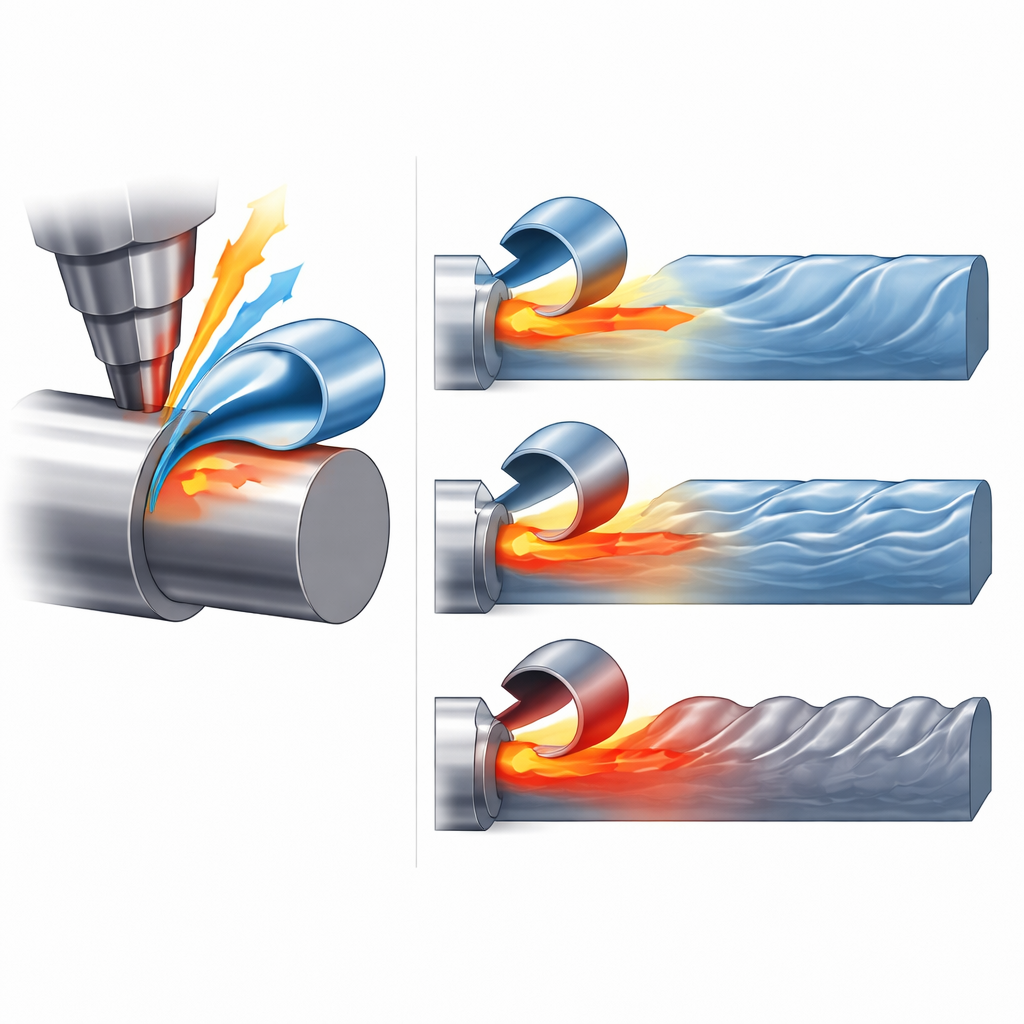
By comparing the metals’ hardness and their published thermal conductivity values with the measured surfaces, the study reveals clear patterns. Across all five alloys, a ten‑percent change in thermal conductivity translated into roughly a six‑percent change in surface roughness, even when cutting conditions stayed fixed. In general, metals that conduct heat well, like aluminum and brass, are less likely to overheat the tool, but their softness and tendency to smear or stick can still spoil the finish. Harder, poorer heat conductors, such as carbon steel, suffer from heat buildup and higher cutting forces, leading to more pronounced grooves and ripples. Stainless steel 304 stands out as an exception: despite holding heat, its microstructure and work‑hardening behavior stabilize chip formation enough to produce very smooth surfaces. The authors also track more subtle descriptors such as skewness (valley‑dominated versus peak‑dominated surfaces) and kurtosis (how sharp the highest asperities are), which relate directly to how well a surface will hold lubricant or where fatigue cracks are likely to start.
From surface statistics to real‑world performance
Rather than stopping at "this metal is rougher than that one," the authors build a framework that links these statistical surface descriptors to practical outcomes such as wear resistance, fatigue life, and dimensional reliability. They show, for instance, that valley‑rich surfaces can be helpful in sliding parts because they trap lubricant, while surfaces with sharp peaks are more likely to serve as stress raisers where cracks can begin. Their statistical tests confirm that differences between materials are not due to random scatter but overwhelmingly to intrinsic properties like hardness and heat flow. The work does not claim to represent best‑case industrial practice—each metal would normally get its own optimized cutting recipe—but it establishes a common baseline that exposes how material choice alone can steer surface integrity. For designers and manufacturers, this means that picking an alloy is not just about strength or corrosion resistance: it also quietly fixes the starting point for how smooth, durable, and reliable a machined surface can be.
Citation: Alsoufi, M.S., Bawazeer, S.A. Influence of thermal and mechanical properties on surface integrity in CNC turning across multiple engineering materials. Sci Rep 16, 14155 (2026). https://doi.org/10.1038/s41598-026-41648-3
Keywords: CNC turning, surface roughness, thermal conductivity, material hardness, surface integrity