Clear Sky Science · en
Mismatched parameters selection and error sensitivity analysis of easy-off TEC worm drive
Why gear teeth matter for smooth machines
Whenever a motor quietly drives a robot arm, an elevator, or a factory conveyor, hidden gear sets are doing the hard work of slowing motion and boosting torque. One compact way to achieve very large speed reductions is with a special screw‑like gear called a worm drive. But traditional high‑performance worm drives are fragile: tiny manufacturing or assembly errors can concentrate forces at the edges of the teeth, leading to noise, vibration, and premature failure. This study explores a new way to shape and align the teeth in a modern “easy‑off” toroidal enveloping conical (TEC) worm drive so that it remains efficient yet far less sensitive to such imperfections.
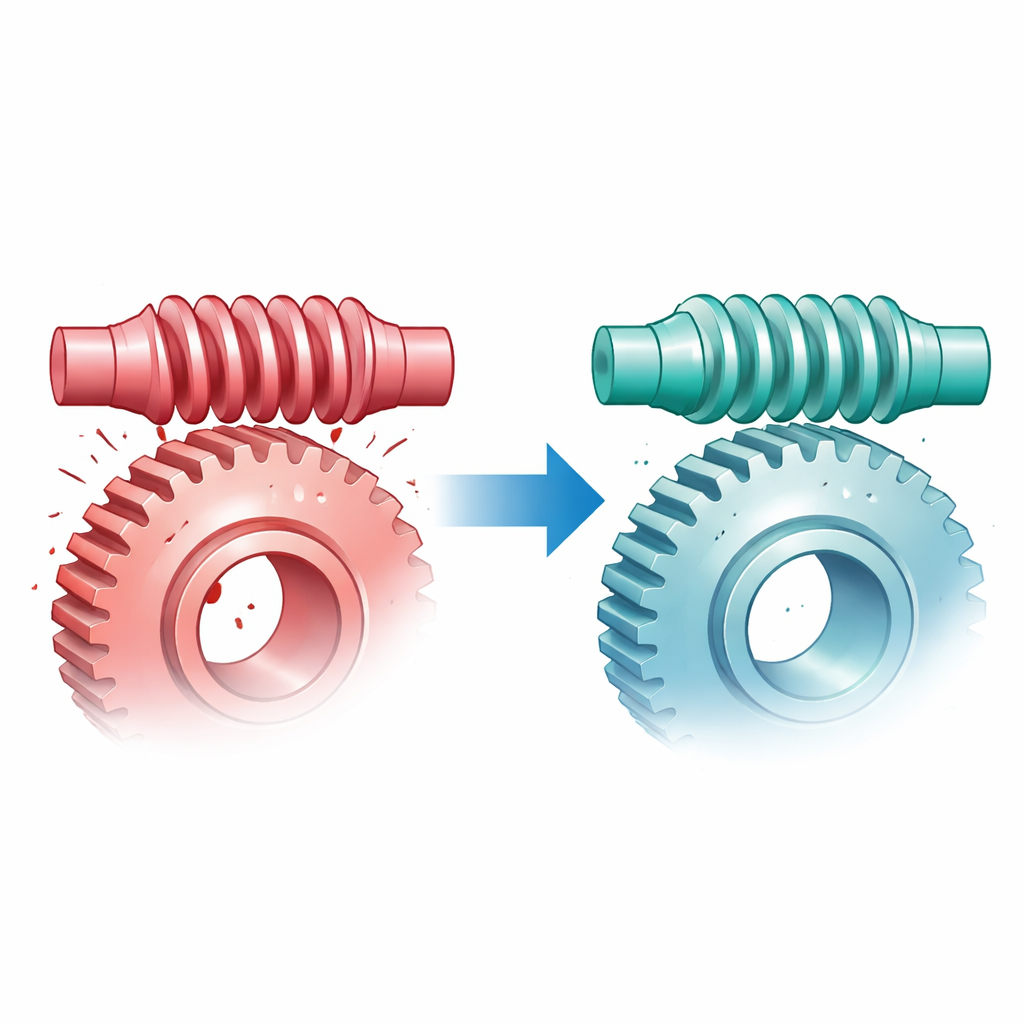
From fragile line contact to forgiving point contact
Conventional TEC worm drives are designed so that the mating tooth surfaces touch along narrow lines. In theory this “line contact” spreads loads efficiently, but in practice even small deviations in angle, distance, or shape can push the contact toward one edge, sharply raising stress and wear. Engineers have proposed a remedy called mismatched modification: instead of insisting that the two tooth surfaces match perfectly everywhere, the designer intentionally introduces a slight mismatch. This converts line contact into a series of small contact patches that behave like points. These point contacts add extra freedom for the teeth to adjust when errors are present, helping the drive maintain good performance even when real‑world conditions are less than perfect.
Building a detailed mathematical picture of tooth contact
The authors construct a comprehensive geometric and motion model of the easy‑off TEC worm drive, explicitly including manufacturing and assembly errors such as small shifts in center distance, shaft angle, and axial mounting position. Using tools from gear meshing theory, they write down the equations that describe where and how the worm and gear teeth can touch at any instant. These equations are highly nonlinear and involve many coupled variables, making them difficult to solve directly. Yet finding precise “instantaneous contact points” on the tooth surfaces is essential for predicting load‑carrying capacity, motion smoothness, and how sensitive the system is to different types of errors.
Smart search for contact points
To tame this complexity, the paper introduces an Adaptive Extremum Search (AES) method. Instead of guessing good starting values by trial and error, the AES approach treats the bundle of tooth‑contact equations as a single function that becomes zero only when all conditions are satisfied at once. The algorithm explores the space of possible parameter values in small, adaptively shrinking neighborhoods, always moving toward combinations that make this function smaller. In numerical tests for a representative TEC worm drive, AES finds accurate initial contact points noticeably faster—about a quarter less computation time—than a previously used double‑grid technique. These better starting points allow standard numerical solvers to converge reliably, enabling detailed mapping of contact traces on the teeth and the associated motion errors.
How design choices and errors shape performance
Armed with this model and solver, the authors systematically vary key mismatched design parameters—such as the process drive ratio, center distance, shaft angle, hob position, and grinding‑wheel geometry—and observe how the patterns of contact patches, the size of the local elliptical contact regions, and the worm gear’s rotational error respond. A well‑chosen mismatch design produces long contact traces that cover most of the tooth width and height, with parabolic, “slow‑fast‑slow” variations in rotational error that favor low vibration. Among the many knobs the designer can turn, the shaft angle stands out as the most critical: small deviations here can strongly shorten contact regions and enlarge motion errors, especially on one side of the teeth. The study also shows an important trade‑off: if the tooth surfaces are made too similar—so that the contact ellipses become very elongated and approach a line—the drive regains good load distribution but once again becomes much more sensitive to small errors.

What this means for real machines
For engineers seeking quiet, durable, high‑ratio transmissions, the results offer both reassurance and guidance. A carefully mismatched easy‑off TEC worm pair can be surprisingly tolerant of realistic assembly errors, maintaining stable point contact and smooth rotation even when distances and angles are slightly off. The Adaptive Extremum Search method provides a practical way to design and evaluate such drives in detail before cutting any metal. At the same time, the work cautions that pushing mismatches too low in pursuit of ideal contact can backfire, making the system fragile again. In short, the paper shows how a touch of deliberate imperfection in tooth geometry can make worm drives more robust, reliable components in demanding mechanical systems.
Citation: Huai, C., Sun, S., Gai, J. et al. Mismatched parameters selection and error sensitivity analysis of easy-off TEC worm drive. Sci Rep 16, 10335 (2026). https://doi.org/10.1038/s41598-026-41523-1
Keywords: worm gear drive, gear tooth contact, error sensitivity, mechanical transmission, computational gear design