Clear Sky Science · en
Inverse design of an ultra-wideband endfire grooved half-mode waveguide (G-HMWG) antenna based on the CNN approach
Smart antennas for the wireless world
Our phones, cars, and home devices all depend on tiny metal structures called antennas to send and receive signals. As we demand faster data, sharper radar, and smarter sensing, these antennas must work over wider frequency ranges while staying small and efficient. This paper shows how combining traditional antenna engineering with modern artificial intelligence can create a compact, high‑performance antenna suited for next‑generation wireless and radar systems in the 6–10 GHz band.
Why end‑fire antennas matter
Many advanced systems—such as short‑range radar for cars, motion‑sensing devices, and point‑to‑point wireless links—need antennas that push energy strongly in one main direction rather than broadcasting everywhere. These are called end‑fire antennas because they radiate mainly out of one end, like a flashlight beam. Conventional designs, including classic Yagi antennas and several modern variations, often force engineers to trade between three key features: high gain (a strong beam), wide frequency coverage, and compact size. Improve one, and the others usually suffer. Earlier designs either worked over a narrow slice of frequencies, required long metal structures, or delivered only modest signal strength.
A new kind of compact antenna
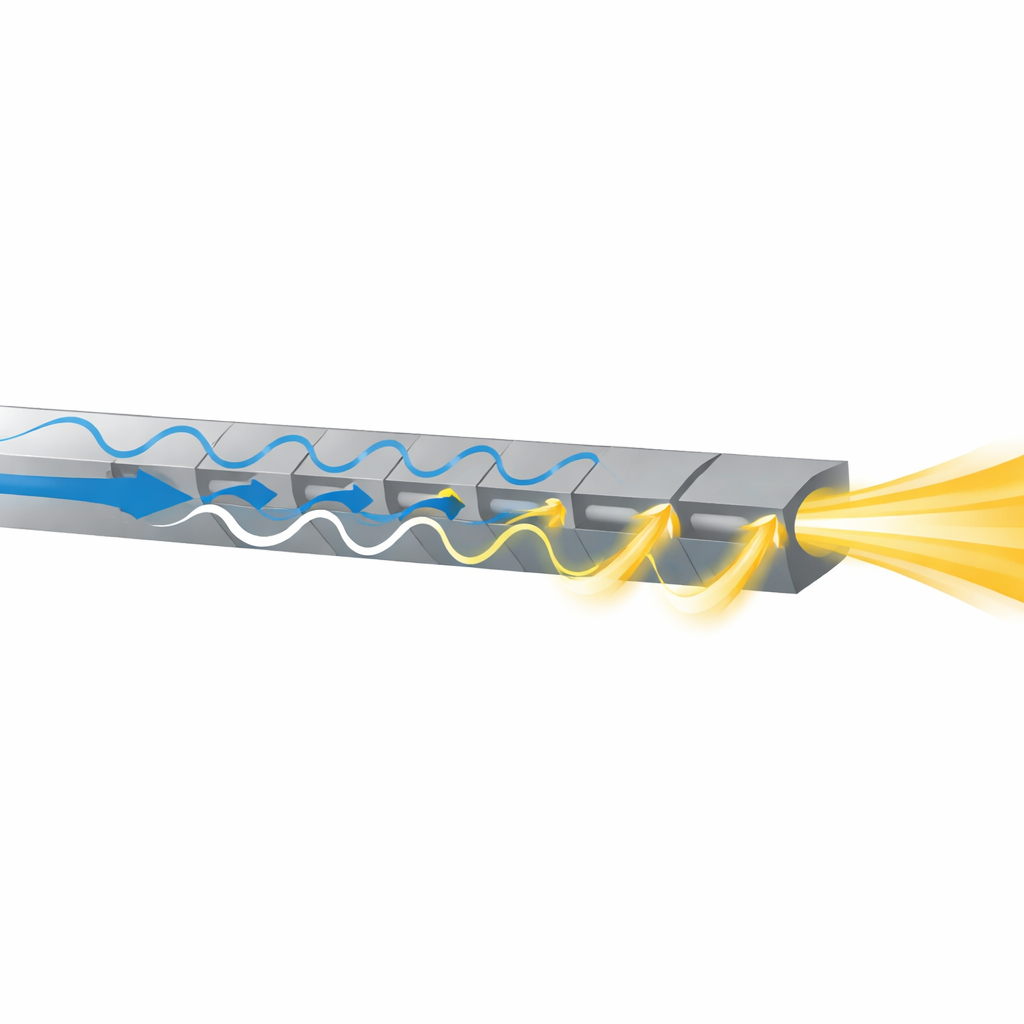
The authors focus on a special structure called a grooved half‑mode waveguide. In simple terms, it is a metal channel that guides radio waves along its length, with carefully cut grooves on one side. These grooves slow and leak the wave in a controlled way, so the energy gradually escapes along the antenna and adds up into a strong beam at the far end. By repeating a basic "unit cell"—a small section of the grooved channel—they assemble a multi‑cell antenna that can be tuned by adjusting just a few geometric knobs: mainly how deep each groove is and how far apart the grooves are spaced. Getting these details right is crucial for shaping the beam and keeping it stable across many frequencies, but exploring all possible combinations by hand or with brute‑force simulations is extremely time‑consuming.
How artificial intelligence helps design the shape
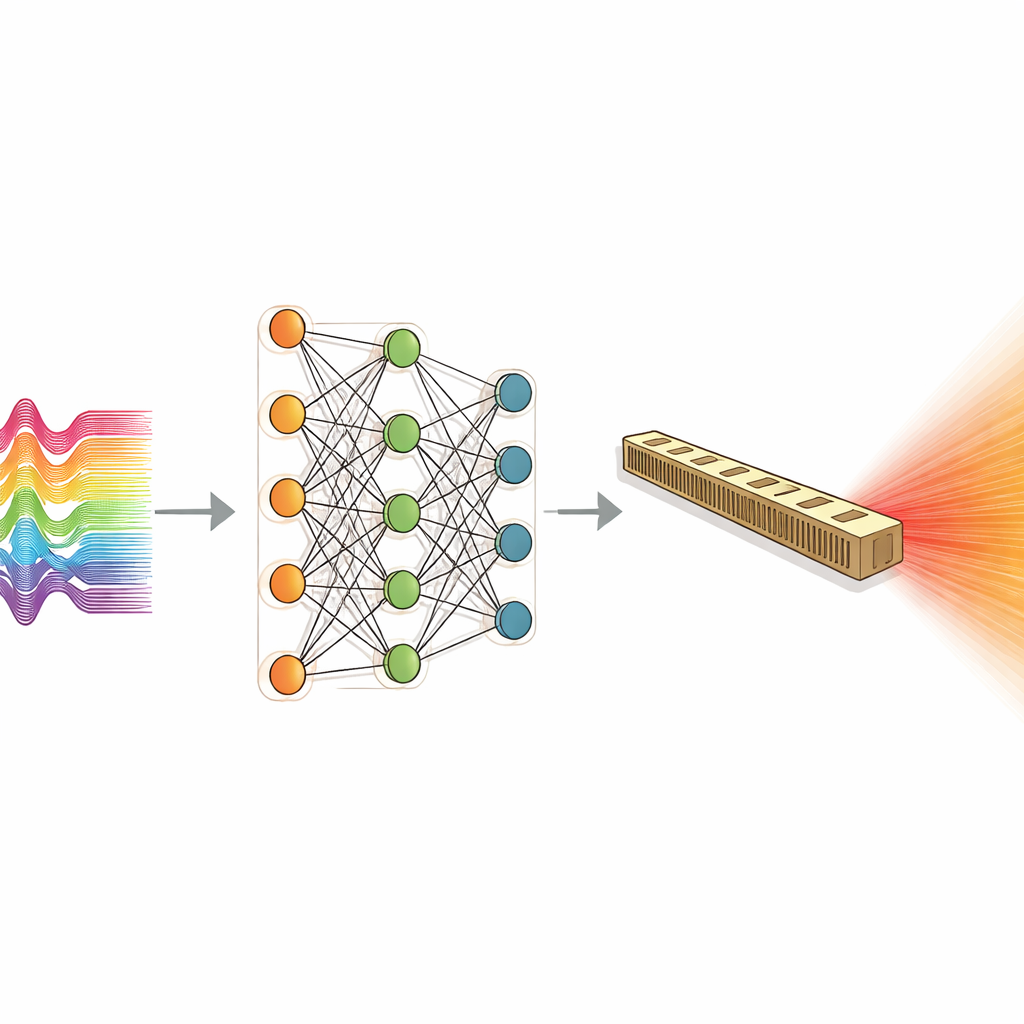
Instead of slowly scanning through thousands of design options, the researchers train a one‑dimensional convolutional neural network, a type of deep‑learning model widely used to recognize patterns. The input to this network is not simple summary numbers but full radiation patterns—how the antenna radiates at many angles and frequencies. From these patterns, the network learns to predict the best values of groove depth and spacing that will produce a compact structure with a clean, forward‑pointing beam. To build this "inverse design" tool, they first run about 400 high‑accuracy electromagnetic simulations, varying only the two key dimensions. These simulations form a training set that teaches the network how changes in shape affect the beam, after which the model can instantly suggest optimized dimensions without further heavy computation.
From virtual design to real‑world hardware
Using the AI‑predicted geometry, the team designs and fabricates a real antenna operating between 6 and 10 GHz, a range often used for X‑band radar and ultra‑wideband links. The resulting device is notably compact—about one‑third shorter than comparable earlier designs—yet maintains a strong, highly directional beam toward the end‑fire direction. Measurements show that the antenna efficiently accepts power from its feed line, maintains a peak gain above about 11 dBi, and keeps unwanted sidelobes (stray beams at other angles) well suppressed. Just as important, the shape of the main beam remains stable across the entire operating band, addressing a common weakness of many end‑fire antennas whose beam direction shifts with frequency.
What this means for future devices
For non‑specialists, the core message is that artificial intelligence can act as a powerful design assistant for complex electromagnetic hardware. By learning from a relatively small but well‑chosen set of simulations, the neural network can reverse‑engineer the antenna shape needed to achieve a desired radiation pattern. This approach slashes design time—by around 90–95% compared with traditional trial‑and‑error optimization—while delivering a smaller, more capable antenna. As wireless, radar, and sensing systems become more demanding, such AI‑driven design methods could help engineers rapidly develop customized antennas for everything from smarter cars to next‑generation communication links.
Citation: Rezaei, M., Nooramin, A.S. Inverse design of an ultra-wideband endfire grooved half-mode waveguide (G-HMWG) antenna based on the CNN approach. Sci Rep 16, 11660 (2026). https://doi.org/10.1038/s41598-026-41442-1
Keywords: end-fire antenna, ultra-wideband radar, waveguide technology, AI antenna design, convolutional neural networks