Clear Sky Science · en
An intelligent computational framework combining neural networks with complex Pythagorean fuzzy FUCA for airspace capacity evaluation and traffic forecasting
Why smarter skies matter
Anyone who has sat through a long flight delay has felt how fragile our air travel system can be. Behind every takeoff and landing is a constant balancing act: how many planes the sky can safely hold, how storms and congestion ripple through the network, and how controllers and planners juggle competing priorities. This paper presents a new way to support those decisions by blending artificial intelligence with a sophisticated method for combining expert judgment, aiming to keep air travel safer, smoother, and more predictable even when conditions are uncertain.
Making sense of a crowded, changing sky
Modern air traffic has grown so dense and complex that traditional planning tools—based on fixed rules or simple averages—struggle to keep up. Airspace capacity is essentially the maximum number of aircraft that can move safely through a region under changing conditions, from busy runways to stressed controllers to fragile navigation equipment. Traffic forecasting tries to predict when and where planes will cluster so that congestion can be prevented before it happens. Both tasks are riddled with uncertainty: weather can shift, demand can spike, and experts may disagree about risks. The authors argue that effective management now requires tools that can handle messy, incomplete information without pretending that everything is precisely known.
Teaching computers to learn from the past
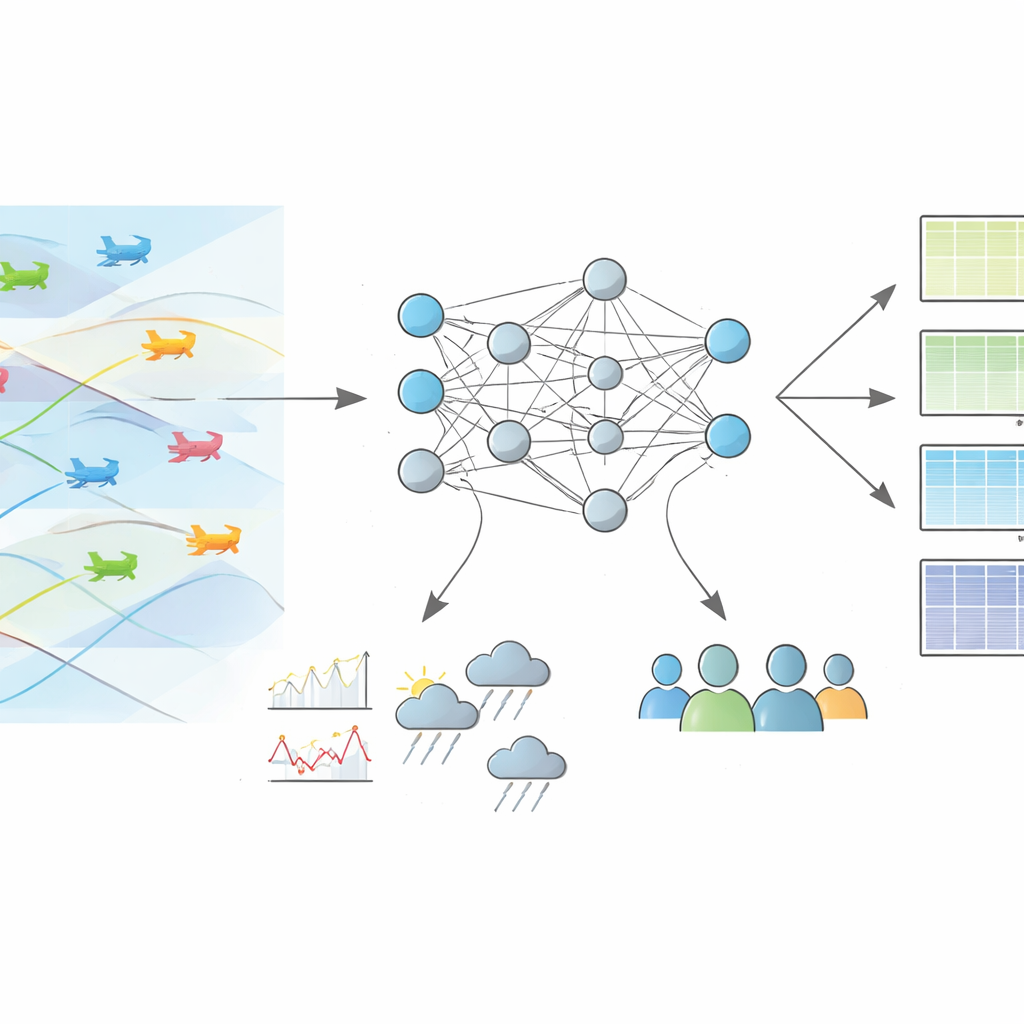
At the heart of the proposed framework is a neural network, a machine learning model that learns patterns from historical data. The network ingests records such as aircraft counts, sector occupancy, weather conditions, and delay histories from different airports and operating scenarios. It then learns to predict how a given way of organizing the airspace is likely to perform: how much traffic it can safely carry, how heavy controller workloads might become, and how likely congestion is under various conditions. Instead of relying only on rules crafted in advance, the system adapts to the complex, nonlinear behavior seen in real operations, capturing relationships that may be too subtle or tangled for humans to quantify directly.
Turning fuzzy opinions into clear rankings
Numbers alone, however, cannot capture everything that matters in aviation. Expert judgments—about safety margins, resilience to bad weather, or the practicality of certain control strategies—are inevitably vague and sometimes conflicting. To handle this, the authors use a decision-making technique called FUCA, which compares all candidate strategies simultaneously rather than just in pairs. They enrich FUCA with “complex Pythagorean fuzzy” information, a mathematical way to represent not just how much experts support or oppose an option, but also how hesitant or uncertain they are. In practice, experts describe each strategy using simple verbal grades such as “poor,” “good,” or “very good” on criteria like runway throughput, controller workload, infrastructure reliability, forecast quality, delay cost, and congestion risk. These linguistic terms are translated into fuzzy values that encode both agreement and doubt, allowing the method to respect nuance instead of forcing crisp yes–no decisions.
From many options to the best strategies
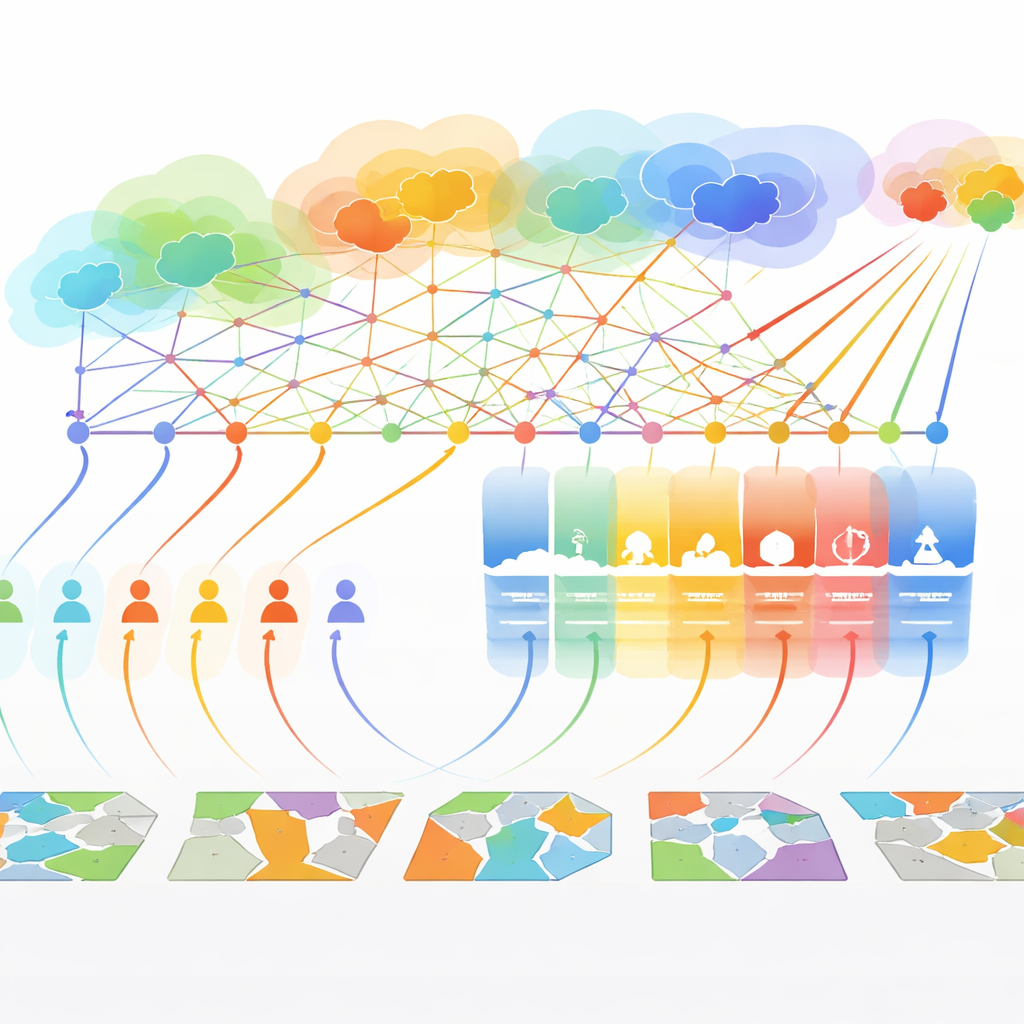
The framework is tested on a rich case study with four types of experts and fifteen realistic airspace strategies, ranging from specific terminal sectors to collaborative decision protocols and advanced flow control schemes. The neural network first produces quantitative performance estimates for each strategy under uncertain conditions. FUCA then fuses these predictions with expert fuzzy assessments, builds a combined scoring table, and ranks all options. The results highlight a handful of consistently strong strategies: a particular en-route sector design, a collaborative decision-making protocol, and an enhanced navigation grid emerge as leaders, while more rigid or overly complex plans sink to the bottom. Extensive sensitivity analyses show that these rankings remain stable even when the relative influence of experts or the importance of criteria is varied across many scenarios, suggesting that the recommendations are not overly fragile.
How this helps real-world aviation decisions
To see how the new framework compares with existing tools, the authors benchmark it against several rival methods used in engineering and transportation planning. Their hybrid approach shows stronger ability to distinguish between similar alternatives, better handling of high uncertainty, and more stable rankings when inputs change. For managers and regulators, this translates into a decision-support system that can blend live data with human experience, explore what-if scenarios, and highlight strategies that remain effective under a wide range of conditions. While the case study is hypothetical and future work will need to validate the model on real traffic data and at larger scales, the research points toward a practical path: using AI and advanced fuzzy reasoning to guide airspace design, capacity planning, and traffic management in a world where the skies are only getting busier.
Citation: Huo, D., Zhang, S. An intelligent computational framework combining neural networks with complex Pythagorean fuzzy FUCA for airspace capacity evaluation and traffic forecasting. Sci Rep 16, 13322 (2026). https://doi.org/10.1038/s41598-026-41437-y
Keywords: airspace capacity, air traffic forecasting, neural networks, fuzzy decision-making, aviation management