Clear Sky Science · en
AI fragmentation-based optimization of Sorafenib derivatives targeting VEGFR2 for angiogenesis-related pathologies: a structure-based in-silico study
Why reshaping a cancer drug matters for many diseases
New blood vessels keep our organs alive, but when their growth goes out of control, they can feed tumors, damage the eye, and disrupt the placenta during pregnancy. This study explores how artificial intelligence and advanced computer simulations can redesign an existing cancer drug, sorafenib, to more precisely control a key switch for blood vessel growth called VEGFR2, with the long-term hope of safer treatments for angiogenesis‑related diseases.
The traffic light for new blood vessels
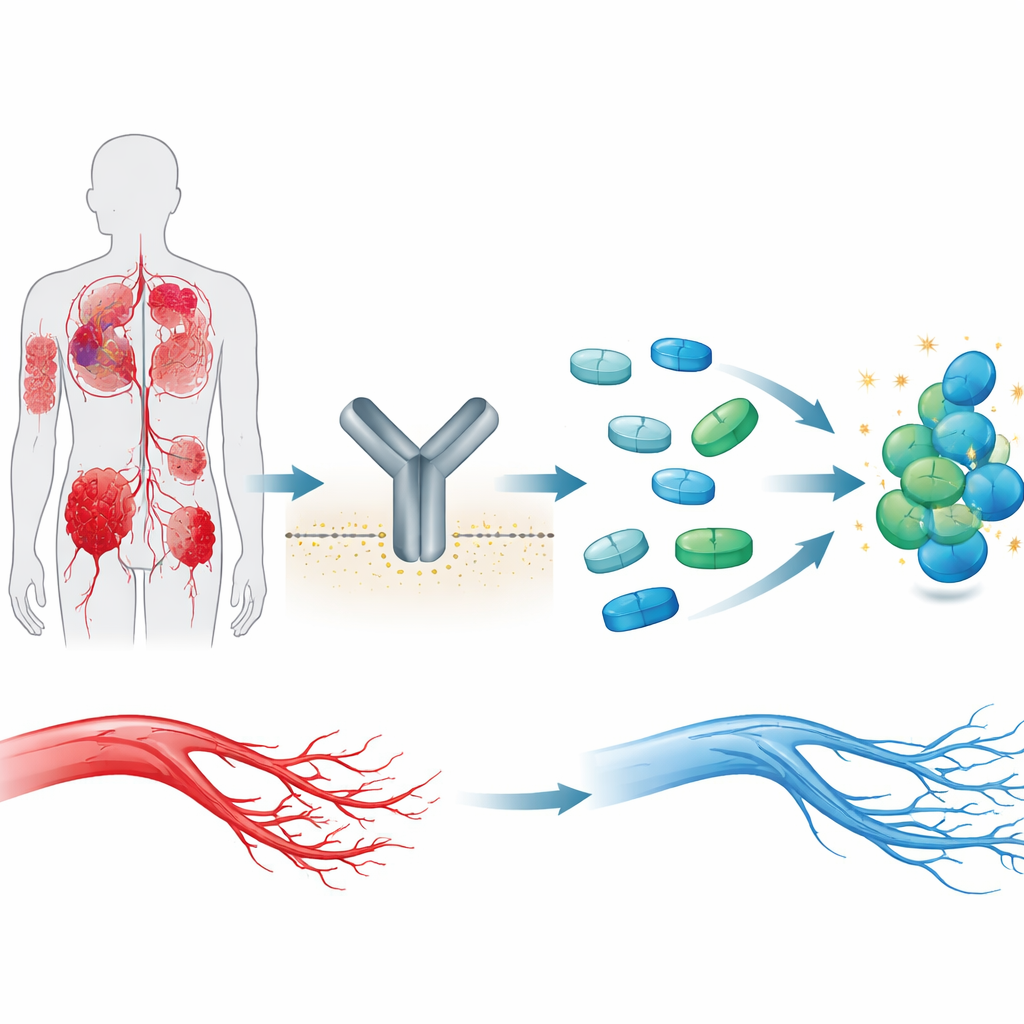
Blood vessel growth, or angiogenesis, depends heavily on a protein on the surface of vessel‑lining cells called VEGFR2. When its partner molecule VEGF binds, VEGFR2 tells cells to divide, migrate, and form new vessels. This is helpful in wound healing and development, but harmful when it drives tumor blood supply, certain eye diseases, chronic inflammation, or abnormal changes in the placenta. Because of this central role, VEGFR2 has become a major drug target, and several medicines already block it. However, many of these drugs, including sorafenib, hit multiple related proteins, which can cause serious side effects.
Turning sorafenib into a better tool
Sorafenib is a powerful but blunt instrument. It latches onto the inner “engine” region of VEGFR2 and related enzymes, shutting down signals that promote blood vessel growth. Unfortunately, its broad activity brings problems such as high blood pressure, heart strain, skin reactions, and a risk of liver injury. Instead of starting from scratch, the authors used sorafenib’s basic chemical skeleton as a starting template and asked: can we use AI to gently reshape this molecule so it grips VEGFR2 more tightly, behaves better in the body, and looks less toxic—without losing its anti‑angiogenic punch?
Letting AI explore safer chemical space
The team fed sorafenib’s structure into an AI‑driven system that makes small, chemically realistic changes—adding or swapping fragments in ways a medicinal chemist could reproduce in the lab. This produced twenty new candidate molecules that all kept sorafenib’s core features but differed in side groups and overall shape. The researchers then relied entirely on computer methods to test these candidates: virtual docking into a high‑resolution 3D model of VEGFR2, long molecular dynamics simulations that mimic the jostling of atoms in watery, body‑like conditions, and energy calculations that estimate how strongly each molecule stays bound.
A standout candidate in the simulations
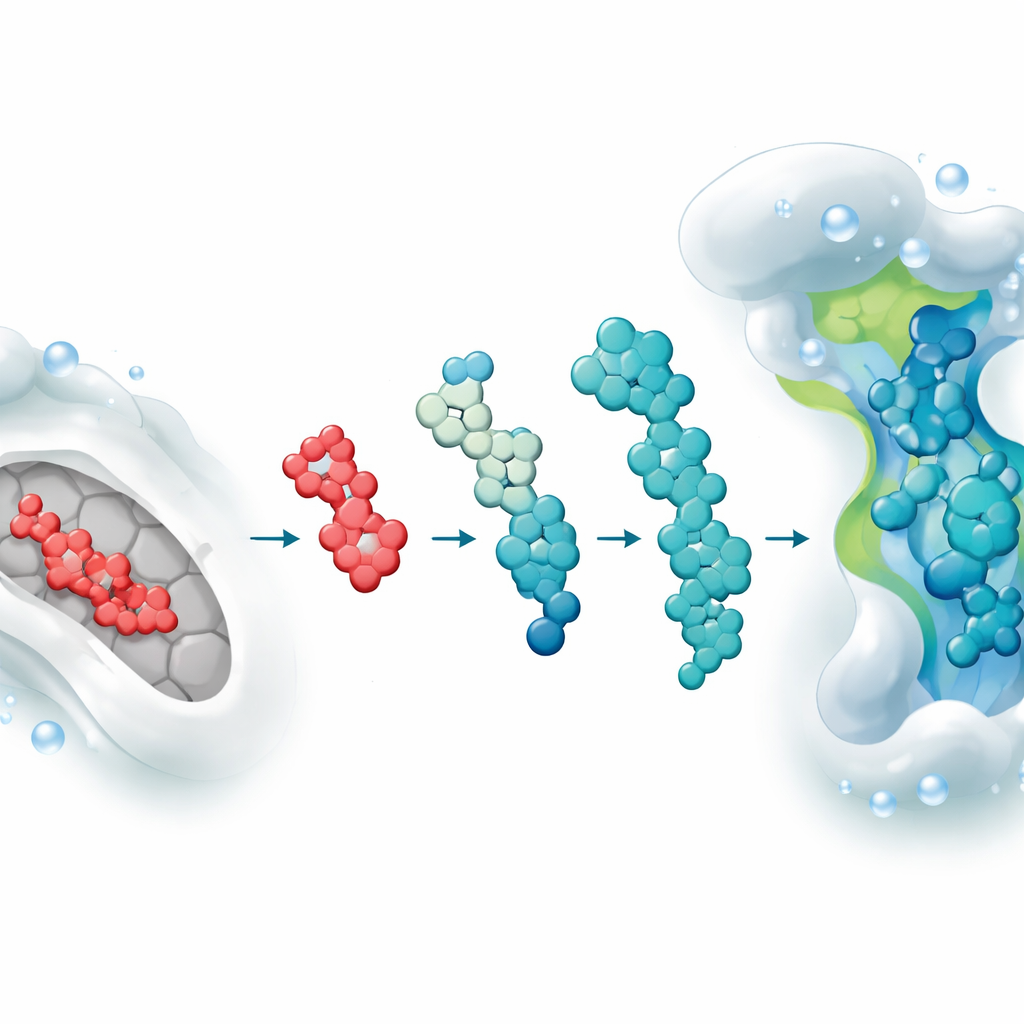
One design, called AI‑Fragmented Derivative 7 (Grow), consistently rose to the top. Docking studies suggested it nestled into VEGFR2’s main active groove more snugly than sorafenib, forming a denser web of contacts with key amino acids that are known to matter for real‑world inhibitors. A half‑microsecond of molecular dynamics simulations showed the complex remained remarkably stable over time: the protein stayed compact, the binding pocket did not collapse or distort, and the new molecule barely drifted, maintaining several hydrogen bonds and hydrophobic contacts throughout. Advanced quantum‑level calculations indicated that Derivative 7’s electrons are arranged in a way that favors charge interactions with VEGFR2, supporting its predicted strong binding.
Hints of better behavior in the body
Beyond simply binding well, a drug must move safely through the body. The authors used web‑based prediction tools to estimate how each candidate might dissolve, be absorbed, be broken down by liver enzymes, and potentially cause harm. Derivative 7 was predicted to have slightly better water solubility and a more balanced mix of oily and polar regions than sorafenib, properties that often make dosing and formulation easier. Importantly, machine‑learning toxicity models flagged sorafenib as more likely to cause drug‑induced liver injury, whereas Derivative 7 fell on the safer side of this particular risk. At the same time, it retained a broadly similar metabolic profile, meaning its breakdown routes might be predictable.
From computer promise to real‑world proof
In everyday terms, this work shows how AI and physics‑based simulations can “whittle and polish” an existing drug into a potentially sharper and safer version aimed at the same molecular switch. The redesigned sorafenib derivative appears, on screen, to grab VEGFR2 more firmly and to carry fewer red flags for liver damage, while keeping the basic features that make sorafenib effective. However, all of these findings are predictions: the new molecule has not yet been synthesized or tested in cells, animals, or patients. The study’s real contribution is to provide a well‑reasoned, data‑rich candidate—and a reusable digital pipeline—for next‑generation medicines that better tame runaway blood vessel growth in cancer, eye disease, and other angiogenesis‑driven conditions.
Citation: Inan, D., Karageçili, S. & Ali, N. AI fragmentation-based optimization of Sorafenib derivatives targeting VEGFR2 for angiogenesis-related pathologies: a structure-based in-silico study. Sci Rep 16, 11848 (2026). https://doi.org/10.1038/s41598-026-41232-9
Keywords: angiogenesis, VEGFR2 inhibitors, sorafenib derivatives, AI drug design, molecular docking