Clear Sky Science · en
Image-based detection of bolts and bolt-missing defects in multi-angle and complex background scenarios
Why checking tiny fasteners matters
Hidden inside bridges, towers, and other steel structures are hundreds of thousands of bolts that quietly hold everything together. If too many of these fasteners work loose or go missing, the strength of the whole structure can be reduced, sometimes with dangerous consequences. Inspecting them one by one by hand is slow, costly, and easy to get wrong, especially when workers must climb high or squeeze into awkward spaces. This study explores how smart cameras and artificial intelligence can automatically spot missing bolts in real-world conditions, making safety checks faster, safer, and more reliable.
From real bridges to a rich photo library
To teach a computer to recognize missing bolts, the researchers first needed a large and varied collection of images. They gathered photos from three main sources: a full-sized suspension bridge in service, steel transmission towers in the field, and a specially built steel plate studded with bolts in the laboratory. Together these provided more than 5,000 images showing bolts from many angles, in sunshine and shade, with rust, stains, and coatings of different colors. To further expand this library, the team used classic image tweaks, such as adding blur and noise or changing colors, and also turned to a kind of “imagination engine” called a generative adversarial network, which creates realistic new scenes where the key object—the bolt—remains accurate but the background and surroundings are varied. 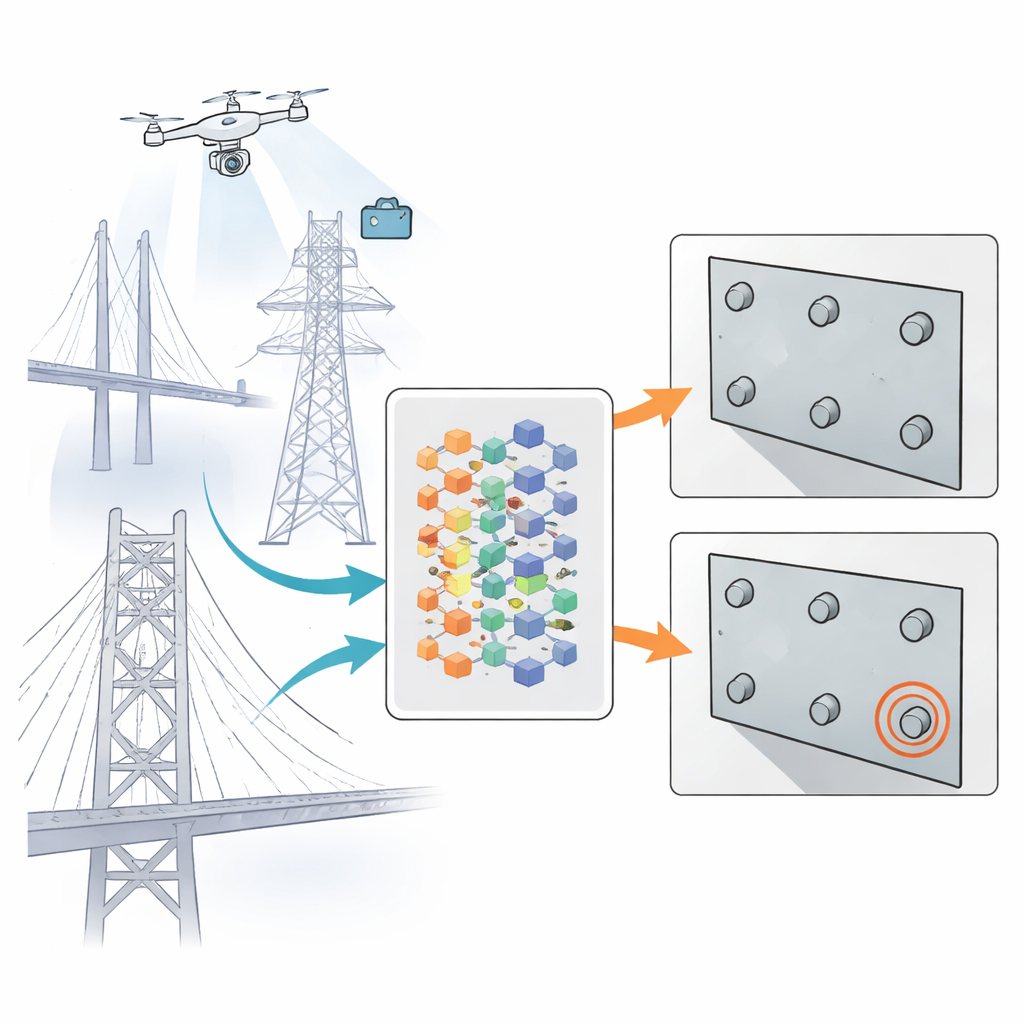
Putting popular AI models to the test
With this rich image library in hand, the team compared three leading computer-vision systems widely used for spotting objects in pictures: three versions of the YOLO (You Only Look Once) family. These systems scan an image in a single pass and propose boxes where they believe objects are present. The researchers measured how often each version correctly detected bolts and correctly marked empty holes where a bolt was missing. All three models did fairly well, but one version—YOLOv8—stood out by balancing accuracy with speed. It identified bolts and missing bolts reliably while processing images much faster than its competitors, making it a strong starting point for further improvement.
Teaching the computer to see through clutter
Real steelwork is rarely photographed in a clean, straight-on view. Bolts are seen from odd angles, through shadows, or against busy backgrounds of grass, concrete, and painted steel. To cope with this, the researchers upgraded the YOLOv8 model with two key additions. First, they plugged in a modern image-analysis block called a Swin-Transformer, which helps the system notice relationships across distant parts of an image instead of focusing only on tiny patches. Second, they added a multi-scale and detail-enhancing module that pays special attention to fine edges and small shapes at different sizes. Working together, these upgrades made the model much better at telling whether a small dark circle is truly a bolt head, an empty hole, or just a confusing smudge in the background. 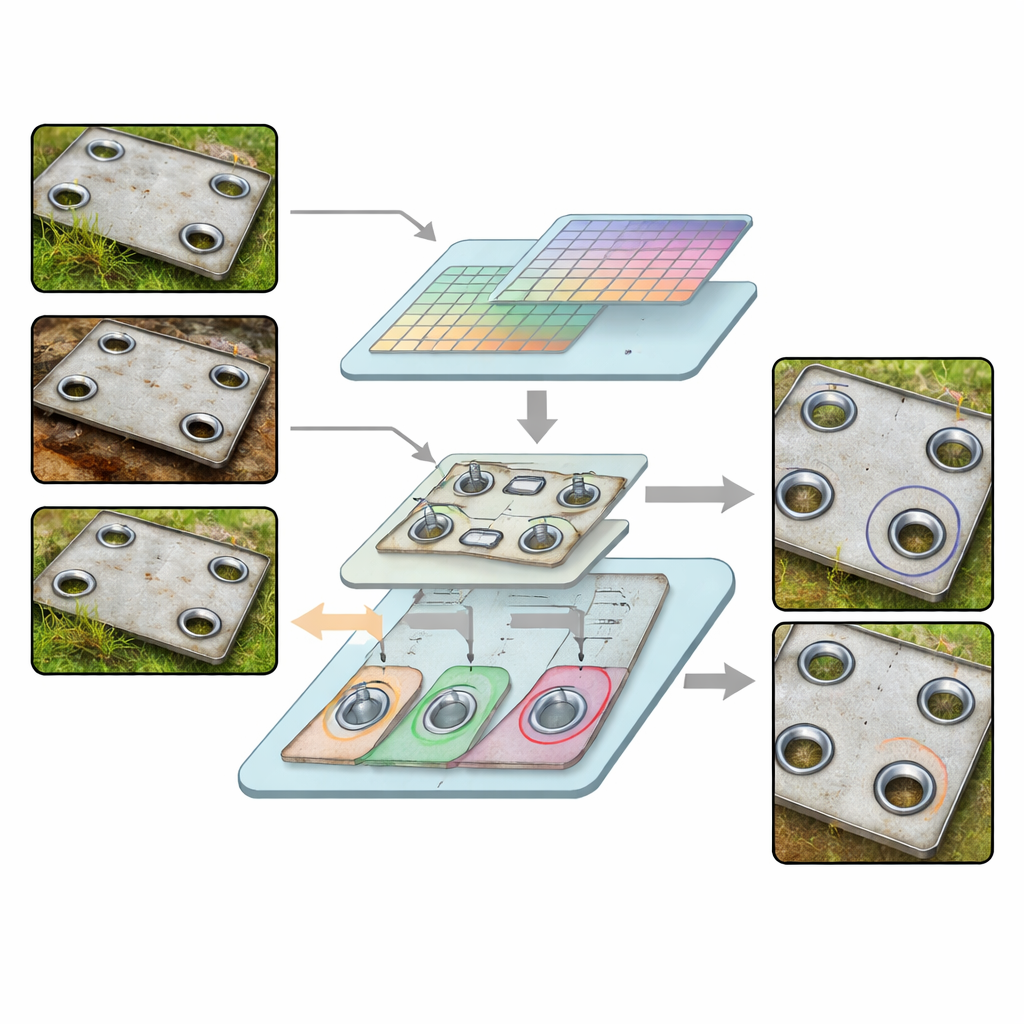
Proving performance in tough conditions
The improved system was then put through a series of stress tests. It analyzed images of bolts viewed from shallow and steep angles, under dim, normal, and glaringly bright light, and on steel plates painted red, white, or blue and photographed against messy grassy surroundings. In most of these situations, the model correctly judged the bolt status nearly every time; even at the most extreme camera angles and brightest lights, accuracy stayed above about 90 percent. Finally, the researchers flew a drone along a 15-year-old suspension bridge, capturing thousands of real inspection images. The model examined more than 12,700 bolt sets, accurately locating almost all of them and flagging a single genuinely missing bolt among tens of thousands—a strong sign that the method can work outside the lab.
What this means for everyday safety
For non-specialists, the main message is that routine safety checks on large steel structures may soon rely less on people inching along girders with clipboards and more on drones and smart algorithms. By learning from a carefully built and diversified photo collection, and by using advanced image-processing tricks to see through clutter, the system in this study can reliably tell when a bolt is present or missing, even when conditions are far from perfect. While not flawless, it already performs well enough to serve as a powerful aid to human inspectors, helping them focus on the few places where real problems may exist and, ultimately, contributing to safer bridges and towers with less disruption and lower cost.
Citation: Gu, Y., Peng, D., Song, J. et al. Image-based detection of bolts and bolt-missing defects in multi-angle and complex background scenarios. Sci Rep 16, 11590 (2026). https://doi.org/10.1038/s41598-026-41036-x
Keywords: structural health monitoring, bridge inspection, computer vision, deep learning, bolt defects