Clear Sky Science · en
DNA methylation at OsAmy3E promoter is involved in grain quality under heat stress in rice (Oryza sativa L.)
Why rice grains turn chalky in the heat
Rice feeds billions of people, but rising temperatures threaten not only how much rice farmers can harvest, but also how good the grains look and cook. Under hot conditions, rice kernels often develop a pale, opaque "chalky" center that lowers their market value and can change their texture on the plate. This study explores why some rice varieties stay smooth and translucent in the heat, and reveals a tiny chemical tag on DNA that helps protect grain quality.
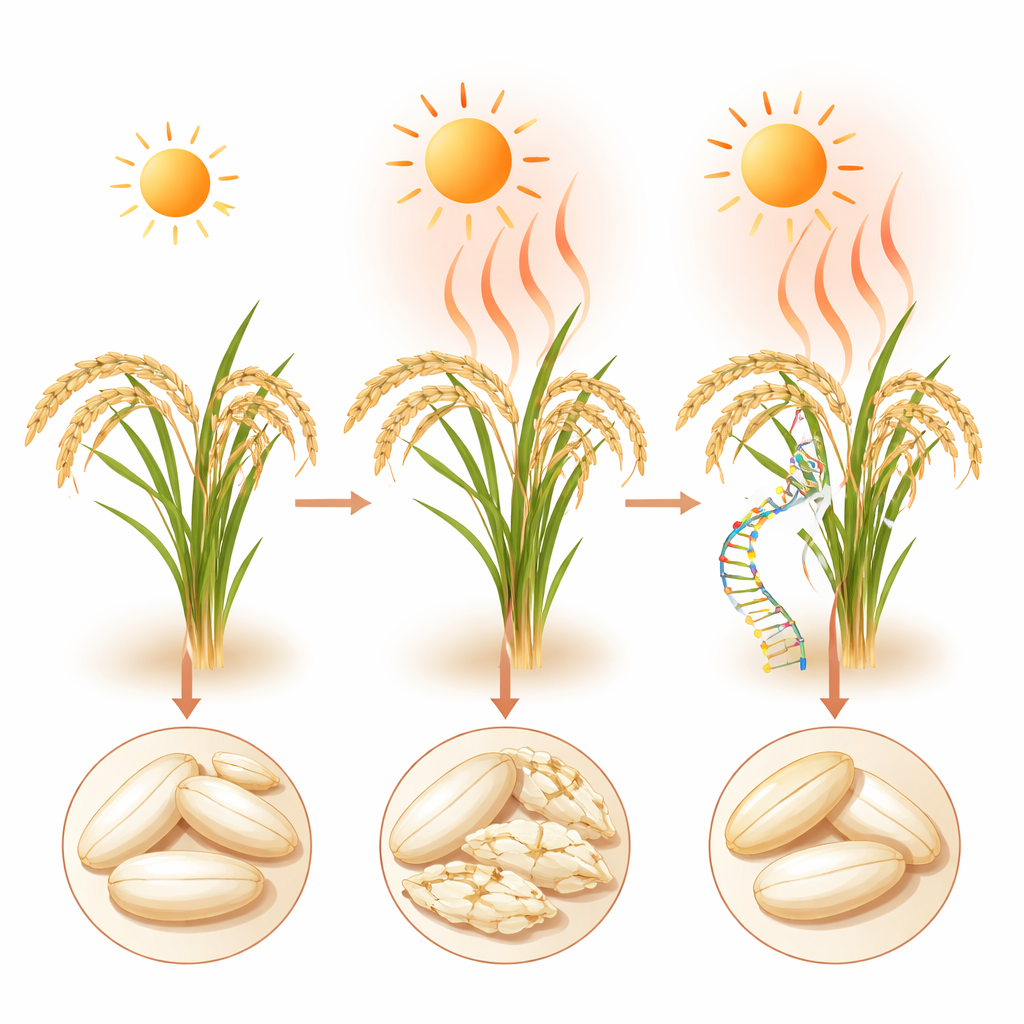
A closer look at heat-damaged grains
When rice plants fill their grains, they normally pack starch in a tight, glassy structure. Heat stress disrupts this process. The authors explain that high temperatures both slow down starch-building reactions and trigger enzymes that chew starch back apart. The result is loosely packed starch granules that scatter light and make grains look chalky. In Japan, the popular variety Hinohikari is particularly sensitive: when grown at 30 °C during grain filling, more than three-quarters of its grains become chalky, compared with very few under cooler conditions.
A heat-tough rice variety and a suspect gene
Breeders have developed heat-tolerant varieties, including one called Kumasannochikara, that keep a much lower fraction of chalky grains in the same hot conditions. Earlier work had pointed to a starch-degrading enzyme called alpha-amylase, and in particular one of its genes, OsAmy3E, which switches on strongly during heat and is linked to chalkiness. In this study, the researchers confirmed that under heat Hinohikari turns this gene on far more than Kumasannochikara does, and that the tolerant variety shows better grain appearance as a result. Interestingly, the DNA sequence in front of the gene, which controls when it is turned on, is identical in both varieties, hinting that something other than the letters of the gene itself is responsible.
DNA “off switches” that respond to heat
The team focused on DNA methylation, a small chemical tag that can act like an off switch when placed in a gene’s control region. They measured methylation in the promoter of OsAmy3E in developing grains. Under normal temperature, both varieties showed similar methylation levels and modest gene activity. Under heat, however, Kumasannochikara gained much higher methylation in this region, and its OsAmy3E activity stayed relatively low. Hinohikari, in contrast, did not add these methyl tags and strongly activated the gene. This pattern suggests that extra methylation in the tolerant variety helps keep the starch-degrading enzyme in check during heat waves, preserving grain structure.
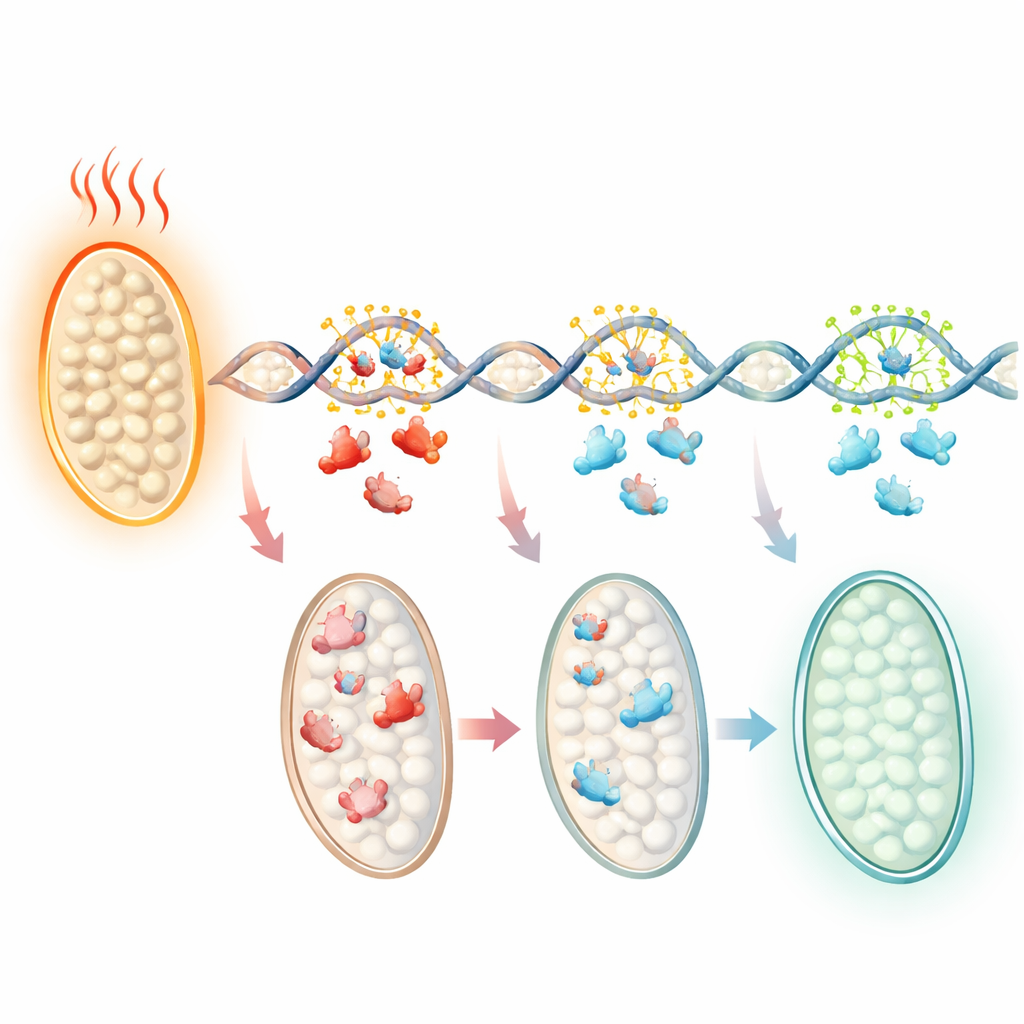
Passing heat protection to the next generation
To see whether this methylation-based control could be used in breeding, the researchers crossed the two varieties in different directions and studied their offspring. In first-generation grains, suppression of OsAmy3E under heat appeared only when Kumasannochikara was the mother, pointing to influences from the maternal tissues surrounding the developing seed. In second-generation plants, however, the scientists could sort seedlings into "methylated" and "non-methylated" groups based on the OsAmy3E promoter in their leaves. When these groups were later exposed to heat during grain filling, the methylated plants—regardless of which parent was which—showed lower OsAmy3E activity and produced far fewer chalky grains than the non-methylated plants.
What this means for future rice breeding
Together, the findings show that tiny methyl tags on a single gene’s promoter can make a big difference to rice grain quality under heat stress. By selecting seedlings that already carry high methylation at the OsAmy3E promoter, breeders may be able to develop lines that maintain attractive, translucent grains even as growing seasons warm. More broadly, the study highlights epigenetic marks—chemical modifications layered on top of DNA sequence—as promising new markers for breeding crops that can thrive in a hotter world.
Citation: Chen, WJ., Suriyasak, C., Nong, H.T. et al. DNA methylation at OsAmy3E promoter is involved in grain quality under heat stress in rice (Oryza sativa L.). Sci Rep 16, 11024 (2026). https://doi.org/10.1038/s41598-026-40998-2
Keywords: rice heat tolerance, grain chalkiness, DNA methylation, epigenetics in crops, climate-resilient agriculture