Clear Sky Science · en
Functional changes of precuneus architecture across newborns, infants, and early adolescents
Why this brain region matters as children grow
The human brain changes rapidly from birth through adolescence, laying the groundwork for movement, memory, and social life. At the center of many of these abilities is a tucked‑away patch of cortex called the precuneus. This study asks a deceptively simple question: how does the precuneus wire up to the rest of the brain as children grow, and how does that wiring differ in autism spectrum disorder? The answers offer a window into how complex thought and social understanding emerge—and what may go differently in some neurodevelopmental conditions.
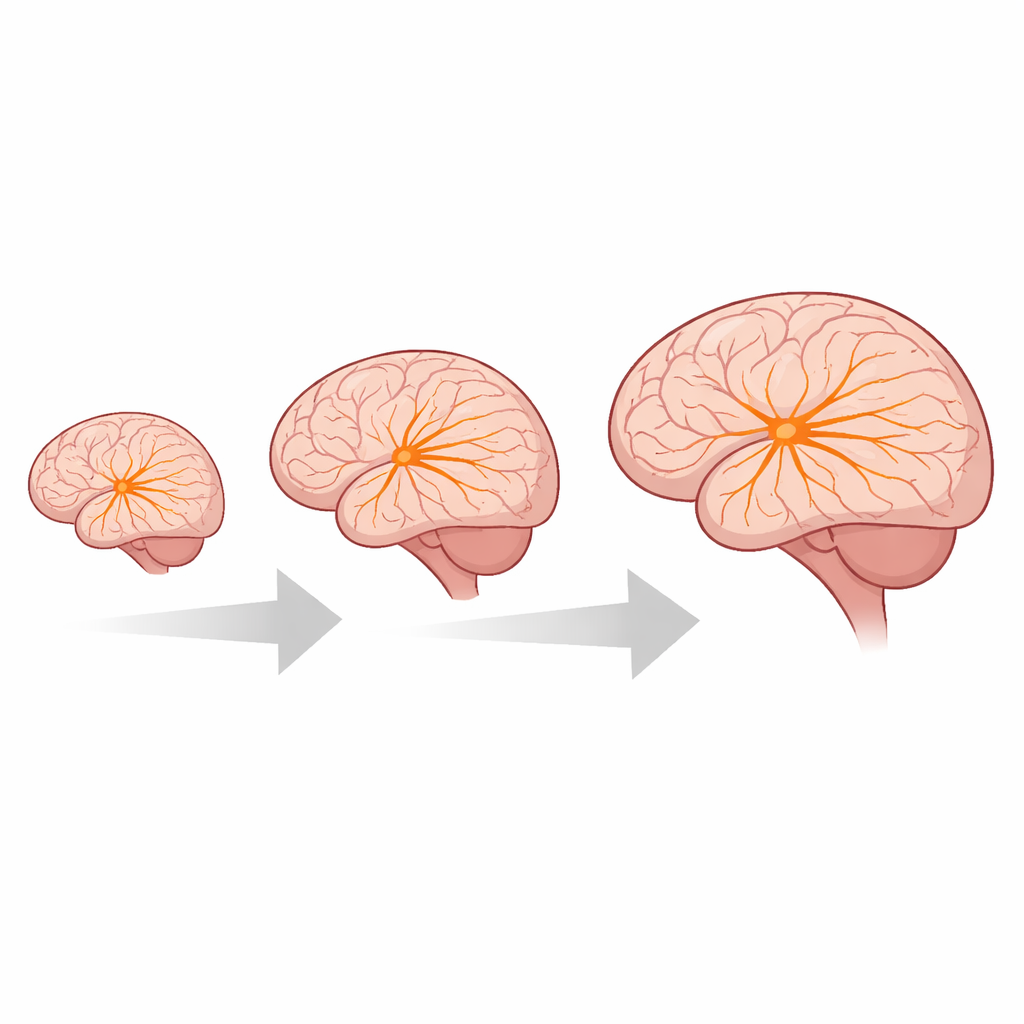
A small but mighty area in the mind’s map
The precuneus sits on the inner surface of the parietal lobe, near the top and back of the brain. It has been linked to imagining ourselves in space, recalling personal memories, daydreaming, and a sense of self. In adults, it is a central hub of the brain’s “default mode network,” a set of regions that become active when we are inwardly focused rather than engaged with the outside world. Because of its importance and its late evolutionary expansion in humans, scientists are keen to understand when its internal layout is established and how its connections mature from newborns to teenagers.
Dividing the precuneus into working zones
The researchers used advanced MRI scans from healthy newborns, 1‑year‑olds, 2‑year‑olds, and early adolescents. They traced how each tiny point in the precuneus connects, via white‑matter pathways, to the rest of the brain. Points with similar connection patterns were grouped together, revealing four distinct subregions in both the left and right precuneus. Two sit higher (dorsal) and two lower (ventral), and this four‑part layout was remarkably consistent at all ages. Even though the brain as a whole is still maturing rapidly in infancy, the basic map of precuneus subregions appears to be in place around birth and remains stable in size throughout early development.
From local chatter to long‑distance conversations
Stability in structure does not mean stability in function. Using resting‑state functional MRI—measuring how activity naturally rises and falls together across regions—the team examined what each precuneus subregion “talks” to at different ages. In newborns, all four subregions mostly communicate with nearby parietal areas, suggesting a focus on local processing. By 1 year of age, long‑range links begin to appear, especially from a ventral posterior subregion that strongly couples with core default‑mode areas such as the medial prefrontal cortex and the inferior parietal lobule. These connections strengthen in distinct waves: ties to a nearby parietal region increase sharply around 1 year, while connections to frontal default‑mode areas rise around 2 years and remain robust into adolescence. Another, more front‑facing dorsal subregion gradually builds stronger connections with the cerebellum, a structure traditionally tied to movement but increasingly recognized for its role in planning, emotion, and higher thought. Here, the cortico‑cerebellar links become notably stronger only by early adolescence, hinting that structural growth in the cerebellum precedes full functional engagement.
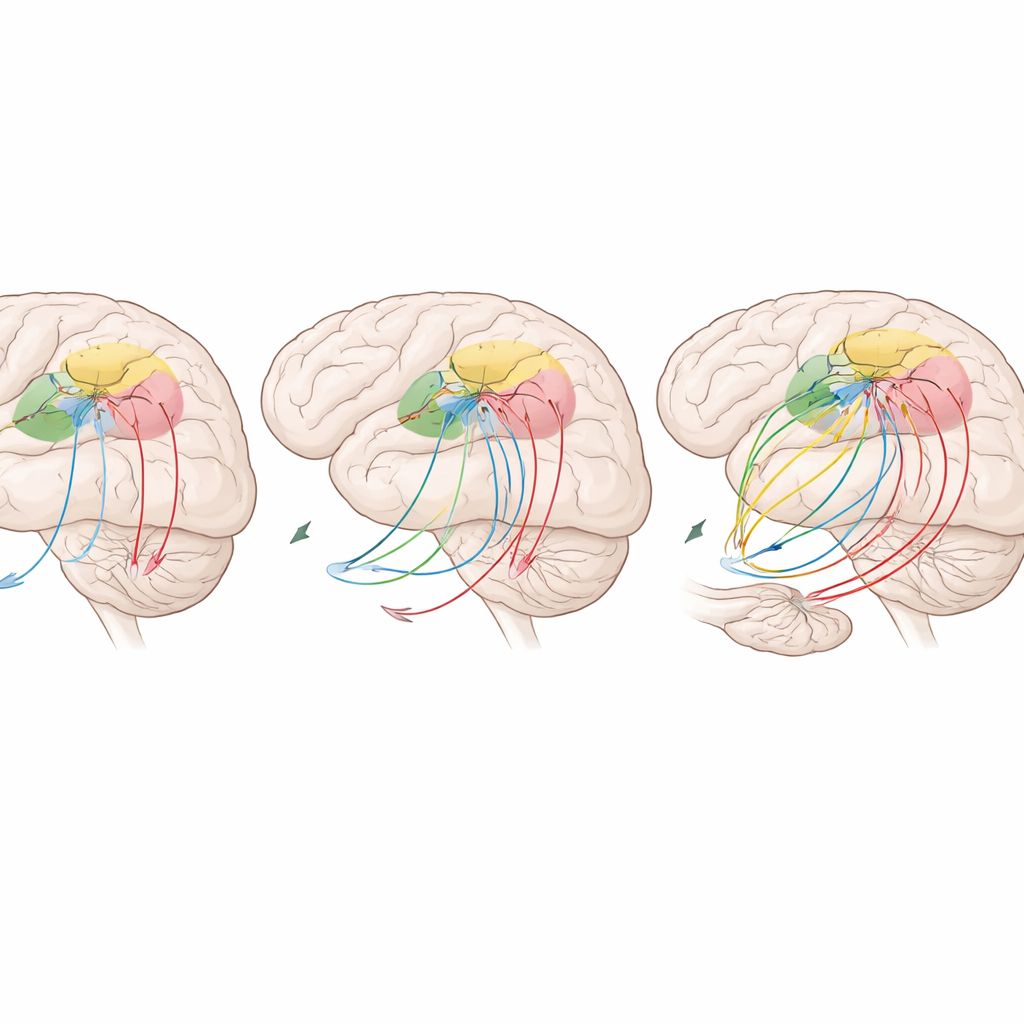
What changes in autism—and what stays the same
To explore atypical development, the researchers applied the same structural approach to a small group of preschool‑aged children with autism spectrum disorder. Strikingly, their precuneus could still be divided into four subregions arranged much like those of typically developing children, suggesting that the basic internal blueprint remains intact. However, one key difference emerged: the dorsal posterior subregion on the left side was relatively smaller in volume. This area is normally tied to visual imagery and memory‑related functions. Earlier work has shown altered connectivity of the precuneus in autism and difficulties with episodic memory and imagining events. The reduced size of this specific subregion may be one structural sign of those broader challenges.
What this means for understanding growing minds
Taken together, the findings suggest that the precuneus is laid out like a four‑room house from the very beginning of life, but the wiring between rooms and with the rest of the brain is gradually upgraded over many years. Some connections within the default mode network organize rapidly in the first two years, while links to the cerebellum mature later, into adolescence. In autism, the basic floor plan is preserved, but one room—the dorsal posterior subregion—appears undersized, which may contribute to differences in memory and inner mental imagery. By charting both typical and atypical growth of this crucial hub, the study provides a clearer framework for probing how early brain wiring supports the emergence of complex thought and how subtle deviations might lead to neurodevelopmental disorders.
Citation: Wang, J., Peng, Q., Ouyang, M. et al. Functional changes of precuneus architecture across newborns, infants, and early adolescents. Sci Rep 16, 11094 (2026). https://doi.org/10.1038/s41598-026-40813-y
Keywords: precuneus development, default mode network, infant brain, cerebellum connectivity, autism spectrum disorder