Clear Sky Science · en
Thermomechanical load in a nonlocal rotating magneto-thermoelastic orthotropic material with Green Naghdi-III model
Why heating and spinning materials matters
Modern technologies—from jet engines and spacecraft to tiny sensors and medical implants—often push materials into extreme conditions. They may be heated suddenly, spun at high speed, and exposed to strong magnetic fields, all at scales where the material’s internal structure starts to matter. This study asks a deceptively simple question: how do such materials actually deform and heat up when all these effects act together? Answering it can help engineers design components that stay safe and reliable instead of cracking or warping under stress.
A special kind of solid under harsh conditions
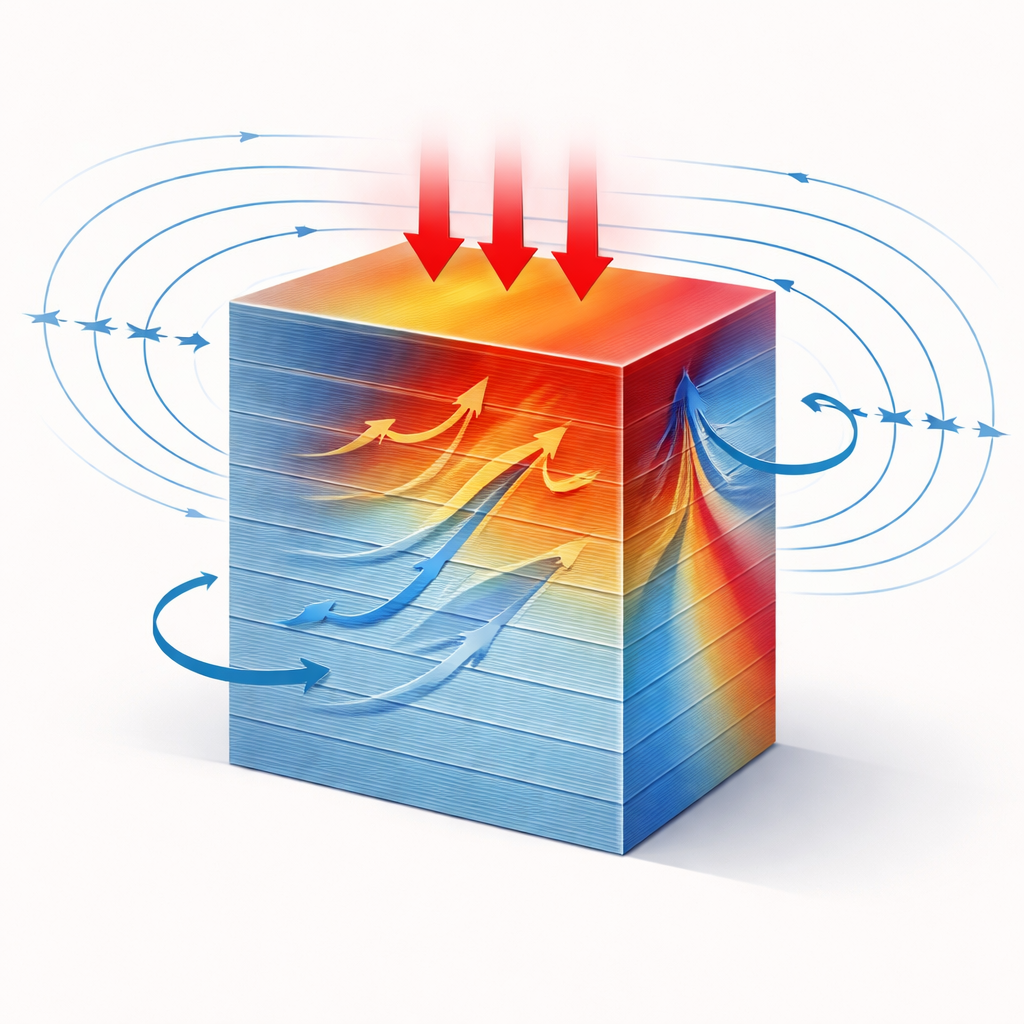
The work focuses on a class of solids called orthotropic materials, whose stiffness and heat conduction differ along three preferred directions—much like wood is stronger along the grain than across it. The authors imagine an idealized half-space made of such a material, extending deep below a flat surface. This solid is allowed to rotate as a whole, is threaded by a magnetic field, and is suddenly exposed to a time-dependent heat input at its free surface. Together, these ingredients mimic situations found in aerospace structures, rotating machinery, geophysical layers, and advanced devices where temperature, motion, and magnetism interact.
Looking beyond local behavior
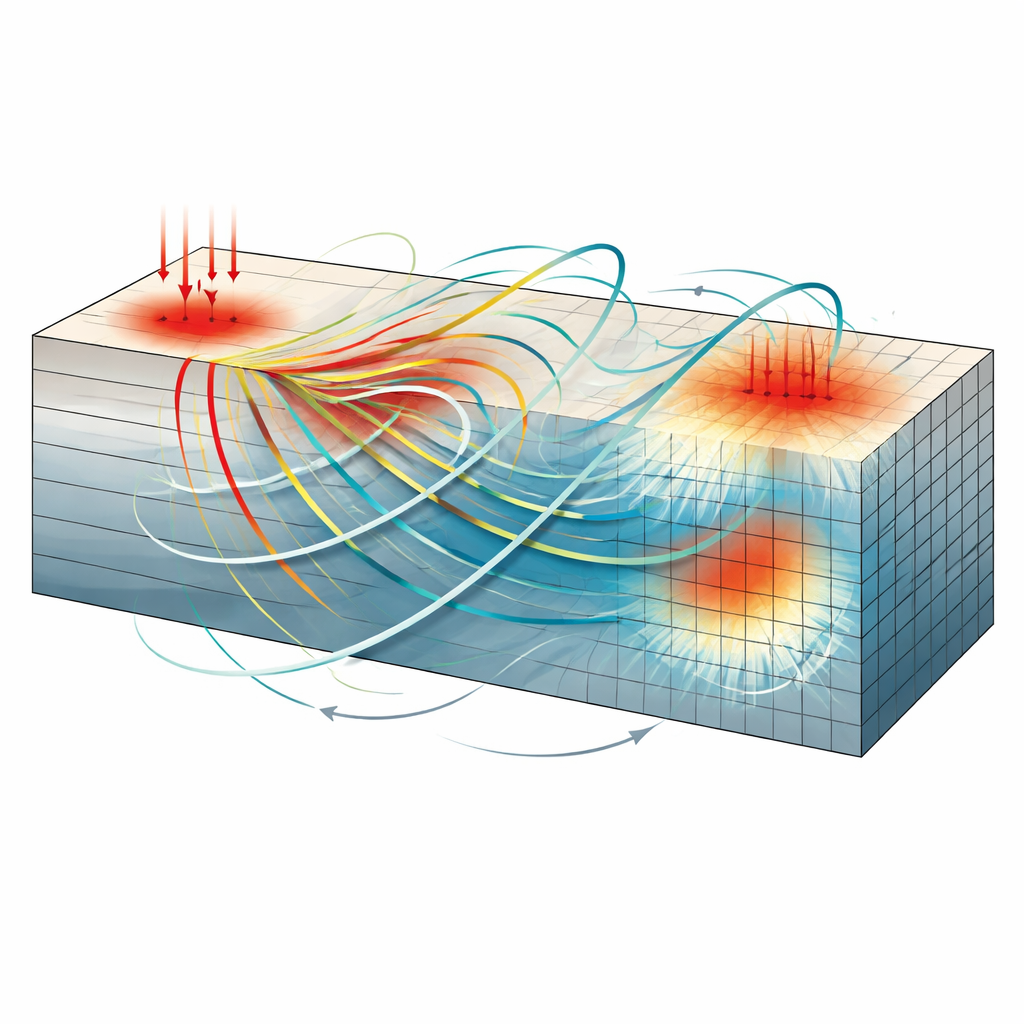
Traditional theories assume that stress and heat at a point depend only on what happens right there. At very small scales, however, atoms and microstructures communicate over longer distances, so nearby regions influence each other. The paper incorporates this “nonlocal” behavior using a theory that lets the response at one point depend on a neighborhood around it. At the same time, the authors use an advanced thermoelastic framework (the Green–Naghdi Type III model) that treats heat as travelling in waves with finite speed, rather than diffusing instantly throughout the material. This combination allows them to study how waves of temperature and deformation move together through an anisotropic, rotating, magnetized solid.
Solving the wave puzzle
To untangle this multi‑effect problem, the researchers turn to analytical methods. They express displacements, stresses, and temperature as wave-like modes that vary in space and time, and then apply an eigenvalue technique to derive exact formulas for how these quantities evolve beneath the heated surface. After rewriting the governing equations in a dimensionless form, they solve them and reconstruct the full fields of temperature, motion, and internal forces. To explore realistic behavior, they feed in material data for cobalt and use computer simulations to plot how each quantity changes with depth, time, and the strength of rotation, magnetic field, and nonlocal effects.
What time, scale, spin, and magnetism do
The results show that all the main physical quantities—temperature, displacements in both directions, and the different stress components—grow in magnitude as time progresses after the heat is applied, then gradually decay with depth, returning to equilibrium far from the surface. Increasing the nonlocal parameter, which strengthens long‑range interactions, enhances these responses and alters their oscillatory patterns, especially near the surface where gradients are large. Rotation amplifies the stresses and displacements and makes the mechanical waves more sensitive to the spinning motion, revealing how gyroscopic effects reshape the traveling wave fronts. Likewise, a stronger magnetic field intensifies the normal and shear stresses and increases the deformation, reflecting the added influence of electromagnetic forces on the moving, conducting solid.
Big-picture takeaway for real-world designs
In everyday terms, the study shows that when a directionally structured solid is heated suddenly while spinning in a magnetic field, its internal response is neither simple nor purely local. Heat and mechanical waves travel together, are modified by long‑range interactions inside the material, and are boosted by both rotation and magnetism. The authors demonstrate that a carefully constructed mathematical model can capture these intertwined effects and still yield exact solutions. Such models help engineers predict where stresses will concentrate, how far thermal disturbances will penetrate, and how design choices—like rotation speed, magnetic field strength, or microstructural length scales—will affect performance. This understanding is crucial for building safer, more efficient components in fields ranging from geophysics and earthquake engineering to aerospace and advanced biomedical devices.
Citation: Salah, D.M., Abd-Alla, A.M., El-Kabeir, S.M.M. et al. Thermomechanical load in a nonlocal rotating magneto-thermoelastic orthotropic material with Green Naghdi-III model. Sci Rep 16, 12047 (2026). https://doi.org/10.1038/s41598-026-40500-y
Keywords: thermoelastic waves, rotating solids, magnetoelastic materials, nonlocal effects, orthotropic media