Clear Sky Science · en
Association between castration-induced changes in circadian body temperature rhythms and gut microbiome diversity in goats
Why farmers and animal lovers should care
Castration is widely used in livestock to make animals easier to handle and to improve meat quality, but it also quietly reshapes the animals’ bodies in ways we are only beginning to understand. This study followed young male goats through castration and tracked two hidden but powerful systems at once: their daily cycles of body temperature and the bustling community of microbes living in their intestines. By linking these two, the work offers clues about how a routine farm procedure might ripple through animal health, comfort, and productivity.
Daily heat cycles inside a goat
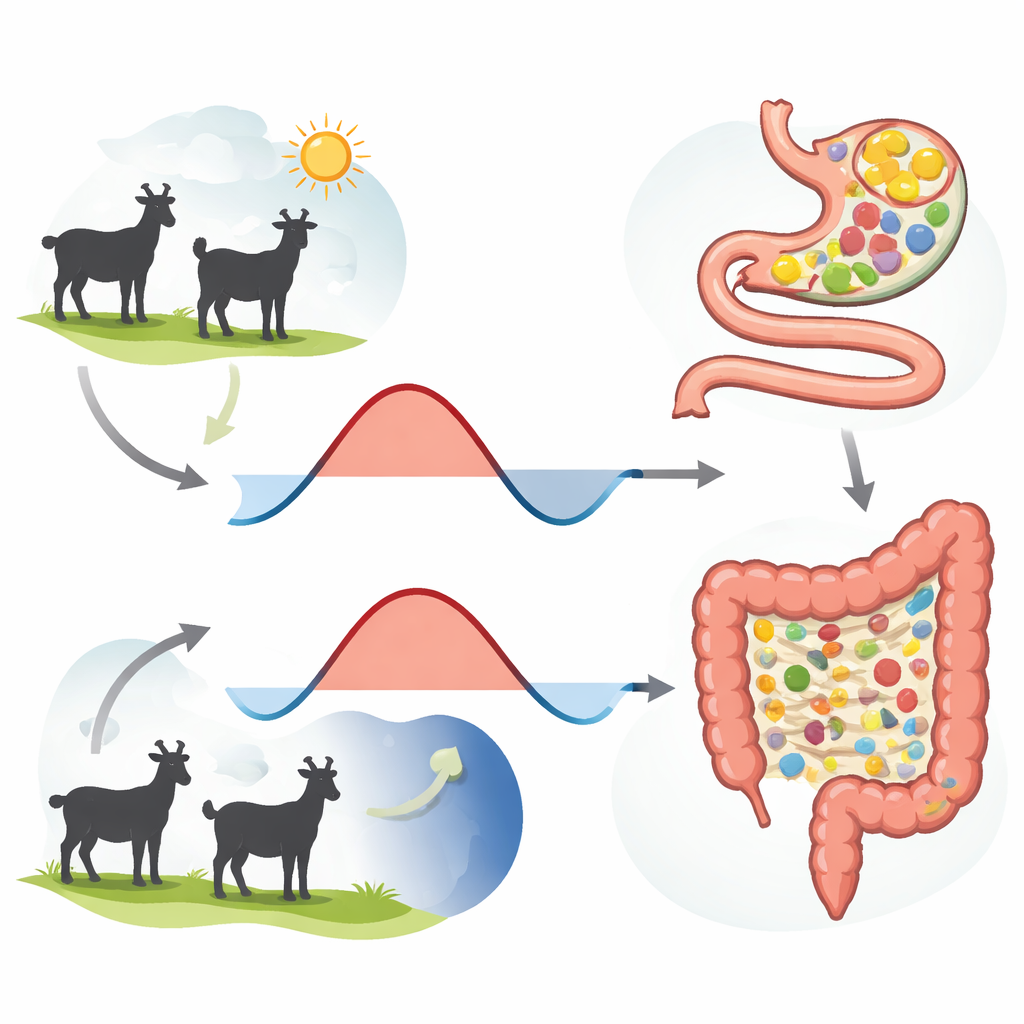
Like people, goats run on an internal clock. One of the clearest signs of this clock is the rise and fall of body temperature over each 24-hour day. The researchers implanted tiny temperature loggers in six male Shiba goats and recorded abdominal temperature every five minutes. They split the goats into two groups: those castrated before puberty and those castrated after puberty. Using mathematical models that fit smooth waves to the data, they showed that castration did not just lower a hormone—testosterone—it also changed how strongly body temperature rose and fell each day and when the daily peak occurred. These shifts were especially marked in goats castrated after puberty, suggesting that sex hormones help stabilize daily temperature rhythms once they are fully active.
A hidden world of gut microbes
The team also sampled the contents of the small intestine and colon before and after castration, then used DNA sequencing to catalog the bacteria present. Overall diversity—the number and balance of different species—did not collapse, which suggests the gut ecosystem remained robust. However, the makeup of the bacterial community in the colon did change. Some groups became more common, others less so, and the pattern depended on whether goats were castrated early or late. The small intestine was more stable, showing only modest reshuffling. These region‑specific responses fit with what is known about the gut: the colon hosts dense microbial communities that are particularly sensitive to changes in diet, hormones, and the animal’s internal environment.
Links between heat rhythms and gut communities
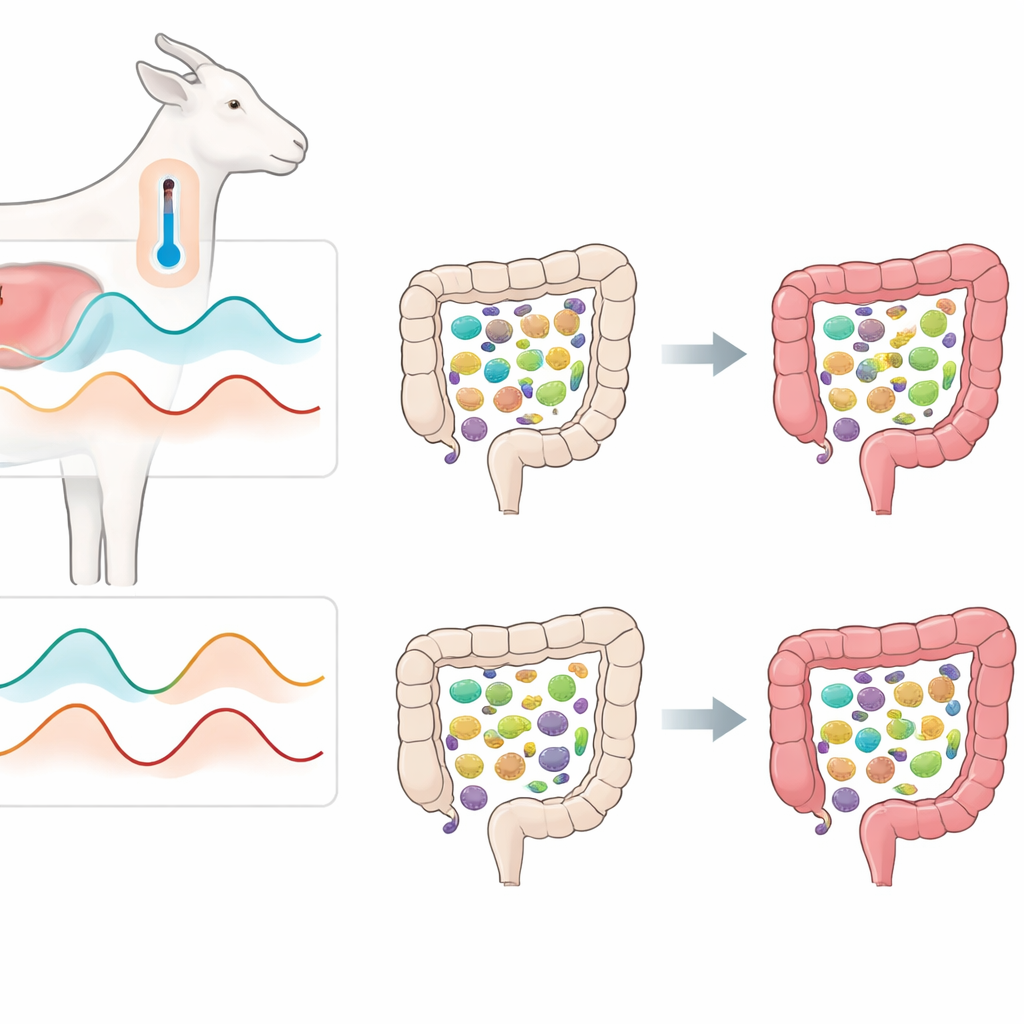
To see whether temperature cycles and microbes were moving together, the researchers compared how much each goat’s temperature rhythm changed with how much its gut community shifted. In the colon, goats whose average temperature level or the size of their daily swings changed more tended to show larger changes in microbial composition, hinting at a connection between thermal rhythms and the bacteria that thrive there. In the small intestine, the timing of the daily temperature peak was more closely tied to microbial differences than the overall level of warmth. While the sample was small, these patterns point to a coordinated dance between an animal’s internal clock and its gut residents.
Microbial shifts that may favor gut health
Castration was also associated with a tilt in the colon’s bacteria toward groups known, in other animals, to produce short‑chain fatty acids—small molecules that feed the gut lining and help keep inflammation in check. At the same time, some bacteria from families that include opportunistic pathogens declined. This trend was strongest in goats castrated after puberty, which showed striking gains in several short‑chain‑fatty‑acid‑producing groups alongside drops in bacteria such as Escherichia and Campylobacter. Although the study did not directly measure these beneficial molecules, the pattern suggests that changing hormone levels and temperature rhythms might nudge the gut toward a more protective, energy‑efficient state.
What this means for animal care
Altogether, the study suggests that castration in goats does more than affect behavior and meat traits: it reshapes the animals’ daily temperature patterns and, in turn, is linked with region‑specific shifts in their gut microbes, especially in the colon. Because the work involved only six animals and no never‑castrated controls, the authors stress that the findings are exploratory, not proof of cause and effect. Even so, the results raise the possibility that simple continuous temperature tracking could serve as a non‑invasive window into both welfare and internal microbial balance in livestock. Understanding how timing of castration and other management choices interact with the body’s clock and the gut microbiome could ultimately help farmers keep animals healthier, more comfortable, and more productive.
Citation: Matsufuji, I., Kitagawa, Y., Ohkura, S. et al. Association between castration-induced changes in circadian body temperature rhythms and gut microbiome diversity in goats. Sci Rep 16, 10058 (2026). https://doi.org/10.1038/s41598-026-40455-0
Keywords: goat castration, circadian body temperature, gut microbiome, livestock welfare, intestinal bacteria