Clear Sky Science · en
Coronary artery bypass grafting versus percutaneous coronary intervention for patients with multivessel coronary artery disease and advanced heart failure
Why this matters for people with weak hearts
When several arteries that feed the heart are badly clogged, the heart muscle can weaken so much that everyday tasks feel exhausting and the risk of dying rises sharply. Doctors can try to restore blood flow either with open-heart bypass surgery or with less invasive stents threaded in through an artery. This study followed hundreds of real-world patients with advanced heart weakness to see how these two strategies compare over six years, shedding light on trade-offs that many families and their doctors now face.
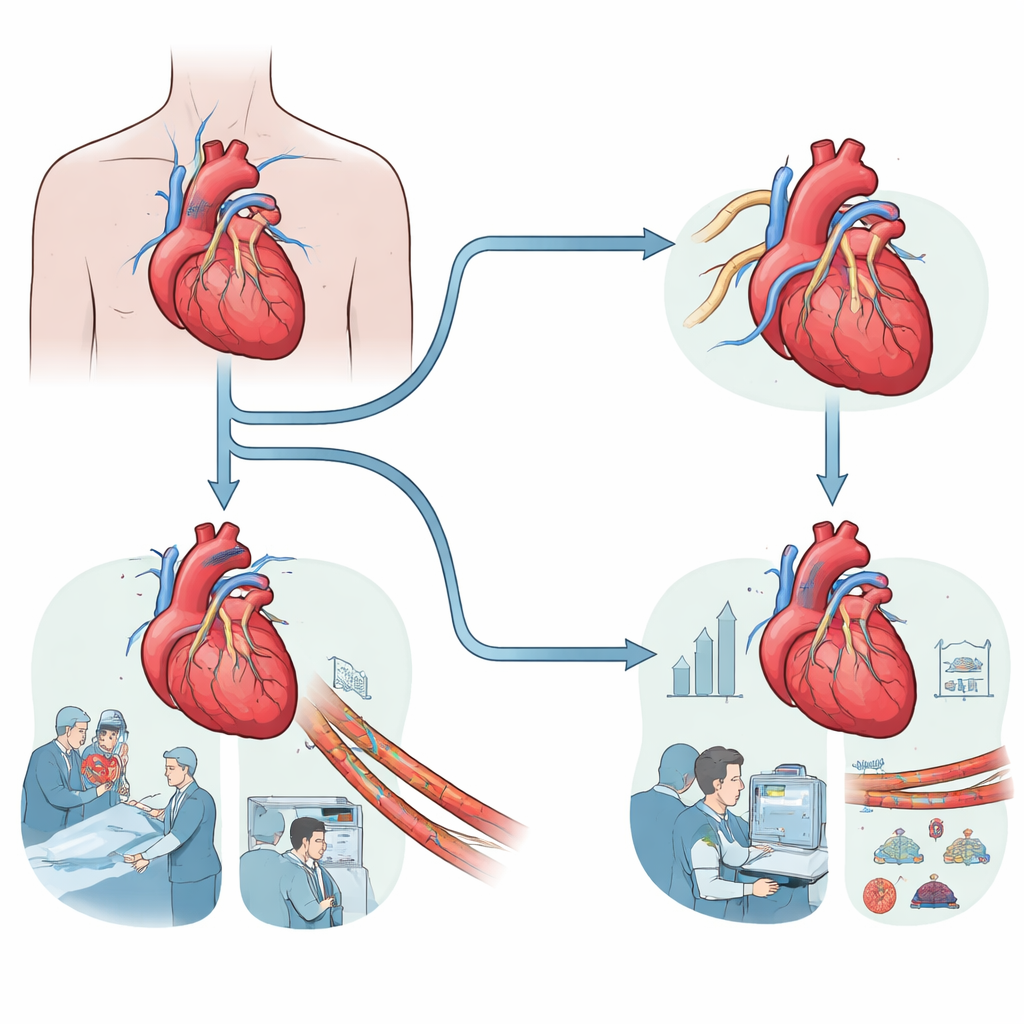
Two main ways to restore blood flow
The research focused on people whose heart pumping power had dropped to about one-third of normal and who had blockages in several heart arteries. All 586 patients were reviewed by a multidisciplinary “Heart Team” of cardiologists and surgeons, who decided whether each person would receive coronary artery bypass grafting (CABG) or percutaneous coronary intervention (PCI), the technical name for stent procedures. About one third underwent bypass surgery and two thirds received stents, and all continued to receive modern heart medicines. The team then tracked who died, was hospitalized for worsening heart failure, had a heart attack, stroke, or needed another procedure over roughly six years.
Big picture outcomes: more similarities than differences
From a layperson’s perspective, the headline result is that overall survival and serious heart failure hospitalizations were broadly similar between the two groups. Roughly six in ten patients in both groups either died or were hospitalized for heart failure during the six-year period, and the difference between CABG and PCI was not statistically clear. When the researchers adjusted for how sick patients were at the start, including how weak their hearts were and how complex their artery disease looked, the risk of death alone remained essentially the same with either approach.
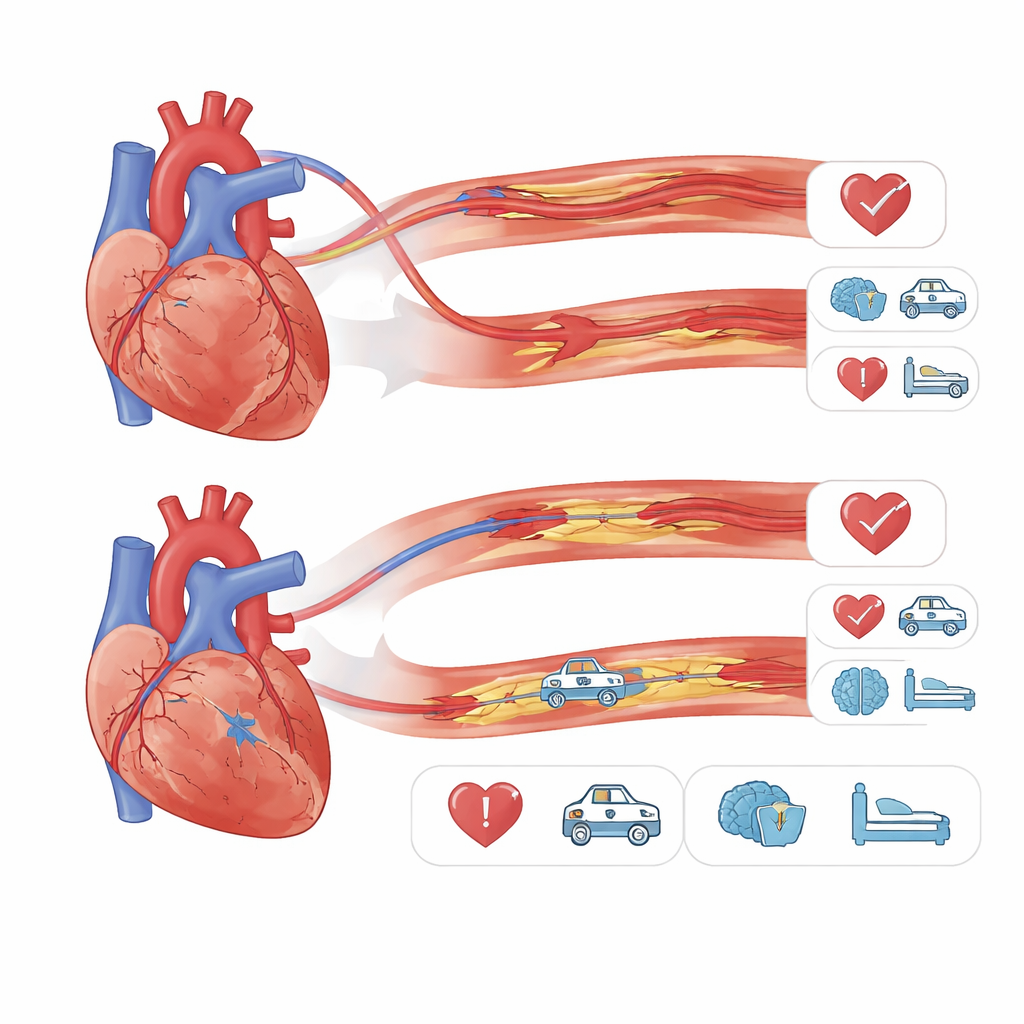
Different risks: strokes, repeat procedures, and recovery
Although the chance of being alive years later was comparable, the pattern of complications differed in ways that matter to patients. People who received stents had more heart attacks and were about twice as likely to need another unplanned procedure to re-open arteries. In contrast, those who had bypass surgery spent much longer in the hospital after their operation and had a higher rate of strokes around the time of treatment. Early in-hospital death was also somewhat more frequent after surgery, reflecting the strain of a major operation on an already weakened heart, even though this difference did not quite reach statistical certainty.
Who might do better with which treatment
The study also explored whether certain types of patients fared better with one option over the other. Frail patients—those with low physical reserve—seemed to have worse outcomes if they underwent bypass surgery, suggesting that the invasiveness of open-heart surgery can be especially hard on them. Patients whose artery disease was of intermediate complexity appeared to do somewhat worse with PCI, hinting that surgery may better stabilize the blood supply in these more challenging cases. However, these subgroup findings were not strong enough to be definitive and were viewed as a starting point for future research rather than final answers.
What this means for treatment choices
For someone living with severely weakened heart muscle and multiple clogged heart arteries, this study suggests that both stents and bypass surgery can offer similar chances of long-term survival, but with different trade-offs. Surgery tends to provide more durable blood flow and fewer future heart attacks or repeat procedures, at the cost of higher short-term risk, more strokes, and longer recovery. Stent procedures are gentler in the short run and carry less stroke risk, but may lead to more heart attacks and additional interventions later. Because patients in this situation often have many other health problems, the authors conclude that the best choice is rarely one-size-fits-all. Instead, a careful Heart Team discussion that weighs anatomy, overall health, frailty, and personal preferences is essential until larger randomized trials can give more definitive guidance.
Citation: Jonik, S., Gumiężna, K., Kochman, J. et al. Coronary artery bypass grafting versus percutaneous coronary intervention for patients with multivessel coronary artery disease and advanced heart failure. Sci Rep 16, 9963 (2026). https://doi.org/10.1038/s41598-026-40168-4
Keywords: coronary artery disease, heart failure, bypass surgery, stent procedure, revascularization