Clear Sky Science · en
Within-cohort associations between corneal epithelial remodeling and anterior corneal higher-order aberrations after FS-LASIK and KLEx (SMILE): a two-cohort descriptive study
Why eye surgery patients should care
Laser eye surgeries like FS‑LASIK and SMILE promise life without glasses, yet some people still notice glare, halos, or hazy night vision afterward. This study asks a simple but important question: as the clear surface of the eye heals and subtly reshapes itself after surgery, does that quiet remodeling help or harm the sharpness and comfort of what we see?
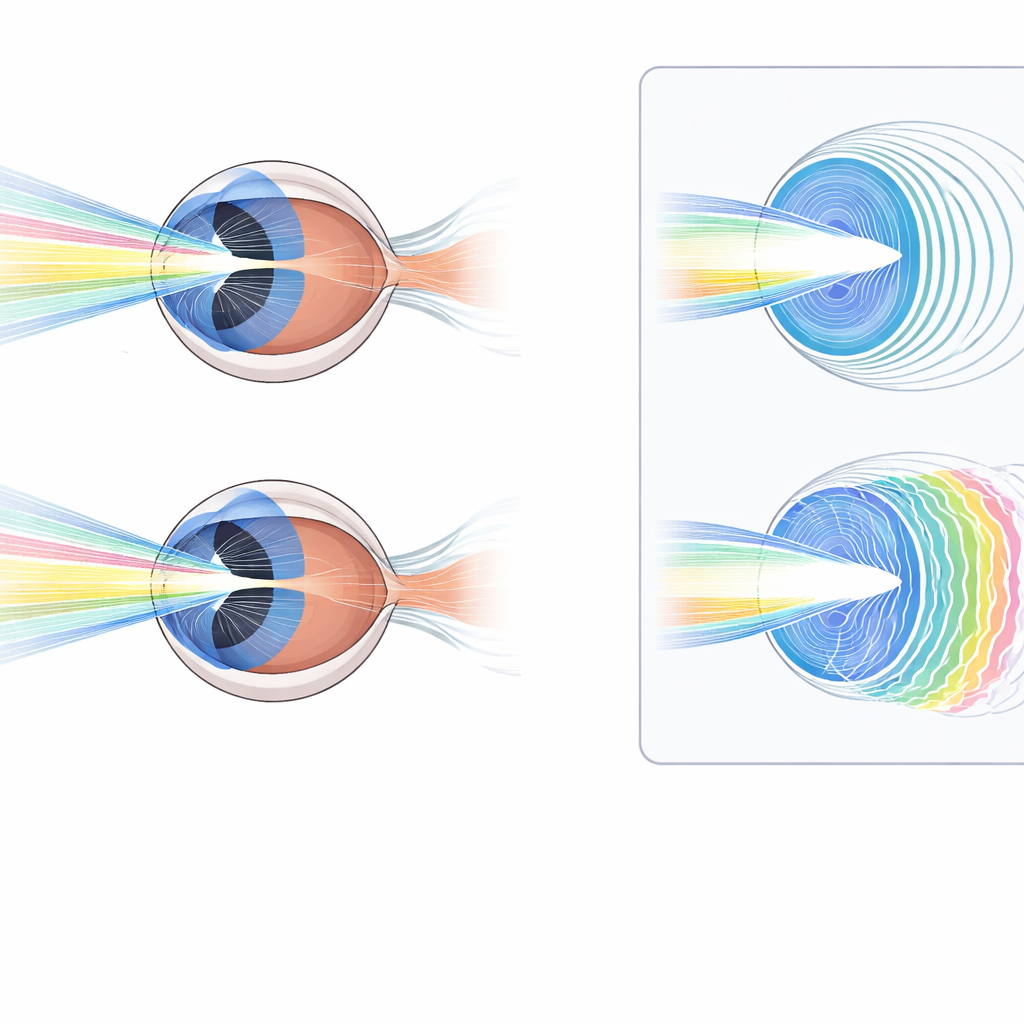
Two modern paths to sharper vision
The researchers focused on two popular procedures for correcting nearsightedness. FS‑LASIK creates a thin flap on the front of the cornea, lifts it, and then reshapes the underlying tissue with a laser before replacing the flap. SMILE, by contrast, removes a small lens‑shaped piece of tissue through a tiny side opening, leaving the surface more intact. Neither operation directly cuts away the outermost living layer of the cornea—the epithelium—but earlier work has shown that this layer is anything but passive. Over weeks and months, it thickens and thins in different regions, as if trying to smooth out the new corneal shape.
Measuring tiny changes in a clear window
To capture these subtle shifts, the team followed 245 patients—138 treated with SMILE and 107 with FS‑LASIK—measuring only one eye per person. Using optical coherence tomography, a form of depth‑resolved imaging, they mapped epithelial thickness in the very center of the cornea, a doughnut‑shaped paracentral ring, and a slightly wider mid‑peripheral ring before surgery and again at one and three months. A separate device, the Pentacam, analyzed how smoothly light passed through the front surface of the cornea by calculating so‑called higher‑order aberrations: complex distortions beyond simple blur or astigmatism that are linked to glare, ghost images, and reduced night vision.
How the surface heals after different procedures
In both groups, the epithelium became thicker in the central and paracentral zones after surgery and stayed that way through three months, a clear sign of remodeling. SMILE eyes also showed thickening farther out in the mid‑peripheral region, while FS‑LASIK eyes did not. The thickening was not uniform across the cornea; instead it showed directional biases, likely influenced by surgical details, blinking, and eyelid pressure. At the same time, both types of surgery increased higher‑order aberrations compared with pre‑operative values, though the patterns differed. SMILE eyes showed consistent changes in certain “symmetric” distortions, such as spherical aberration, and in coma‑like distortions, while FS‑LASIK eyes showed more region‑to‑region variability over time.
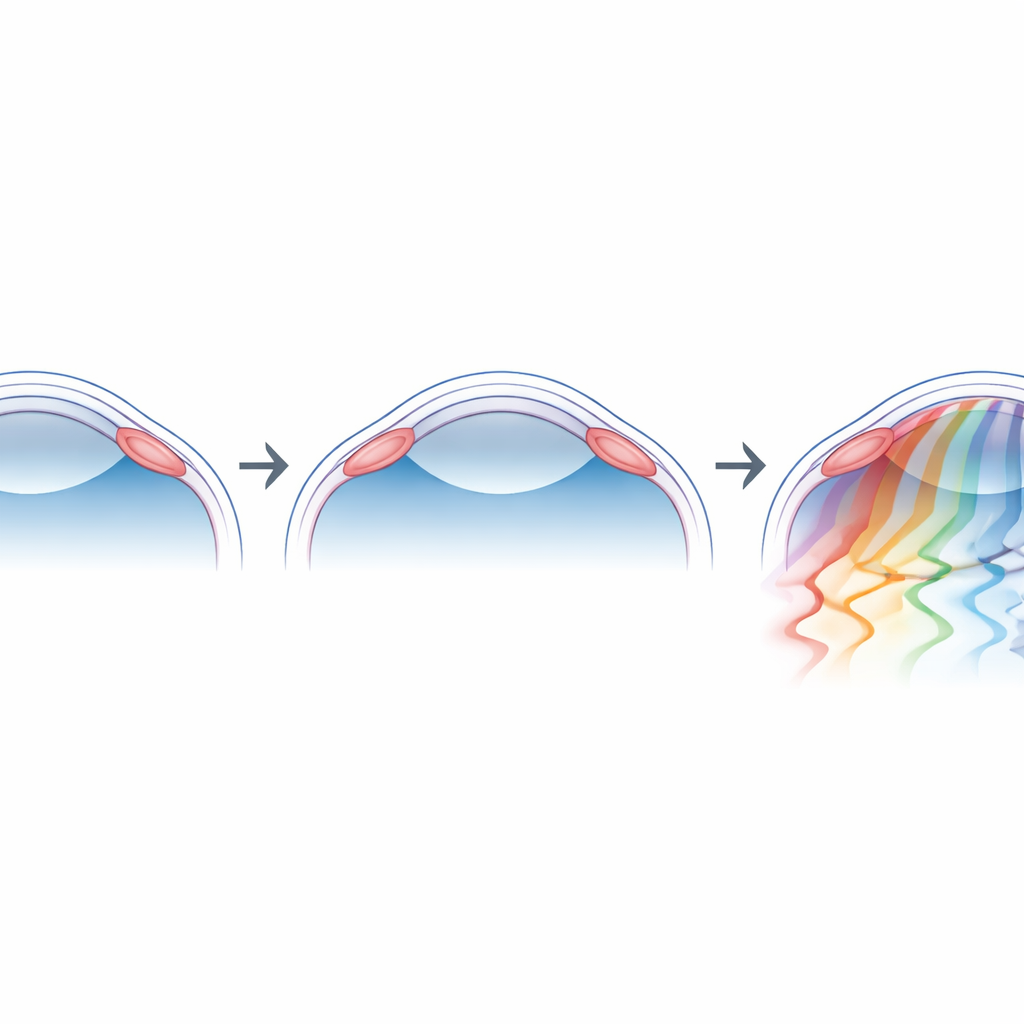
Linking surface reshaping to visual distortions
The core of the study was to see whether areas that thickened more strongly also showed bigger changes in optical distortions. Within the SMILE group, thicker epithelium—especially in the center and paracentral ring—went hand‑in‑hand with increases in spherical‑type aberrations and decreases in coma‑type terms. This suggests that as the surface layer grows and evens out, it may smooth some asymmetric irregularities even while it adds more symmetric forms of blur. In the FS‑LASIK group, the connections were weaker and depended on the region: central thickening correlated with more spherical aberration, but changes farther out sometimes pointed in the opposite direction, hinting at a more complex and uneven healing pattern after flap‑based surgery.
What this means for patients and surgeons
To a lay reader, the main takeaway is that the clear outer skin of the eye does not simply sit on top of the laser‑reshaped cornea; it actively remodels itself for months, subtly altering how light enters the eye. These changes are measurably tied to fine‑scale optical distortions that can affect night driving or comfort in bright lights. The study does not declare one procedure superior, because the two patient groups started with very different degrees of nearsightedness, which strongly influences healing. Instead, it offers a careful map of how the eye’s surface responds after each type of surgery and how that response relates to visual quality. In the long run, understanding and perhaps guiding this microscopic reshaping could help surgeons refine treatments, manage expectations, and design follow‑up care to preserve both clarity and comfort of vision.
Citation: Yang, X., Niu, J., Wu, H. et al. Within-cohort associations between corneal epithelial remodeling and anterior corneal higher-order aberrations after FS-LASIK and KLEx (SMILE): a two-cohort descriptive study. Sci Rep 16, 12656 (2026). https://doi.org/10.1038/s41598-026-40156-8
Keywords: laser eye surgery, SMILE, LASIK, corneal healing, night vision