Clear Sky Science · en
Development of a high-speed planetary gearbox for an electric vehicle
Smaller Gears, Longer Rides
Electric cars promise clean, quiet travel, but what happens between the spinning electric motor and the turning wheels still has a big impact on cost, driving range, and comfort. This study presents a new type of compact gearbox that sits between the motor and the wheels in an electric vehicle. By rethinking how the gears are arranged and which materials they are made from, the authors show a way to make the drive unit lighter, more efficient, and quieter—helping each battery charge take you farther. 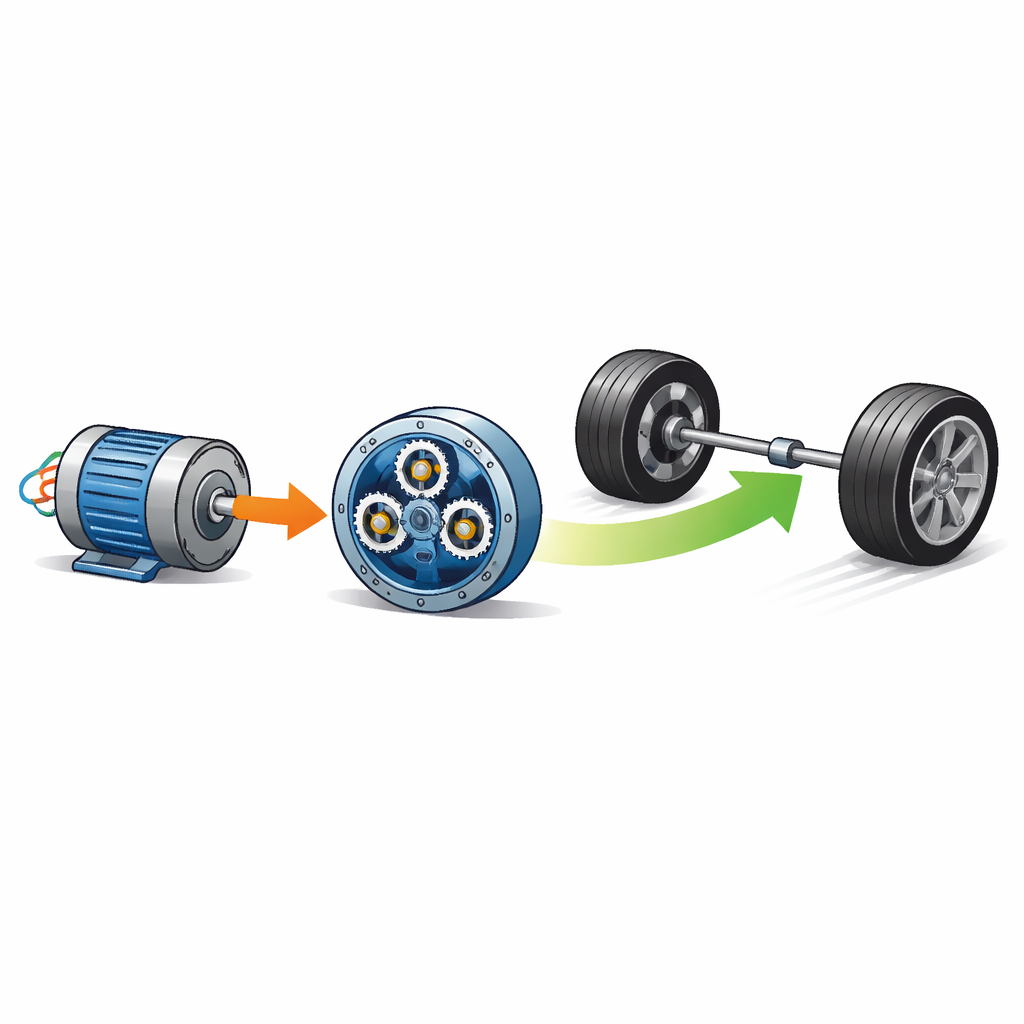
Why Electric Cars Still Need Gears
Unlike gasoline engines, electric motors can spin very fast while still delivering strong pulling power. Even so, they still require a gearbox to match the motor’s speed to the road. Most current electric cars use two-stage cylindrical gearboxes that provide the needed speed reduction but come with trade-offs: they are relatively bulky, lose more energy to friction, and place high stresses on gear teeth at high speeds. All of this adds weight, lowers efficiency, and can shorten the life of the drivetrain. With electric vehicles, every kilogram and every percent of efficiency matters, because they directly influence driving range and battery size.
A New Way to Arrange the Gears
The researchers tackled this problem by systematically exploring thousands of possible gearbox layouts using a design method called morphological analysis. Starting from basic building blocks—gearbox type, gear shape, number of stages, supports, lubrication, and more—they mapped roughly 9000 potential combinations. From this large design space, they selected a single-stage planetary gearbox with double-ring "satellite" gears as the most promising configuration for electric vehicles. In a planetary gearbox, smaller gears orbit a central gear inside a toothed ring, sharing the load between several contact points. In the proposed design, each orbiting gear is actually a rigid pair of gears mounted together, and all of them are supported in the center on a three-lobed carrier, which keeps the mechanism short in length while still handling high torque and speed.
How the Compact Design Works Inside
In the new gearbox, power from two high-speed electric motors—spinning up to 15,000 revolutions per minute—enters a central gear. Several paired gears orbit this center gear and also mesh with an outer ring gear, all connected through a stiff carrier that acts as the output to the wheels. By carefully choosing the number of teeth on each gear, the team achieved an overall speed reduction of about 9.8 in a single stage, comparable to what ordinary electric cars get from two stages. Because multiple satellites share the load and are supported in a central bearing arrangement, the design distributes forces more evenly, resists vibration, and reduces the length of the gearbox. A drip-air lubrication system sprays oil directly where the teeth meet, and heat-resistant seals keep everything contained even at very high speeds. 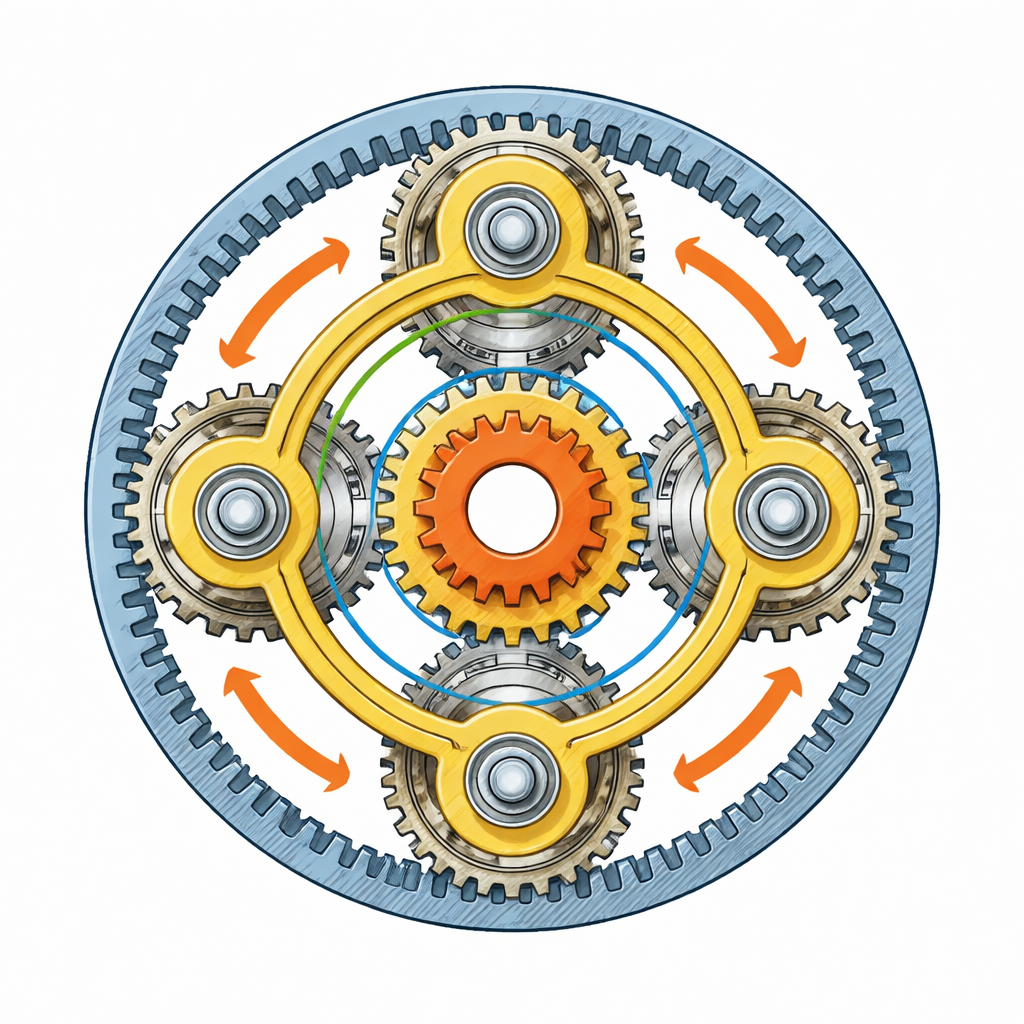
Smart Materials for Tough, Lightweight Parts
Beyond geometry, the authors focused on choosing gear materials that can handle intense contact pressures without being unnecessarily heavy or expensive. They favor alloy steels whose surfaces can be hardened for wear resistance while keeping the interior tough and resilient. By comparing different steel mixtures, they show that certain nickel-chromium-molybdenum steels offer a good balance between performance and cost, especially when combined with treatments like nitriding and careful grinding. High-precision bearings, lightweight polymer cages, and fluororubber seals further support high-speed operation. To predict how all these parts will age under heat, friction, and repeated loading, the team outlines a suite of mathematical models that track wear, fatigue, temperature changes, and internal damage, reducing the need for costly trial-and-error testing.
What This Means for Drivers and Designers
Analytical calculations suggest that the new planetary gearbox reaches an efficiency of about 97.8%, compared with around 96.8% for a typical two-stage cylindrical design. That one extra percentage point may sound small, but over many kilometers it can translate into a noticeable increase in driving range or allow for a slightly smaller battery. The gearbox is also more compact, lighter, and mechanically simpler, which can lower production costs and improve reliability and noise levels. While the current work is based on detailed calculations rather than full-scale road tests, the authors outline plans for future prototypes and stress and vibration studies. If confirmed in practice, this design could help make electric cars—and potentially robots, aircraft actuators, and other machines—more efficient, durable, and pleasant to use.
Citation: Zagirnyak, M., Drahobetskyi, V., Salenko, Y. et al. Development of a high-speed planetary gearbox for an electric vehicle. Sci Rep 16, 11416 (2026). https://doi.org/10.1038/s41598-026-40022-7
Keywords: electric vehicle drivetrain, planetary gearbox, high efficiency transmission, lightweight powertrain, gear durability modeling