Clear Sky Science · en
SBA-15-supported copper(II)–2-hydrazinopyridine complex as an efficient reusable catalyst for the selective monoarylation of ammonia
Turning Simple Ingredients into Valuable Building Blocks
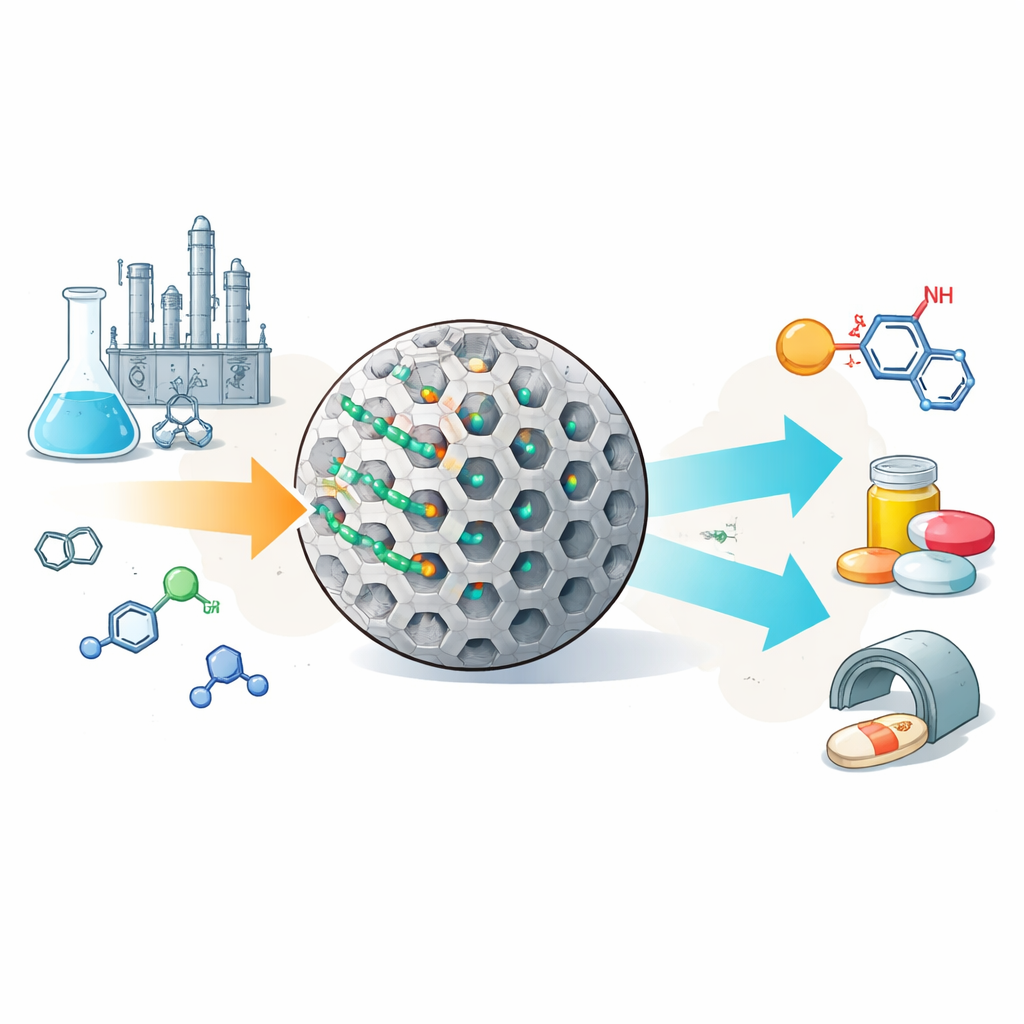
Chemists rely on small nitrogen‑containing molecules, such as anilines, to build medicines, dyes, and advanced materials. Making these compounds efficiently and sustainably is a long‑standing challenge, especially when starting from ammonia, a cheap and abundant source of nitrogen. This study presents a new solid copper‑based catalyst that can repeatedly turn simple ring‑shaped molecules called aryl halides and ammonia into valuable anilines, offering a promising path away from expensive precious‑metal catalysts.
A Solid Helper for Cleaner Chemistry
The heart of the work is a carefully engineered solid material named SBA‑15@bis(Py‑2‑NHNH2)‑Cu(II). At its core is SBA‑15, a type of silica (similar to glass) that is full of long, uniform nano‑sized channels. These channels provide a high surface area, like an extremely fine sponge, on which the active copper sites are anchored. The researchers first decorated the channel walls with organic linkers containing nitrogen atoms, then attached copper ions to these linkers. The design keeps the copper firmly in place while leaving enough open space for reacting molecules to move in and out of the pores.
Proving the Structure and Stability
To confirm that the catalyst was built as planned, the team used a suite of physical techniques more familiar to materials scientists than to synthetic chemists. Infrared and solid‑state nuclear magnetic resonance measurements showed that the organic linkers were successfully attached to the silica surface. Thermal analysis revealed that the material stays stable to high temperatures, while gas‑adsorption tests showed that, although the pores became smaller and fewer after modification, they remained open and well defined. Electron microscopy images confirmed that the ordered tubular architecture of SBA‑15 survived the chemical treatments, and X‑ray photoelectron studies demonstrated that copper was present in the desired oxidation state and directly interacting with the nitrogen atoms of the linker.
From Ammonia to Anilines Under Mild Conditions
With the structure established, the researchers explored how well the catalyst could promote the key reaction: joining ammonia to aromatic rings to form primary aryl amines (anilines). They systematically varied the solvent, base, temperature, ammonia strength, and catalyst amount using a model starting material, p‑bromotoluene. Dimethyl sulfoxide (DMSO) emerged as the best solvent, while sodium acetate provided the right balance of basicity to drive the reaction without causing side processes. Under optimized conditions—moderate catalyst loading, concentrated ammonia in DMSO, and a temperature of 120 °C—the reaction produced the desired aniline in high yield.
Broad Reach Across Different Starting Materials
Once the best conditions were set, the team tested a series of aryl halides with different substituents and leaving groups. Overall, the catalyst worked well with a wide range of substrates, following the expected reactivity order in which iodides react more easily than bromides, and bromides more easily than chlorides. Rings bearing electron‑withdrawing groups tended to give higher yields than those with electron‑donating groups. Some molecules carrying hydroxyl groups reacted more sluggishly, likely because these groups can bind directly to the copper sites and temporarily block them. Even heteroaromatic rings such as bromopyridine were successfully converted, underscoring the versatility of the system.
A Durable and Truly Reusable System
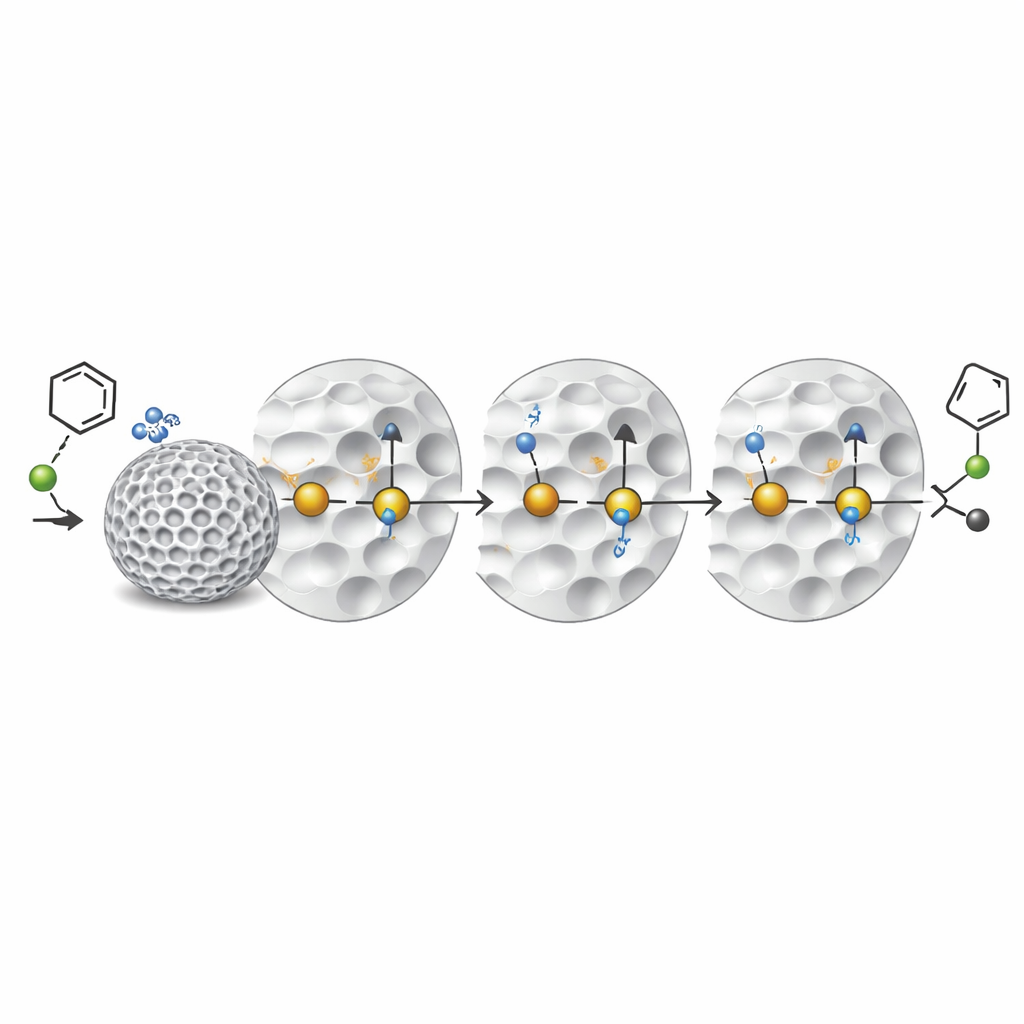
One of the most important tests for any solid catalyst is whether it can be used repeatedly without falling apart or leaching metal into the product. The SBA‑15‑supported copper catalyst passed this test convincingly. It could be recovered by simple centrifugation and reused at least five times with only a slight drop in yield. Measurements of copper content in the liquid after reaction showed extremely low metal loss, and a “hot filtration” experiment confirmed that the liquid alone, once the solid was removed, barely continued to react. Follow‑up structural analyses, including infrared spectra, microscopy, and elemental mapping, showed that both the silica framework and the copper sites remained intact after use.
What This Means for Future Synthesis
In everyday terms, the researchers have created a sturdy, reusable “factory surface” that efficiently couples ammonia to aromatic building blocks, delivering valuable anilines without relying on costly precious metals. By immobilizing copper inside the ordered pores of SBA‑15 and demonstrating that it stays put over many cycles, the study points toward greener and more economical routes for making key ingredients in pharmaceuticals, agrochemicals, and specialty materials. This catalyst design illustrates how smart support structures and carefully chosen linkers can turn common metals into powerful, sustainable tools for modern organic synthesis.
Citation: Ghahramani, F., Mansoori, Y., Akinay, Y. et al. SBA-15-supported copper(II)–2-hydrazinopyridine complex as an efficient reusable catalyst for the selective monoarylation of ammonia. Sci Rep 16, 11167 (2026). https://doi.org/10.1038/s41598-026-39959-6
Keywords: heterogeneous catalysis, ammonia amination, copper catalyst, mesoporous silica, aniline synthesis