Clear Sky Science · en
Separation of large droplets from an oil-in-water emulsion using a deterministic lateral displacement (DLD) microfluidic chip
Why tiny oil droplets matter
From salad dressings and skin creams to drug delivery systems, many everyday products depend on tiny droplets of oil floating in water. If some droplets are much bigger than others, they tend to merge and rise or separate, turning smooth creams grainy and shortening shelf life. This study explores a gentle way to remove those troublemaking large droplets using a small plastic chip with microscopic structures, aiming to make more stable, uniform emulsions without extra chemicals.
Making smoother mixtures by removing the big ones
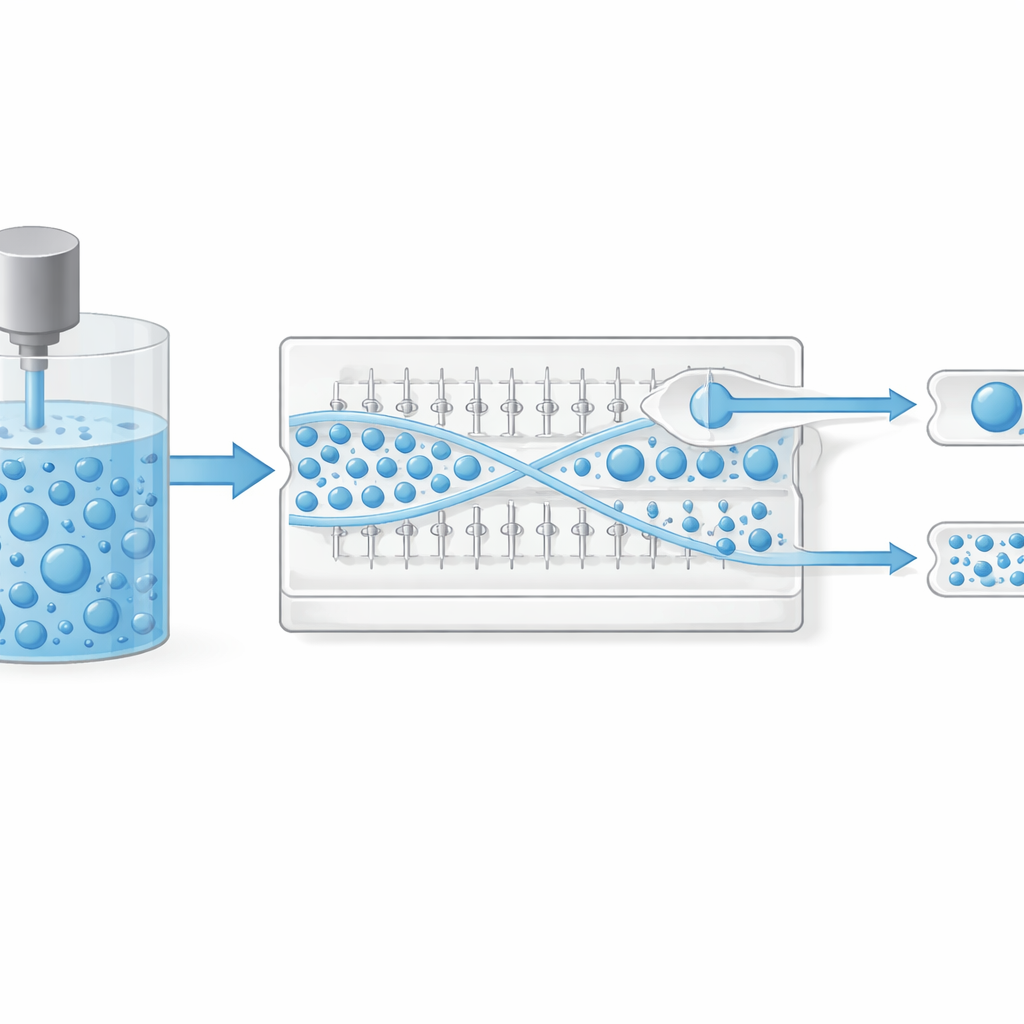
Oil-in-water emulsions are mixtures where oil droplets are dispersed in water. They are crucial in cosmetics, foods, and medicines, where product feel, appearance, and how active ingredients are delivered all depend on droplet size. Larger droplets act like seeds that speed up merging and separation, especially when no surfactants (stabilizing chemicals) are used. If droplet sizes can be pushed below about a micrometer and kept narrowly distributed, random thermal motion can counteract gravity, helping the mixture stay uniform for longer. The authors therefore focus not on how to make an emulsion from scratch, but on how to clean up an already-made emulsion by selectively removing its bigger droplets.
A chip that sorts droplets by size
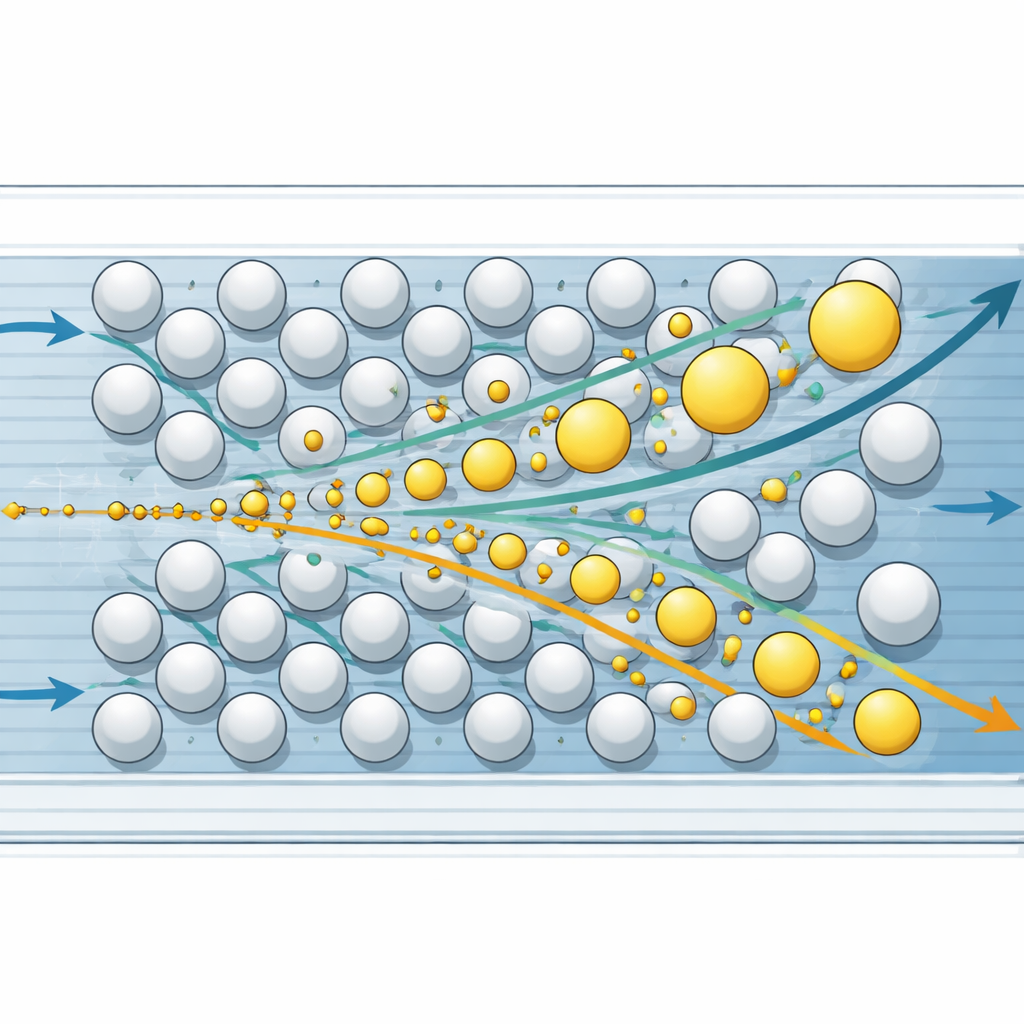
To do this, the team used a microfluidic technology called deterministic lateral displacement, or DLD. Inside a transparent, credit card–sized chip lies a forest of tiny pillars arranged in slightly shifted rows. As liquid flows between these pillars, small droplets follow smooth, zigzagging paths shaped by the water, while droplets above a certain size are nudged sideways each time they hit a pillar. This creates two distinct routes in a single pass: one for small droplets that stay in the middle of the channel and one for larger droplets that are gradually pushed toward the side walls. By carefully choosing the pillar diameter, spacing, and row-to-row shift, the researchers designed a chip with a “cutoff” size of about 1.7 micrometers, meaning droplets larger than this are peeled away from the rest.
Testing the sorting with model particles
Before using real emulsions, the researchers checked how well the chip separated particles of known size. Computer simulations of fluid flow between the pillars showed how streamlines are bent and compressed, explaining why larger objects get steered sideways while smaller ones weave through. Experiments with fluorescent plastic beads one and two micrometers across confirmed the mechanism: small beads spread across the channel, while larger beads traveled in a tight band near the wall and exited through a different outlet. The flow conditions were chosen so that droplets behave almost like rigid spheres rather than squishy blobs, ensuring that size—not deformation—controlled which path they took.
Cleaning real emulsions and checking stability
The team then applied the chip to oil-in-water nanoemulsions made with an ultrasonic device, which uses focused sound waves to break up oil into fine droplets without surfactants. The initial emulsions had median droplet sizes around 1.1 micrometers. After passing through the DLD chip, the median size dropped to about 0.77 micrometers in one sample and 0.73 micrometers in another, and the fraction of larger droplets was markedly reduced. Repeated runs with multiple identical chips produced nearly the same size distributions each time, showing that the process is reproducible. When the post-processed emulsions were stored for a week and monitored for signs of separation, no significant changes were observed, indicating that shrinking the droplet size and narrowing the distribution did, in fact, improve stability.
Prospects and practical hurdles
Although the concept works well, the current device faces practical limits. To target smaller cutoff sizes or handle more liquid per hour, the gaps between pillars must get narrower and the channels taller, which is challenging to fabricate in soft silicone and can cause deformation or leaks under higher pressure. The authors suggest that future versions made from more rigid materials, such as glass or hard polymers, and using many parallel channels could allow higher flow rates suitable for industrial use while keeping the same gentle, passive sorting principle.
What this means for everyday products
In simple terms, the study shows that a cleverly designed microchip can comb out the bigger, unstable droplets from an oil-in-water mixture, leaving behind a finer, more uniform emulsion that stays mixed longer—all without adding stabilizing chemicals or using energy-hungry equipment. If scaled up, this approach could help manufacturers of foods, cosmetics, and medicines fine-tune texture and shelf life using a compact, continuous post-processing step, turning precise control over droplet size into a practical tool for better, more reliable products.
Citation: Hong, H., Lee, E., Hwangbo, S. et al. Separation of large droplets from an oil-in-water emulsion using a deterministic lateral displacement (DLD) microfluidic chip. Sci Rep 16, 9985 (2026). https://doi.org/10.1038/s41598-026-39347-0
Keywords: nanoemulsion, microfluidic chip, droplet separation, emulsion stability, deterministic lateral displacement