Clear Sky Science · en
Electromagnetic-force characteristics of EDS high-speed maglev with tilting angle
Why train tilt matters for floating trains
Imagine a bullet train that never touches its tracks, gliding at airplane speeds while riders barely feel a bump. This is the promise of high-speed magnetic levitation, or maglev, trains. But in the real world, tracks curve, structures flex, and cars can lean or tilt. This study asks a simple but crucial question: when a levitating maglev train tilts, what happens to the invisible magnetic forces that keep it afloat and stable? Understanding this hidden behavior is key to building faster, safer, and more energy-efficient trains of the future.
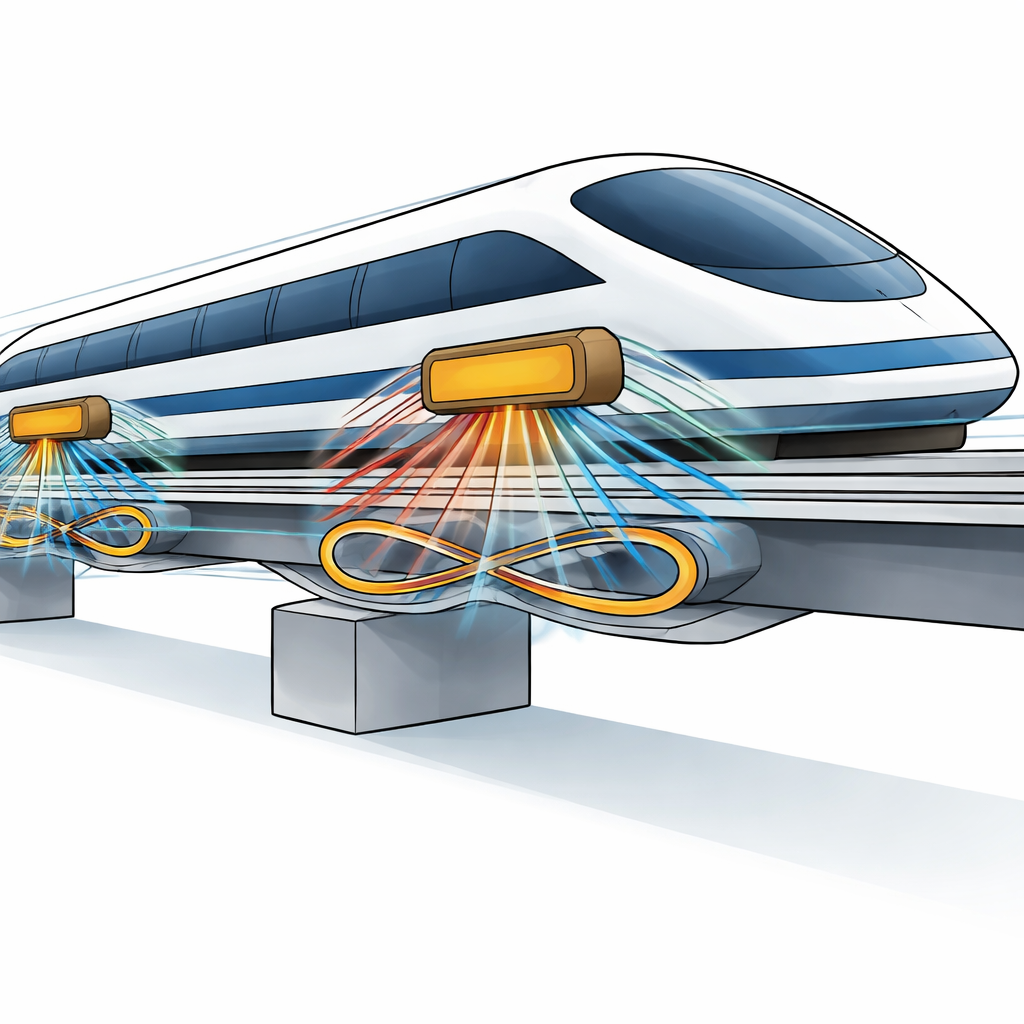
How floating trains stay up without wheels
The maglev system studied here belongs to a family called electrodynamic suspension. Instead of wheels, the train carries powerful superconducting magnets—coils cooled until electricity flows with almost no resistance. As the train speeds along, these magnets sweep past special figure-eight coils embedded in the track. Their motion induces electrical currents in the track coils, which in turn generate magnetic forces that both lift the train and keep it centered. Because these track coils are wired in a clever way, they naturally push the train back toward a stable position whenever it drifts, giving the system an inherent self-correcting behavior.
What happens when the magnets lean
In theory, the magnets on the train are perfectly aligned with the track. In practice, they can tilt due to tight curves, construction tolerances, or long-term deformation of structures. Such tilting breaks the symmetry of the magnetic field around the coils. To explore this effect, the authors built a detailed three-dimensional computer model of a maglev bogie—a section of train carrying two pairs of superconducting magnets running above six pairs of track coils. They simulated the train moving at 600 kilometers per hour while gradually increasing the tilt angle of the magnets from perfectly upright to about 11 degrees, tracking how the magnetic field, induced currents, and forces changed in space and time.
Changing magnetic footprints and shifting currents
The simulations show that even modest tilts subtly reshape the “magnetic footprint” that the train’s magnets cast onto the track coils. As the magnets lean, the lower side moves closer to the coils and the upper side moves farther away. This asymmetry broadens the region where the track coils feel strong magnetic flux and nudges the area of maximum field downward. Overall, the peak magnetic field in the coils increases by about five percent between no tilt and the largest tilt considered. Inside the track coils, the induced electrical currents respond in a direction-dependent way: currents along the direction of travel weaken, sideways currents become more irregular and less like smooth sine waves, and vertical currents grow stronger and occur slightly earlier in time, shifting their rhythm by a quarter of a cycle.
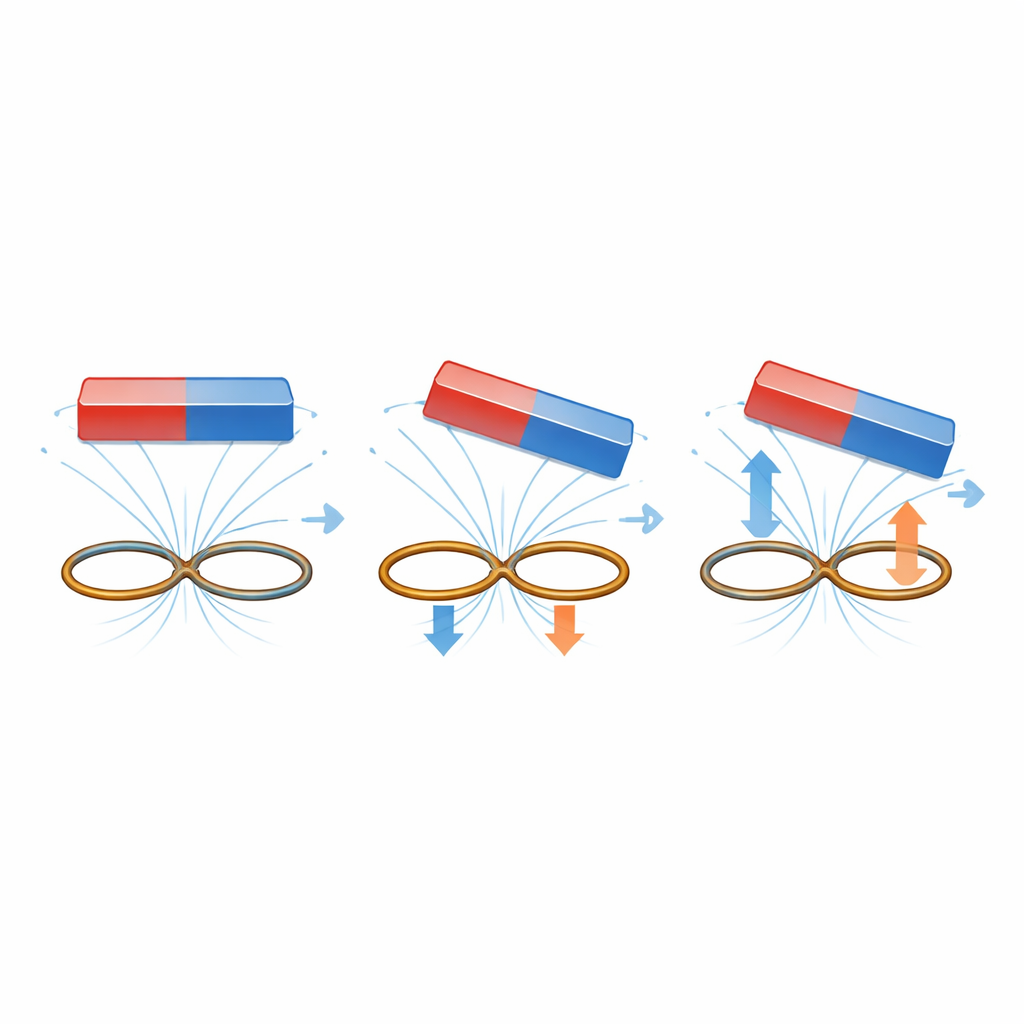
Forces that adapt to keep the ride stable
These changes in current translate directly into changes in the electromagnetic forces acting on the train. Along the track, the magnetic push and pull rise faster as tilt increases. Sideways, the guidance forces become somewhat stronger and more wavy over time. Most striking is the vertical direction: as the magnets tilt more, the levitation force grows and shows clear, repeating oscillations. The study suggests that the closed-loop nature of the track coils—the way their circuits are interconnected—lets them actively compensate for the uneven magnetic coupling created by tilt. In effect, the coils adjust their own currents in three dimensions to counteract the disturbance and help the train maintain a stable, centered levitation.
What this means for future maglev lines
For non-specialists, the key message is that a floating train does not simply “fall over” when it tilts. Instead, the track’s coils sense the imbalance and automatically reshape their currents to restore balance, thanks to the built-in feedback of the magnetic circuit. Still, there are limits: if the tilt becomes too large, the forces can become highly nonlinear and harder to predict, potentially threatening comfort and safety. The authors argue that future maglev systems should set practical limits on allowable tilt and may benefit from active control devices that provide extra corrective force when needed. Their modeling framework offers a new way to quantify how tilt, magnetic fields, and forces are linked, helping engineers refine track design, suspension layouts, and safety margins for ultra-high-speed maglev transport.
Citation: Fu, L., Chen, Z., Chen, Y. et al. Electromagnetic-force characteristics of EDS high-speed maglev with tilting angle. Sci Rep 16, 10053 (2026). https://doi.org/10.1038/s41598-026-39303-y
Keywords: high-speed maglev, electrodynamic suspension, superconducting magnets, train stability, magnetic levitation