Clear Sky Science · en
Haptic feedback in violin education as a case study of robotic exoskeleton-mediated motor learning
Helping Hands for Learning the Violin
Learning the violin is famously hard on the hands, arms, and ears. Beginners must coordinate dozens of tiny movements just to draw a straight bow across a string. This study asks a simple but exciting question: could a wearable robotic "sleeve" that gently guides your arm help you learn those movements faster and more accurately? By combining motion tracking, expert judgements, and users’ own experiences, the researchers tested whether haptic feedback—physical guidance you can feel—can make early violin lessons more effective.
A Robot Sleeve That Guides Your Bow
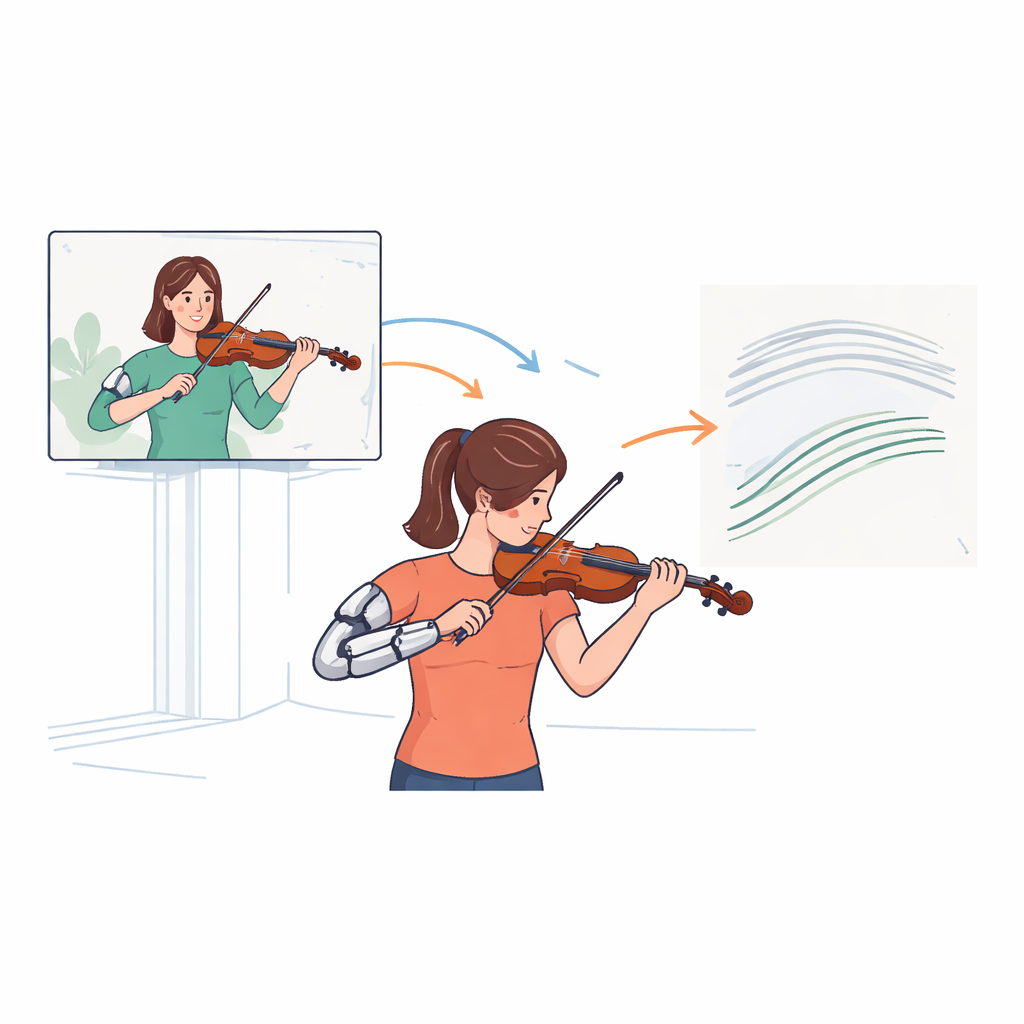
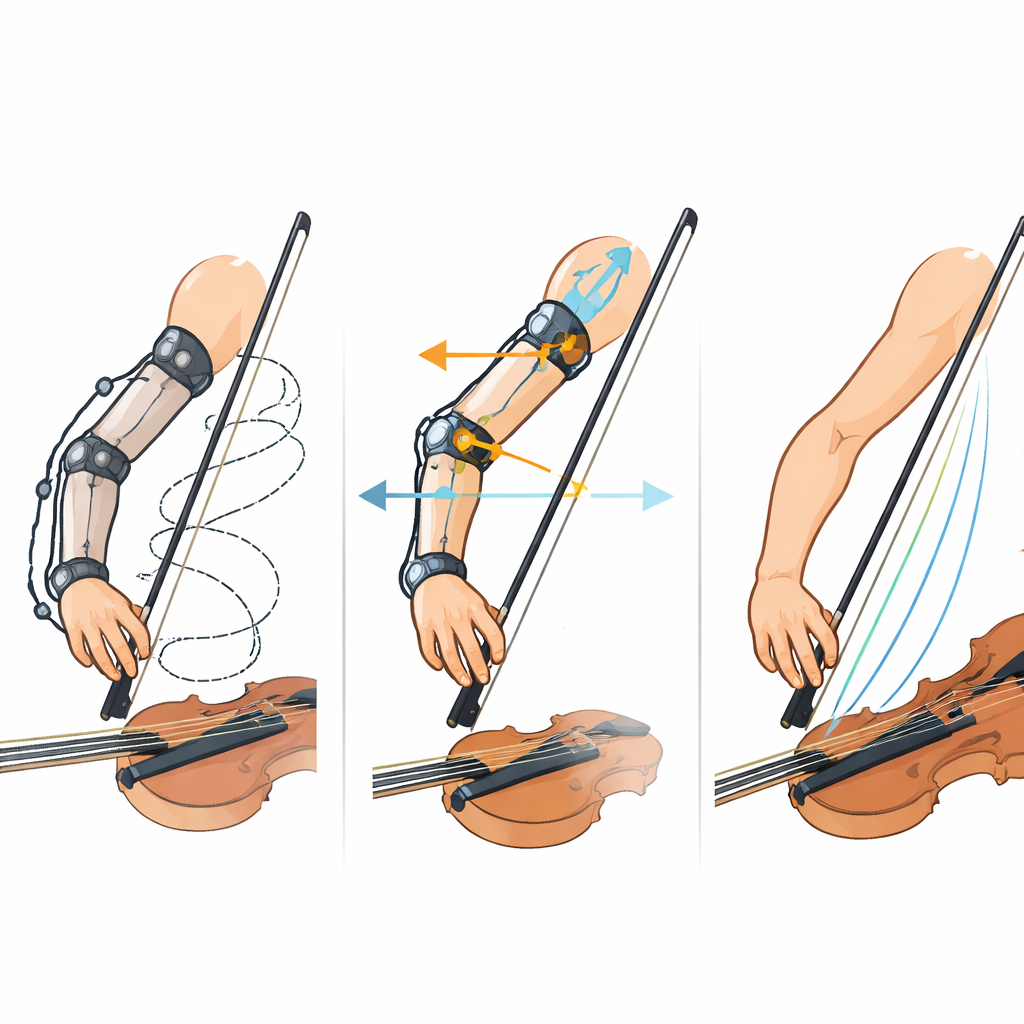
The team built an upper‑arm exoskeleton that straps onto the player’s bow arm. It has motorized joints at the shoulder and elbow plus light structural supports on the back and forearm. In a neutral setting it simply moves along with the player and records motion. In guidance mode, it compares the player’s arm position to a pre‑recorded "ideal" bow stroke from a professional violinist and gently pushes or pulls the arm toward that trajectory using spring‑like forces. The exoskeleton is paired with a motion‑capture suit and a video system so that the learner can watch and mimic the teacher while also feeling how the correct movement should go.
Putting Tech to the Test
To see whether this device actually improves learning, the researchers recruited 24 adult men who were novices on the violin. Everyone watched the same 20‑minute video lesson from a professional teacher and practiced three simple bowing exercises. Half of the participants wore the exoskeleton and received real‑time haptic guidance during the lesson; the other half used only audio and video. All players did a "baseline" performance before training and a "recall" performance afterward, both without guidance. Their movements were recorded in 3D, and their playing was turned into anonymous stick‑figure videos. A panel of five experienced violinists, who did not know who used the exoskeleton or when the clips were recorded, rated technique quality on a seven‑point scale.
What Improved—and What Did Not
Both groups got better after the short lesson, but those who had worn the exoskeleton improved more. Expert judges rated their recall performances higher than those of the control group, even though everyone started at a similar level. Motion data backed this up: players with haptic guidance ended up using a healthier range of motion in the elbow and matched the teacher’s bow path more closely in space and time. Measures of how smooth and consistent their bow strokes were also tracked expert opinion. Interestingly, purely timing‑based measures—how well players hit bow changes in rhythm—did not improve more with the exoskeleton than with video alone, suggesting that the device mainly boosts how and where the arm moves, rather than when.
How It Felt to Wear a Robot
Participants’ own reports painted a nuanced picture. Many in the exoskeleton group said the physical guidance helped them understand correct arm movements, posture, and bow contact, and they felt the lesson was more instructive than those in the control group did. At the same time, players noticed drawbacks. The device added weight, restricted some shoulder motion, and sometimes felt bulky or noisy. Motion data confirmed that shoulder movements could become exaggerated while the exoskeleton was active, raising questions about whether such altered patterns would be desirable in the long term. The study was also short—only one training session and no long‑term follow‑up—so it remains unclear how durable the benefits are or how well they transfer to other pieces or real‑world playing.
What This Means for Future Music Lessons
From a lay perspective, the takeaway is cautiously optimistic: a robotic sleeve that "teaches" your arm how a good bow stroke feels can indeed help beginners quickly pick up key aspects of violin technique, especially the shape and smoothness of their movements. Expert eyes, precise motion measurements, and learners themselves all pointed in the same direction: haptic guidance added something useful beyond standard video instruction. Yet the technology is still experimental. To move from a striking prototype to a trusted teaching tool, designers will need to reduce bulk, avoid distorting natural shoulder motion, and test the device over longer periods and with more diverse players. If those challenges are met, similar systems could eventually support not just violinists, but anyone learning complex physical skills—from surgeons to stroke patients—by giving their bodies a clear, tangible sense of how good movement should feel.
Citation: Campo, A., Peperoni, E., Capitani, S.L. et al. Haptic feedback in violin education as a case study of robotic exoskeleton-mediated motor learning. Sci Rep 16, 13639 (2026). https://doi.org/10.1038/s41598-026-39226-8
Keywords: haptic feedback, violin training, robotic exoskeleton, motor learning, music education technology