Clear Sky Science · en
Evaluating the growth and water use efficiency of chili pepper ‘Tanjung’, ‘Unpad’, and ‘Osaka’ using SFM1 sap flow in agro-environment
Why watering chilies wisely matters
Fresh chili peppers are a staple in kitchens around the world, but growing them is surprisingly thirsty work. As climate change makes rainfall less predictable and water scarcer, farmers need ways to produce plenty of chilies without wasting every precious drop. This study from Indonesia explores how different growing setups and chili varieties can squeeze more harvest out of the same amount of water, using a high-tech tool that actually tracks how much water each plant pulls up through its stem.
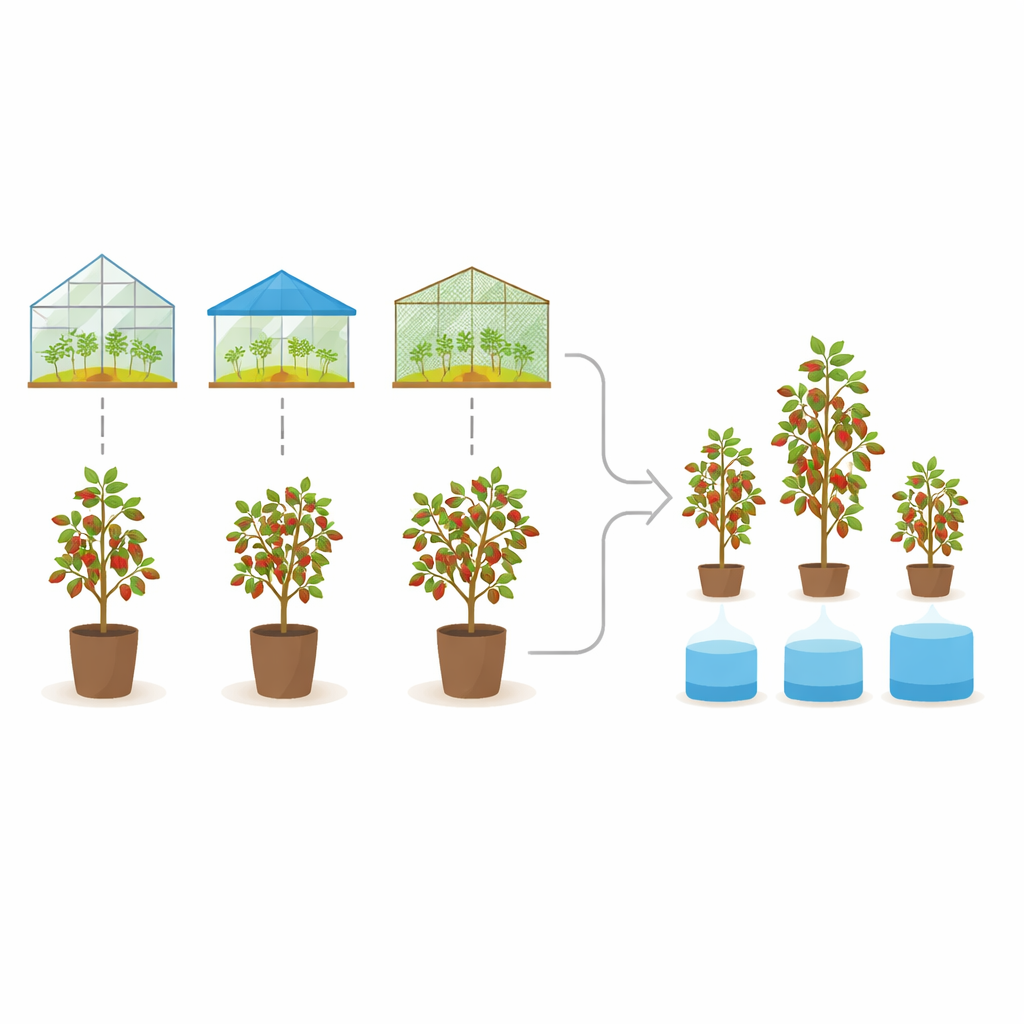
Four ways to shelter a chili field
The researchers compared three popular chili pepper varieties—called Tanjung, Unpad, and Osaka—grown in four types of settings: a greenhouse, a simple roofed rain shelter, a mesh-walled screen house, and a fully open field. Each structure creates its own mini-weather, changing temperature, sunlight, humidity, and wind. Over several months, more than 400 plants were raised in large pots filled with a mixture of cocopeat and biochar, and fed the same balanced nutrient solution. By carefully controlling and measuring how much water went into each pot, the team could link plant performance directly to the surrounding environment.
Listening to plants through their sap
To see how hard the plants were working, the scientists used a device called a sap flow meter. It places tiny heated probes into the stem and measures how quickly heat moves with the rising sap, which reflects how much water is flowing from roots to leaves. Alongside this, they tracked how fast the plants grew and how much new dry mass they produced per liter of water—a measure known as water use efficiency, or how many grams of chili plant you get for each unit of water. Advanced statistical tests then teased apart how much of the result came from the plant variety, the growing structure, or the combination of both.
Thirsty vs. thrifty chili plants
The three varieties behaved very differently. Osaka was the thirstiest: it pulled the most water each day and had the fastest sap flow, especially in the screen house and open field, where conditions encouraged strong transpiration. Unpad used somewhat less water but also turned it into plant material less efficiently, consistently showing the poorest water use efficiency across all environments. Tanjung stood out as the water miser. It drank the least and had relatively low sap flow, yet in the screen house it grew faster than any other combination, exceeding 0.60 centimeters per day and reaching the highest water use efficiency of about 2 grams of plant material per liter of water.
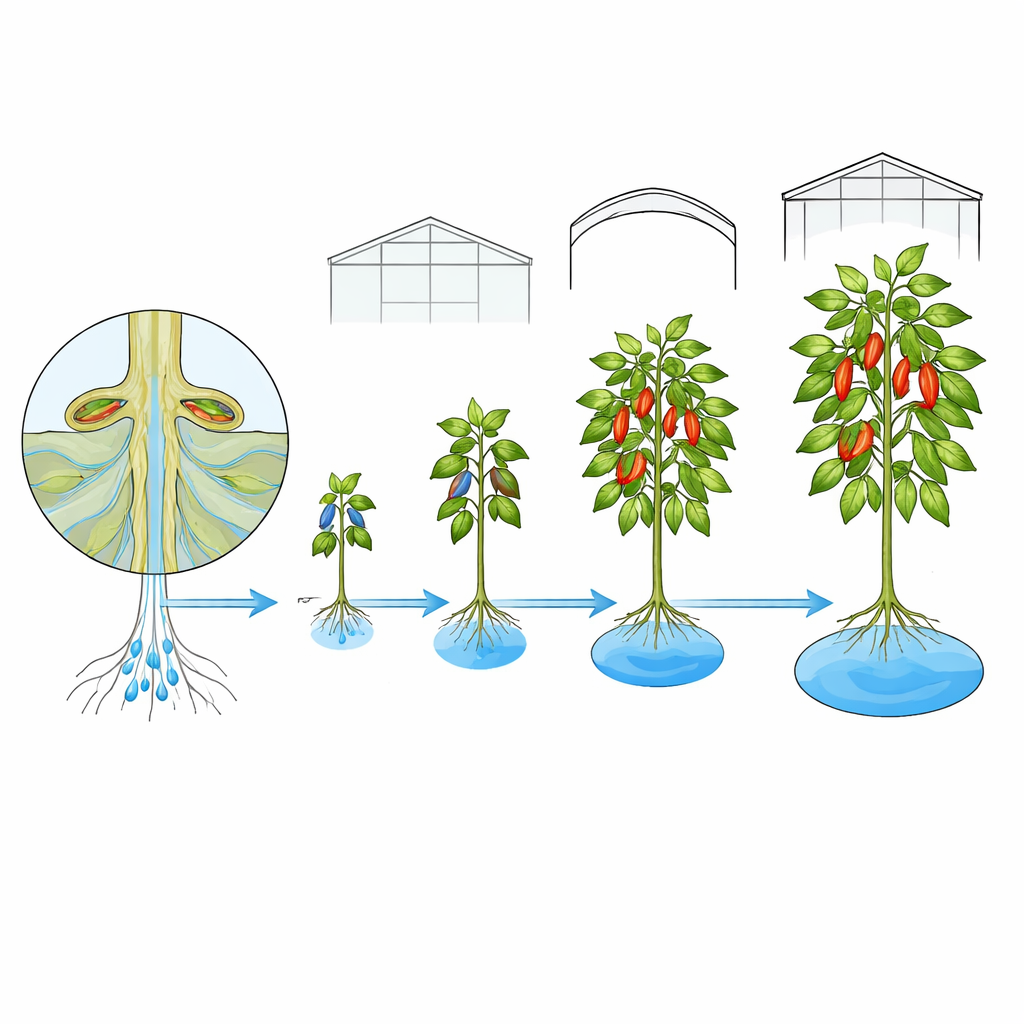
Microclimate makes or breaks performance
The different structures also showed clear patterns. The screen house, which softens sunlight and moderates temperature and wind without fully sealing the plants off, offered the best balance. It encouraged strong growth and efficient use of water, particularly for Tanjung, while avoiding the excessive water loss seen in the open field. The greenhouse and rain shelter tended to reduce sap flow and growth, likely because higher humidity and weaker air movement limited evaporation from leaves. A closer look at the data showed that plants with faster water movement tended to use more water overall, and that faster-growing plants generally converted water into biomass more efficiently.
What this means for future chili farms
Put simply, the study shows that farmers can grow chilies more sustainably by matching the right variety to the right type of shelter. A moderately protected structure like a screen house, paired with a water-efficient variety such as Tanjung, can deliver strong growth while using less water than thirstier types grown in open fields. Tools that monitor sap flow help fine-tune irrigation so plants receive enough moisture to thrive without waste. As weather becomes more erratic, these combined strategies—clever structures, smart variety choices, and precise watering—offer a practical path to reliable chili harvests that respect limited water supplies.
Citation: Kusumiyati, K., Ahmad, F., Soleh, M.A. et al. Evaluating the growth and water use efficiency of chili pepper ‘Tanjung’, ‘Unpad’, and ‘Osaka’ using SFM1 sap flow in agro-environment. Sci Rep 16, 11299 (2026). https://doi.org/10.1038/s41598-026-39053-x
Keywords: chili pepper cultivation, water use efficiency, screen house farming, sap flow measurement, protected agriculture