Clear Sky Science · en
Multi criteria optimization of FDM process parameters for NylonAF80 filaments using CRITIC CoCoSo and machine learning approaches
Why 3D Printing Settings Matter
Anyone who has handled a 3D-printed part knows that some feel tough and smooth, while others warp, crack, or look rough. This study explores how to dial in the settings of a common 3D-printing method so that parts made from a special nylon-based material come out stronger, more accurate in size, and with better-looking surfaces. The work is especially relevant for companies that want to move beyond simple prototypes and use 3D printing for real working parts like gears, bearings, and fixtures.

A Closer Look at a Tough New Plastic
The researchers focused on a filament called NylonAF80, a nylon material reinforced with 8% short aramid fibers, similar to the fibers used in bullet-resistant fabrics. This blend is designed to resist wear, creep, and heat, making it attractive for parts that must survive repeated motion and load. Using a fused deposition modeling (FDM) printer, they produced small rectangular blocks with a hole in the center, mimicking shapes used in gears and bearing housings. Rather than changing one setting at a time, they followed a structured test plan with 18 different combinations of six printing choices, including layer thickness, nozzle and bed temperatures, print speed, and the directions in which the plastic strands and the whole part were laid down.
Measuring Shape, Feel, and Finish
To judge quality, the team tracked three straightforward outcomes. First, they checked dimensional accuracy by comparing the printed volume to the intended volume; differences showed up as a volumetric error, revealing how much the parts shrank or warped. Second, they measured surface roughness, which affects how the part looks and how it behaves under stress. Third, they gauged hardness using a standard indenter that presses into the plastic; higher values signal better resistance to wear and deformation. Even with only two-thirds of each block filled with material to save time and plastic, the best samples reached about 87% of the hardness specified by the filament maker, while the worst settings nearly halved that value and produced more warping and roughness.
Finding the Sweet Spot in the Settings
Because the three quality measures can pull in different directions, the team used multi-criteria decision tools to balance them. One method, called CRITIC, automatically assigned importance to each outcome based on how much it varied and how independent it was from the others, giving similar weight to hardness and smoothness and slightly less to shape error. Another method, named CoCoSo, combined these weights with the test results to rank all 18 printing setups. The best overall recipe turned out to be a very fine layer thickness (0.1 mm), a relatively high nozzle temperature (255 °C), a medium bed temperature (100 °C), moderate print speed (40 mm/s), strands laid at 90 degrees, and the part printed on its edge. This combination produced parts that were both hard and close to the intended shape, with acceptable surface finish. Statistical analysis confirmed that layer thickness and print speed were the most influential levers, followed by how the part was oriented on the build plate.
Using Data and Images to See Inside the Print
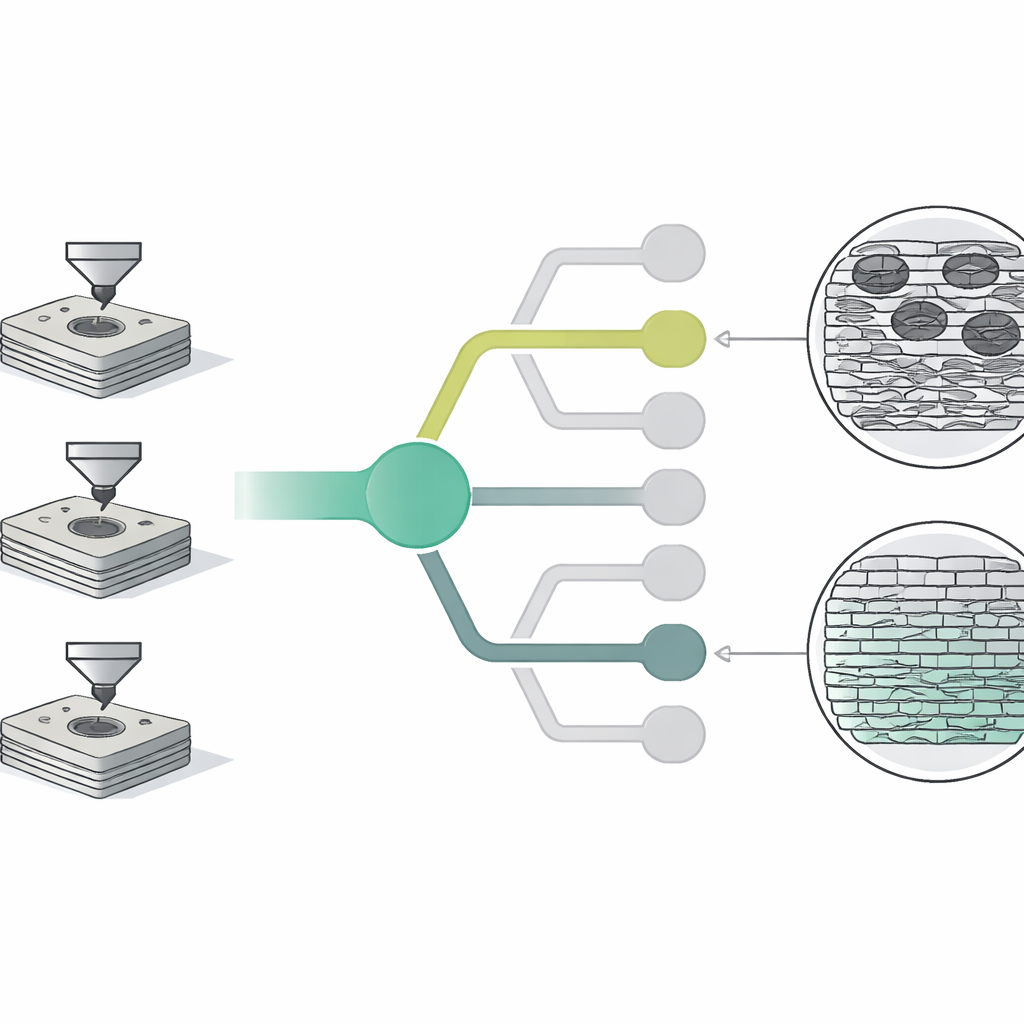
To test whether different analysis methods agreed, the researchers compared CoCoSo with two other decision techniques and found that all three gave very similar rankings. They then brought in simple machine learning models to see if a computer could learn from the small data set and predict which setting combinations would yield above-average quality. Decision trees—flowchart-like structures that split on one setting at a time—outperformed other models and correctly classified hardness, dimensional error, and roughness in most cases when trained on 80% of the data. In every tree, layer thickness appeared at the top, underlining its central role. Finally, high-magnification electron microscope images of samples printed under the best and worst conditions showed why this matters: poor settings produced pores, gaps between layers, and rough, wavy surfaces, while the optimized settings gave tighter bonding and fewer voids.
What This Means for Real-World Parts
In practical terms, the study shows that careful tuning of a few key knobs on an FDM printer—especially layer thickness, print speed, and build orientation—can turn a fiber-reinforced nylon from a promising material into a reliable workhorse for functional parts. By blending structured experiments, decision-making tools, and machine learning, the authors mapped out combinations that minimize warping and roughness while keeping the parts hard and durable. These guidelines could help manufacturers print more dependable gears, bearings, and fixtures for use in vehicles, aircraft, and industrial equipment, and point the way toward future work with larger data sets and even smarter prediction models.
Citation: Alrasheedi, N.H., Kumar, P.M., Sivanantham, G. et al. Multi criteria optimization of FDM process parameters for NylonAF80 filaments using CRITIC CoCoSo and machine learning approaches. Sci Rep 16, 11213 (2026). https://doi.org/10.1038/s41598-026-38122-5
Keywords: 3D printing, fused deposition modeling, nylon composites, process optimization, machine learning