Clear Sky Science · en
AI-driven data-efficient estimation of partition functions in disordered materials
Why tiny flaws in messy materials matter
Many of today’s most promising materials—from nuclear fuels to high‑performance alloys—are not perfectly ordered crystals but chemical “patchworks” where different atoms are thoroughly mixed. Inside these messy structures, tiny missing atoms and other defects control how heat, electricity, and even radiation damage move through the material. The paper introduces PULSE, a new artificial‑intelligence tool that can predict how such defects behave in complex, disordered materials far more efficiently than traditional computer simulations.
The problem with counting the almost uncountable
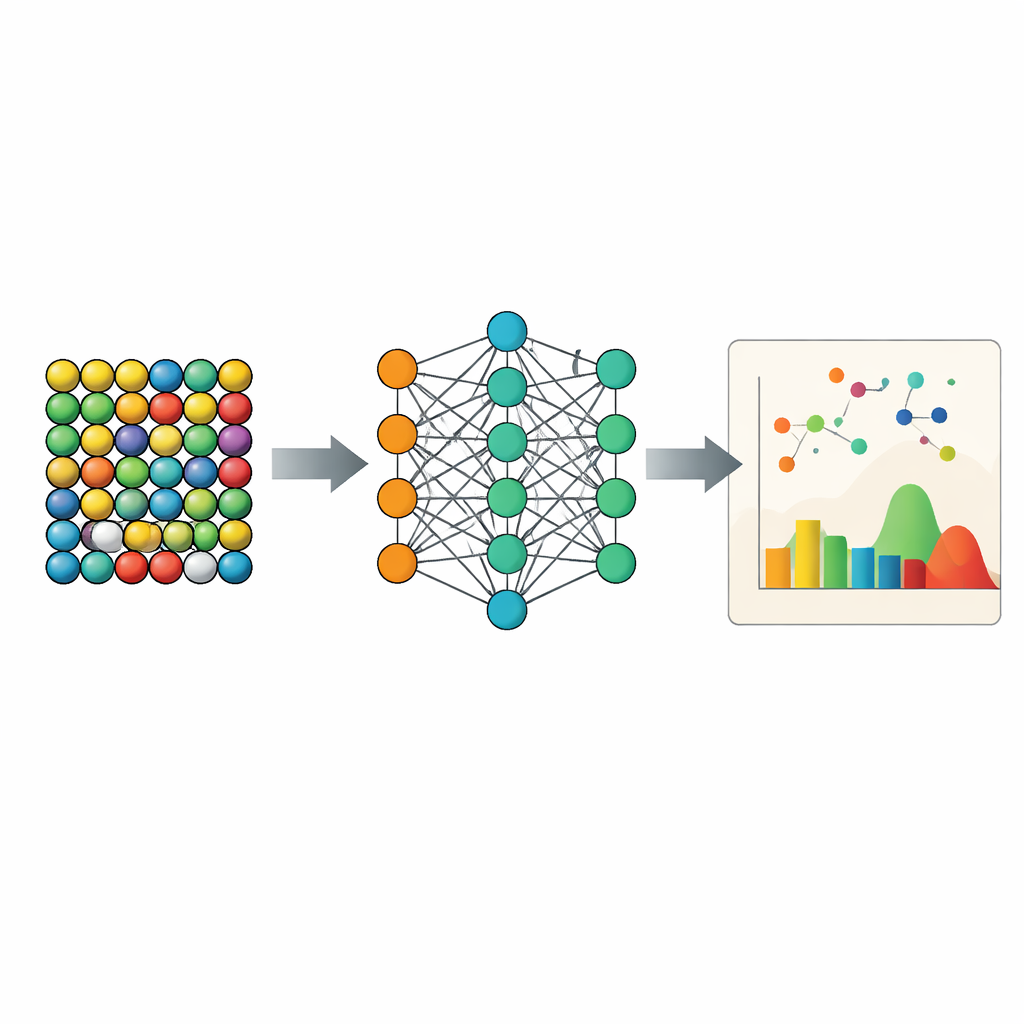
In multicomponent materials like uranium‑plutonium mixed oxides or high‑entropy alloys, atoms can occupy lattice sites in an enormous number of ways. Each distinct arrangement, or configuration, may slightly change how easily defects form and move. To predict real‑world properties, scientists must in principle consider all these possibilities, which is captured mathematically by a quantity called a partition function. Classic approaches either approximate disorder using a handful of carefully designed model structures, or sample many configurations with Monte Carlo simulations. The first strategy can miss important arrangements; the second is often so computationally demanding that it becomes impractical for realistic systems.
A self‑training AI sampler
PULSE (Partition function Unsupervised Learning Sampling and Evaluation) tackles this challenge by learning how to explore configuration space on its own. It is built around an inverse variational autoencoder, a kind of neural network that starts from simple random inputs and transforms them into realistic atomic configurations. Crucially, this model does not need a pre‑compiled database of examples. Instead, it generates candidate arrangements, sends them to an atomistic calculator to obtain their energies, and then adjusts its internal parameters to make beneficial samples more likely. This closed loop allows the AI to focus attention on the configurations that matter most for the partition function, particularly those that dominate behavior at a given temperature.
Putting PULSE to the test in nuclear fuel
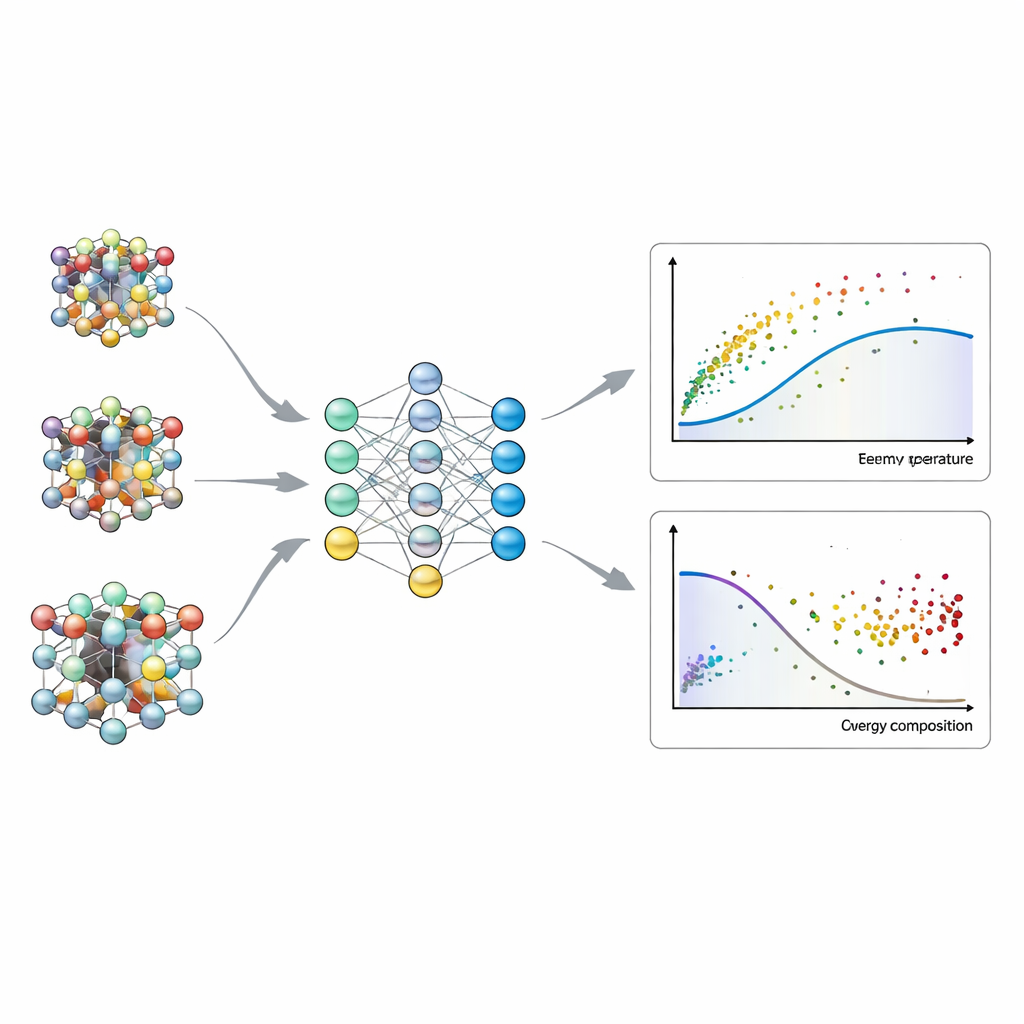
To demonstrate its capabilities, the authors apply PULSE to uranium‑plutonium oxide, a key nuclear fuel material. They focus on Schottky defects—groups of missing atoms that strongly influence how the fuel responds to high temperature and radiation. First, they test the method on relatively small local environments where the partition function can still be computed exactly by brute force. PULSE’s estimates of this quantity, and of the resulting defect concentrations, closely match the exact results while requiring orders of magnitude fewer energy calculations than scanning the full database. Compared with widely used “special quasirandom structures,” PULSE achieves similar or better accuracy, but with a clear built‑in measure of convergence and far lower computational cost at high temperature.
What the AI reveals about local surroundings
Because PULSE explicitly generates and rates atomic neighborhoods around a defect, it can be used to probe how far the influence of a defect extends. By systematically randomizing layers of atoms farther and farther from the defect, the authors find that, in this oxide fuel, only a few shells of neighboring atoms significantly affect defect energetics, and that the relevant distance shrinks as temperature rises. The method also shows how defect concentrations change with plutonium content: as the material becomes richer in plutonium, defect formation generally becomes easier, leading to higher defect densities—especially at lower temperatures where energetic differences are more important.
Why this matters for future materials design
To a non‑specialist, the core message is that PULSE offers a fast, flexible way for AI to “count” and prioritize the most important atomic arrangements inside highly disordered materials. Instead of exhaustively simulating every possible configuration, the method learns on the fly which local patterns control defect formation and then uses this knowledge to estimate defect concentrations and related properties. Although demonstrated on nuclear fuel, the same framework can be applied to a wide range of complex materials, such as high‑entropy alloys or mixed oxides for energy storage and catalysis. In this way, PULSE could help researchers rapidly explore how microscopic disorder shapes macroscopic performance, guiding the design of safer and more efficient materials.
Citation: Karcz, M.J., Messina, L., Kawasaki, E. et al. AI-driven data-efficient estimation of partition functions in disordered materials. Sci Rep 16, 14568 (2026). https://doi.org/10.1038/s41598-026-37953-6
Keywords: disordered materials, machine learning, nuclear fuel, point defects, generative models