Clear Sky Science · en
Occurrence of Nigrospora spp. as the predominant causal agents of leaf spot disease in Cavendish banana in banana plantations in Mindanao Island, Philippines
Why banana leaf spots matter to your breakfast
The Cavendish bananas that stock supermarket shelves worldwide mostly come from large plantations, and many are grown on Mindanao Island in the southern Philippines. Farmers there battle a costly leaf disease long assumed to be “black Sigatoka,” a well-known fungal scourge. This study shows that the main culprit is in fact a different group of fungi altogether, which has major implications for how growers protect the bananas that end up in lunch boxes and smoothies around the globe.
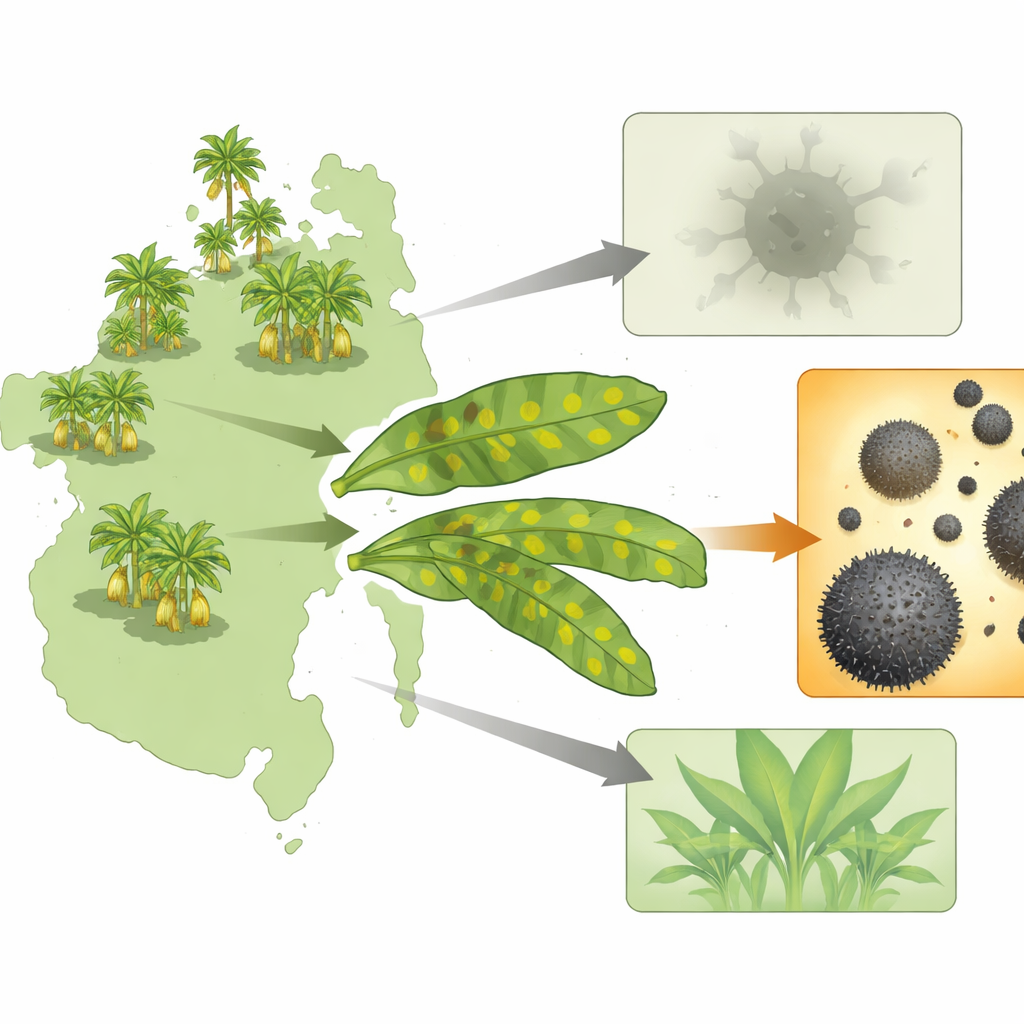
A costly disease with a mistaken identity
Bananas are the world’s most produced fruit, and Cavendish bananas dominate international trade. On Mindanao, growers have invested heavily in fighting black Sigatoka, a disease caused by fungi in the genus Pseudocercospora that create dark, expanding spots on leaves and can slash yields. Because several banana diseases cause look‑alike brown or black spots with yellow halos, farmers and even experts typically diagnosed any such symptoms as Sigatoka and sprayed fungicides accordingly, often 50–70 times per year—one of the largest production costs.
Hunting for the real culprits
The researchers sampled 175 banana leaves showing Sigatoka‑like spots at six plantations across Mindanao. From these, they isolated 217 fungal strains and used DNA sequencing to identify them. To their surprise, nearly three‑quarters of the isolates belonged not to the expected Sigatoka fungi but to a different genus, Nigrospora, which forms dark, round spores. Detailed genetic analyses and microscopic measurements showed that the Nigrospora collection actually contained six distinct species, including one previously unknown to science that the team named Nigrospora nigrocolonia. Most of these species had never before been reported as causes of banana leaf disease.
How aggressive are these new banana foes?
To test whether these fungi truly damage banana leaves, the team placed small plugs of each fungus onto healthy Cavendish leaves, with and without tiny wounds. All six species were able to cause disease on wounded leaves, producing spindle‑shaped dark spots; some strains created lesions more than two centimeters long in only four days, while a few barely discolored the tissue. One species, Nigrospora lacticolonia, dominated the samples and showed the widest range of aggressiveness, from weak to strongly damaging. Another, Nigrospora sphaerica, though rare, produced consistently large lesions. No symptoms appeared on unwounded leaves, suggesting that injuries—such as those from wind, insects, or farm operations—help these fungi invade.
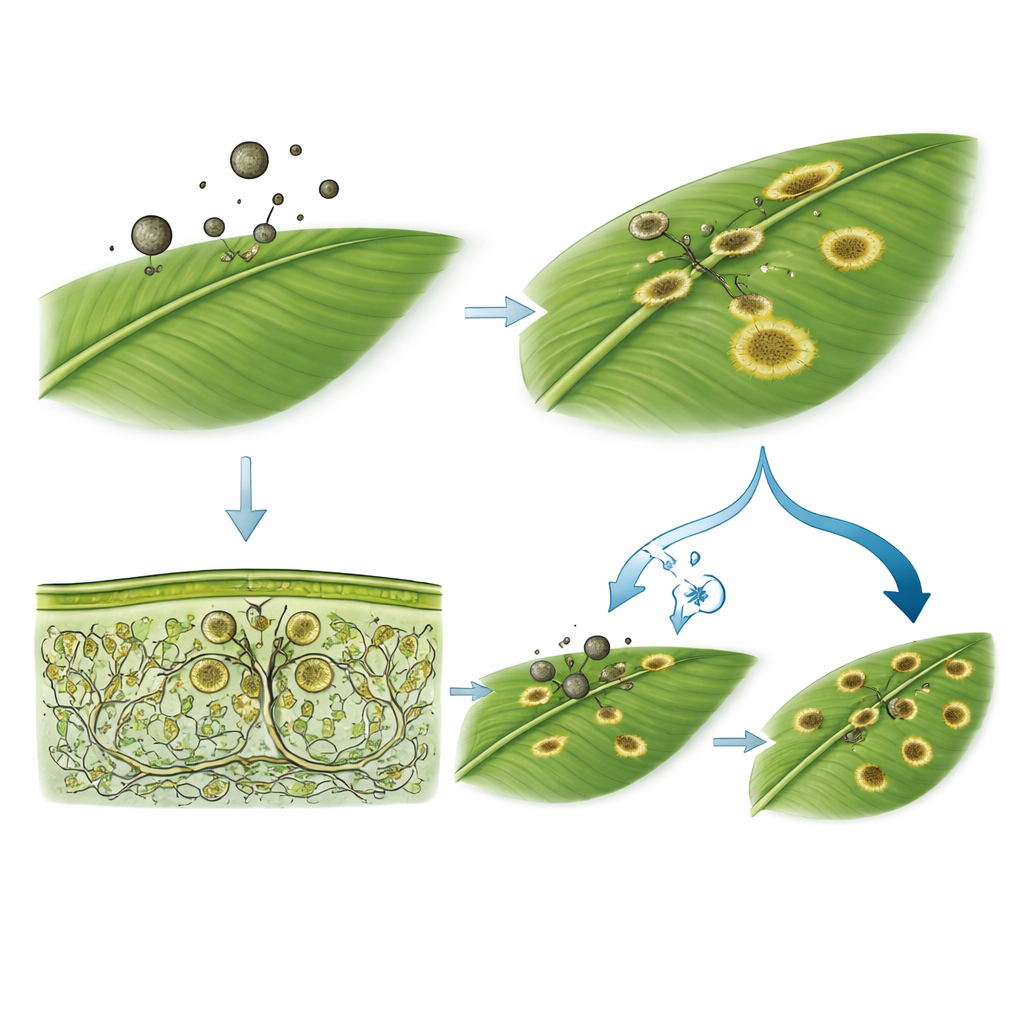
Fungicides: powerful, imperfect tools
Because plantations already spray many fungicides for presumed Sigatoka control, the scientists asked how well those chemicals work against Nigrospora. They exposed 160 fungal isolates to 14 widely used active ingredients in the lab and measured how much growth was stopped. Some compounds, such as pyrimethanil, tebuconazole, and spiroxamine, completely halted all strains at the tested doses. Others were far less reliable: many isolates, especially of the dominant N. lacticolonia, continued to grow even at high concentrations of several fungicides. When the team compared sensitivity patterns using statistical methods, they found no clear grouping by species, genetic type, or farm—suggesting that reduced sensitivity may have arisen repeatedly and spread independently across the island.
What this means for banana growers and consumers
Overall, the study overturns the assumption that black Sigatoka is the chief cause of banana leaf spots in Mindanao. Instead, a suite of Nigrospora species—one newly described—now appears to be the main source of damage. Some of these fungi remain very susceptible to certain fungicides, while others already show signs of reduced sensitivity, raising concerns that current spray programs may be both expensive and only partly effective. For growers, the message is clear: disease control strategies must be updated to reflect the true pathogens in their fields, with regular monitoring of which fungi are present and how they respond to specific chemicals. For consumers, this work helps safeguard a stable supply of bananas by pointing the way toward more targeted, sustainable disease management.
Citation: Nozawa, S., Harada, Y., Takata, Y. et al. Occurrence of Nigrospora spp. as the predominant causal agents of leaf spot disease in Cavendish banana in banana plantations in Mindanao Island, Philippines. Sci Rep 16, 12619 (2026). https://doi.org/10.1038/s41598-026-37922-z
Keywords: banana leaf disease, Nigrospora fungus, Cavendish banana, fungicide resistance, Mindanao Philippines