Clear Sky Science · en
Evolution of surface tension in strained molten aluminum: a liquid–vapor interface study
Why Shaping Liquid Metal Matters
From casting airplane parts to printing tiny metal circuits, engineers increasingly work with molten metals in motion. A key property that governs how these hot liquids spread, bead up, or break apart is surface tension—the invisible “skin” at a liquid’s surface. Traditionally, surface tension is tuned by changing temperature or chemistry. This study asks a different question: can we actively “dial” the surface tension of molten aluminum using only fast mechanical stretching, without adding anything to the liquid? The answer, explored through computer simulations, could reshape how we design precision casting, additive manufacturing, and microfluidic metal systems.
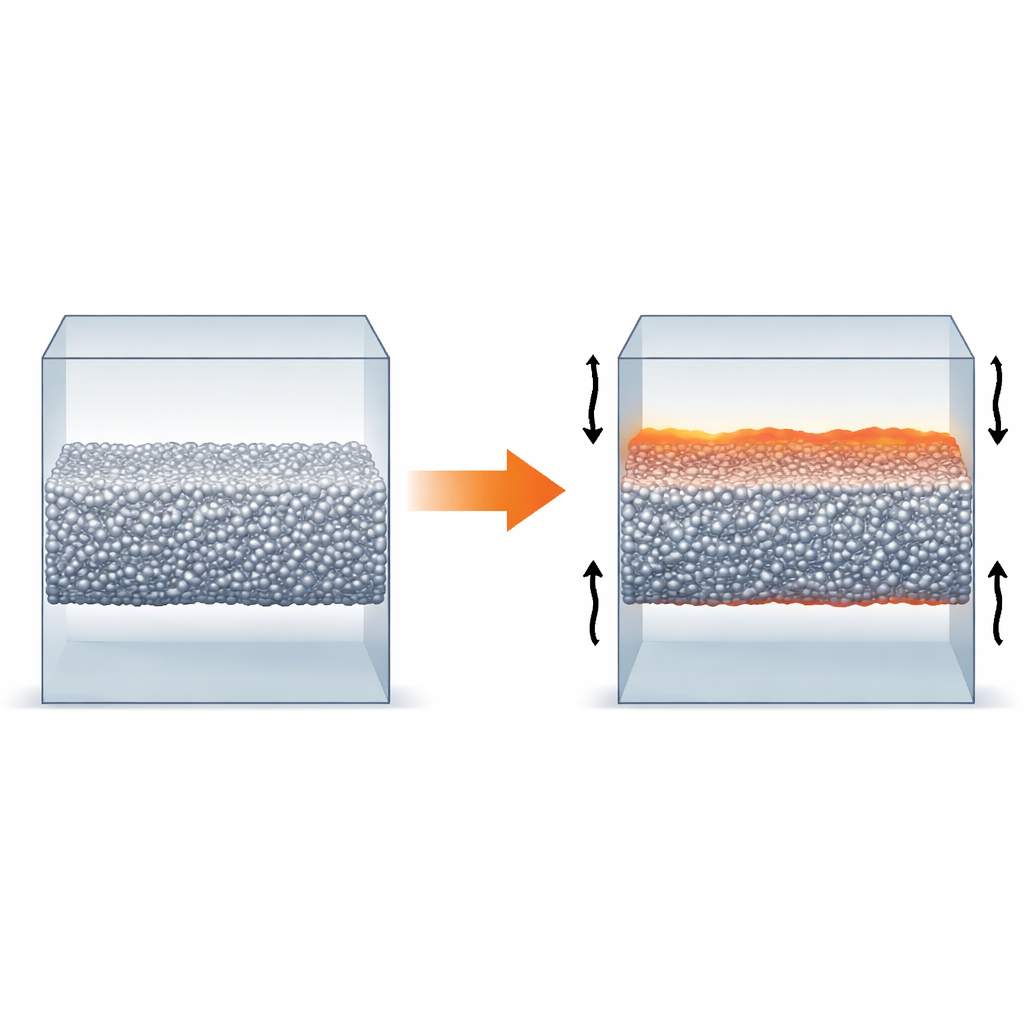
Watching a Liquid Surface Under Mechanical Rhythm
The researchers built a detailed molecular dynamics model of molten aluminum at its melting point, surrounded by vapor, so that two liquid–vapor surfaces naturally form. They then imposed a gentle but rapid sideways oscillation on the simulation box—essentially stretching and compressing the melt cyclically along one horizontal direction, at frequencies from about 1 to 50 billion cycles per second (GHz) and with strain amplitudes up to 5%. This setup mimics ultrafast mechanical disturbances that might occur during laser processing or shock loading, but in a controlled, virtual environment where every atom’s motion can be tracked.
Measuring an Invisible Skin in Motion
To see how the surface reacts, the team computed a time-resolved version of surface tension, called dynamic surface tension. Instead of assuming a calm, static interface, they calculated how local density and stress vary layer by layer near the liquid surface as the load oscillates. Standard formulas for surface tension assume equilibrium, so the authors modified them to remove the “bulk flow” motion that the mechanical drive adds, isolating the true microscopic stress that contributes to the surface’s elastic character. By averaging over many load cycles once the system settled into a steady rhythm, they extracted how the surface tension oscillates and how its average value shifts under different frequencies and amplitudes.
When a Liquid Surface Behaves Like a Spring
The data revealed that the molten aluminum surface responds much like a driven, damped spring–mass system—an idea borrowed from basic mechanics. Under cyclic loading, the surface tension does not simply wobble around its original value. Instead, its average value rises: at the most intense conditions studied (50 GHz and 5% strain), the mean dynamic surface tension increases by about 5% compared with equilibrium. During each cycle, the instantaneous surface tension can swing as high as 30% above and 15% below the equilibrium value. By fitting the oscillations, the authors identified two characteristic frequencies and damping constants that describe how the interface naturally wants to vibrate and how quickly those vibrations fade. These parameters indicate the interface is underdamped and can approach a resonance near 50 GHz, where the response is particularly strong.
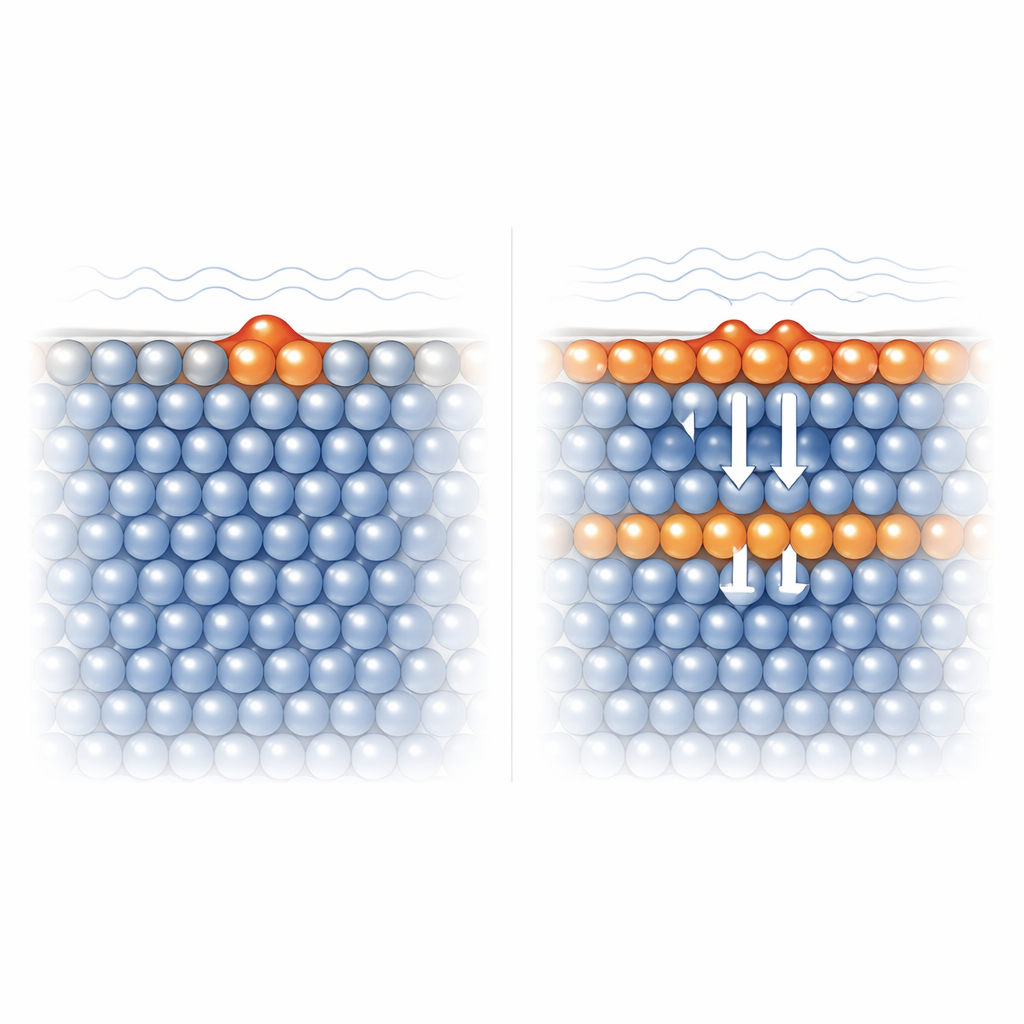
Layered Atoms and Hidden Time Scales
A closer look at atomic layering near the surface explains why the behavior is so rich. The simulations show that atoms at the very outermost layer and those in a subsurface layer just beneath it do not respond in perfect sync. Under high-frequency loading, the stress and density profiles develop distinct peaks in these two regions, and their oscillations can differ in strength and timing. Yet both layers seem to share the same underlying natural frequencies, suggesting that they are coupled by a common restoring force, even though their local rearrangements proceed on different time scales. At lower frequencies, the liquid has ample time to relax between cycles, and the interface looks more like its equilibrium self; at higher frequencies comparable to the intrinsic relaxation time of the liquid, the system is driven before it can fully settle, leading to sustained, non-equilibrium adjustments and a higher average surface tension.
Turning Vibration Into a Control Knob
Overall, the study shows that rapidly stretching molten aluminum sideways can systematically and reversibly raise its surface tension, while also imposing controlled oscillations around this new baseline. To a non-specialist, this means that engineers may one day “tune” how liquid metal droplets form, merge, and wet surfaces simply by choosing the right vibration frequency and strength—without changing the metal’s composition. Such dynamic control could improve the stability of liquid interfaces in casting, help manage flow in metal-based 3D printing, and enable fine adjustments of droplet behavior in microfluidic or space-processing systems. By framing the liquid surface as a driven, damped oscillator and linking that picture to atomic-scale layering, the work lays a foundation for designing processes where surface tension is not a fixed property, but an actively engineered parameter.
Citation: Yu, Z., Li, W., Yang, Y. et al. Evolution of surface tension in strained molten aluminum: a liquid–vapor interface study. Sci Rep 16, 12455 (2026). https://doi.org/10.1038/s41598-026-37039-3
Keywords: molten aluminum, dynamic surface tension, liquid metal interfaces, high-frequency loading, molecular dynamics simulation