Clear Sky Science · en
Prefrontal and temporal cortical activation during a new computerized multiple cognitive task simulating activities of everyday life
Thinking Training for Real Life
Many brain-training apps promise sharper thinking, but they often rely on simple puzzles that look nothing like the messy decisions we make every day. This study asks a straightforward question: if we put people in a lifelike computer scenario—such as planning a meal on a tight budget—does the brain engage its key thinking centers more deeply than in stripped-down lab tasks? The answer matters for designing tools that might one day help older adults or people with mental health conditions keep their daily thinking skills strong.
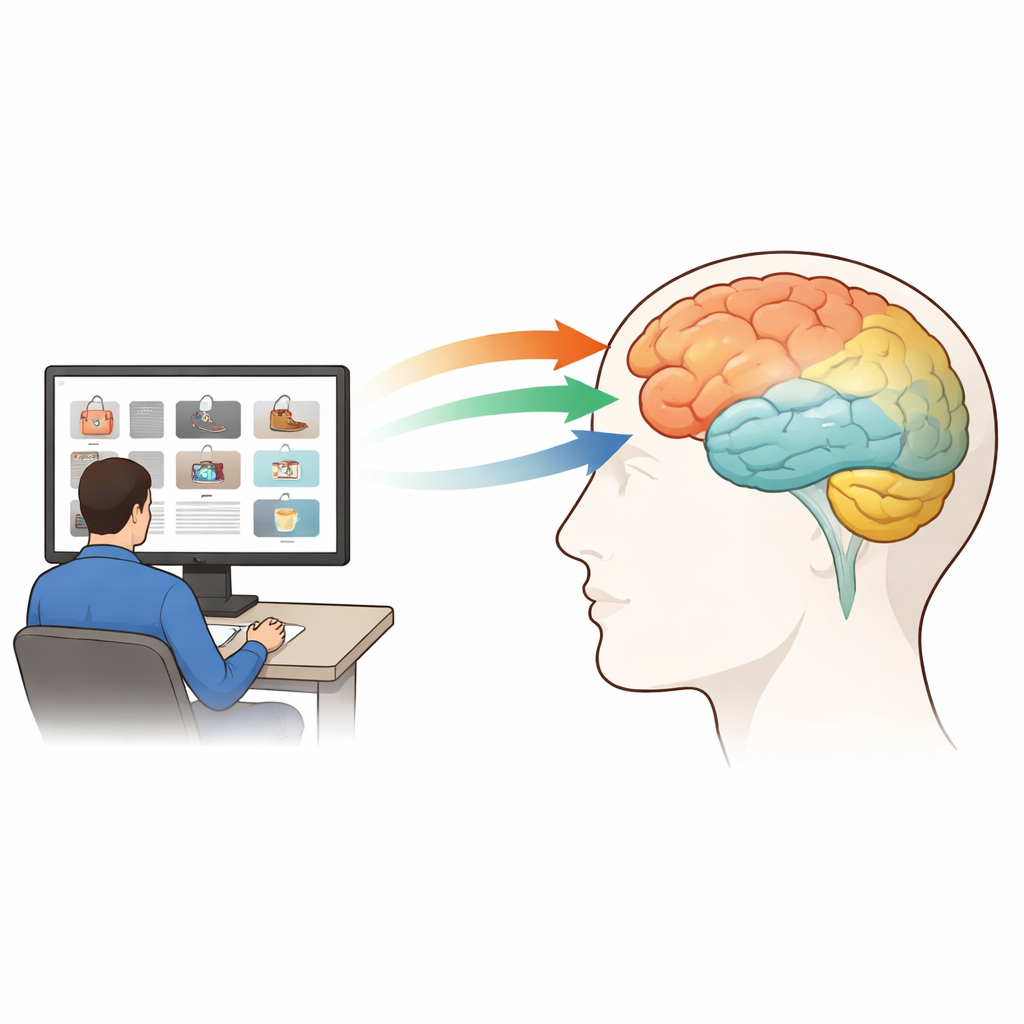
A Shopping Trip Inside the Brain
The researchers created a computerized multiple cognitive (CMC) task that mimics everyday challenges like shopping or preparing a meal. On each trial, participants saw a goal (for example, buying ingredients for a specific dish) and a limited budget. After a short waiting period, they viewed a screen full of photos of foods and household items, each with a price. They had to mentally plan which items were truly needed, decide which extras could fit within the budget, and then select their choices—all while keeping track of the running total in their heads. Finally, they were asked to recall the goal, the budget, and the total cost of the items they had chosen.
A Fair Comparison Task
To find out what was special about this lifelike task, the team also designed a control version that looked almost identical on the screen. The same kinds of pictures appeared, and participants still clicked items, read symbols aloud, and moved their eyes and hands. But in the control task, the goal and budget were replaced with meaningless character strings, and people were simply told to click a fixed set of items and read out nonsense symbols. This meant that any extra brain activity seen in the CMC task would not just reflect looking, speaking, or moving, but the added mental demands of remembering, planning, deciding, and calculating.
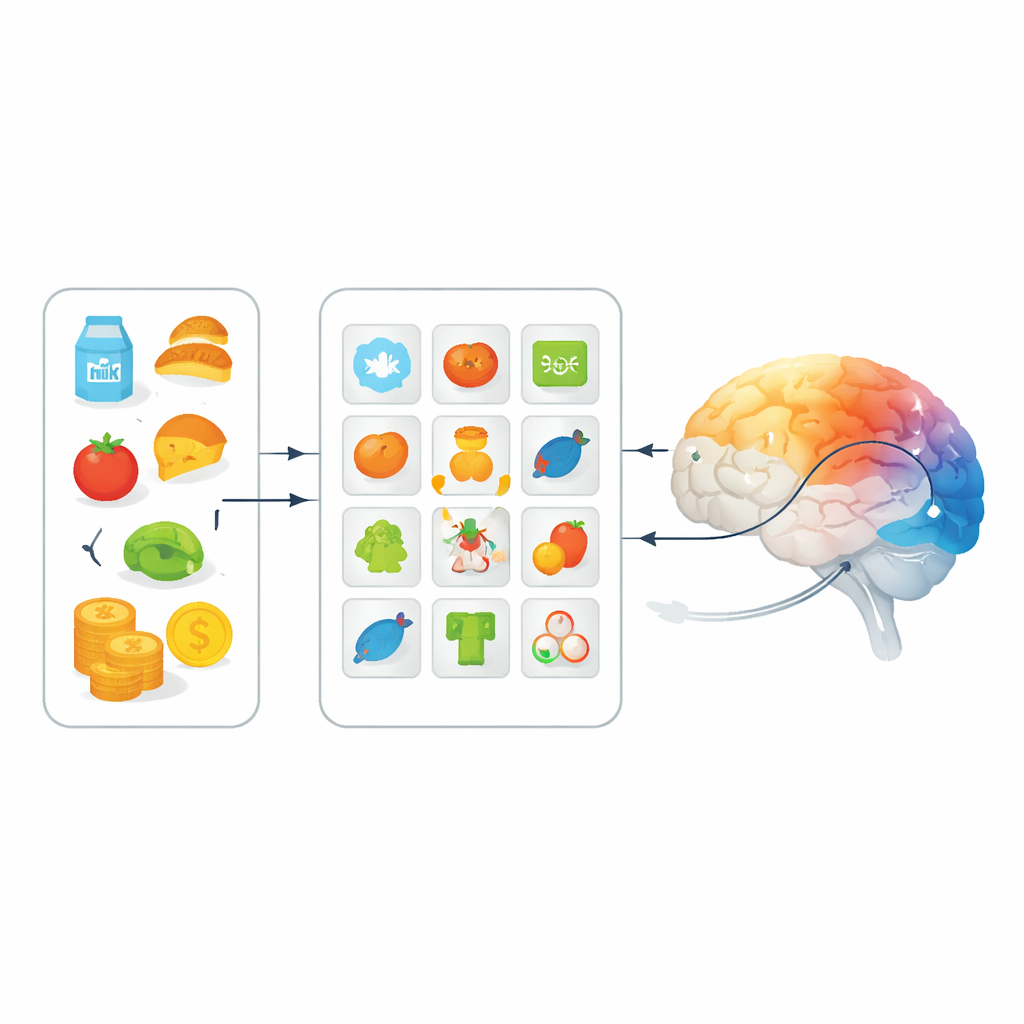
Watching Blood Flow in Thinking Regions
While 20 healthy young adults performed these tasks, the researchers used near-infrared spectroscopy, a light-based technique that sits on the scalp and tracks changes in blood oxygen in the outer layers of the brain. They focused on the prefrontal cortex—areas behind the forehead that support planning, working memory, and decision-making—and on nearby temporal regions along the side of the head that are important for language and recall. During the realistic CMC task, blood flow increases appeared in two major prefrontal zones on the sides of the brain (dorsolateral and ventrolateral prefrontal cortex) and in parts of the temporal cortex, particularly on the right side. By contrast, the control task produced no meaningful increase in these regions.
Different Brain Areas for Different Steps
The timing of these activity changes revealed how different brain regions took turns as the task unfolded. When the goal and budget first appeared and had to be stored, the upper-side prefrontal region (dorsolateral) was most active, consistent with its role in holding and organizing information. As participants compared items, weighed options, and chose what to buy within the budget, activity in the lower-side prefrontal area (ventrolateral) climbed, in line with its links to selecting and inhibiting information and making decisions. During the final recall stage, when people had to report the goal, the budget, and the total cost, the temporal regions lit up, reflecting their role in retrieving verbal and meaning-based information. Participants who selected more items tended to show stronger signals in right-side prefrontal areas, suggesting that heavier mental load boosted activation there.
What This Could Mean for Future Brain Training
Altogether, the study shows that a realistic, goal-driven computer task—one that feels more like planning dinner than solving abstract puzzles—engages a broad fronto-temporal network in the brain, with different hubs stepping in for storing, choosing, and recalling information. The pattern resembles classic working-memory tasks but appears especially strong in right-sided regions tied to imagery and concrete scenarios. Although this is only an early, small-scale study, it supports the idea that brain-training programs grounded in everyday situations may better tap the circuits we rely on in real life, and could form the basis for future clinical tools to help people manage the mental demands of daily living.
Citation: Ichihara-Takeda, S., Onuki, M. & Fukunaga, K. Prefrontal and temporal cortical activation during a new computerized multiple cognitive task simulating activities of everyday life. Sci Rep 16, 12982 (2026). https://doi.org/10.1038/s41598-026-36717-6
Keywords: cognitive training, working memory, prefrontal cortex, everyday decision-making, brain imaging