Clear Sky Science · en
Optimization of drawing parameters based on top-coal flow law in thick-seam caving mining
Why this mining study matters
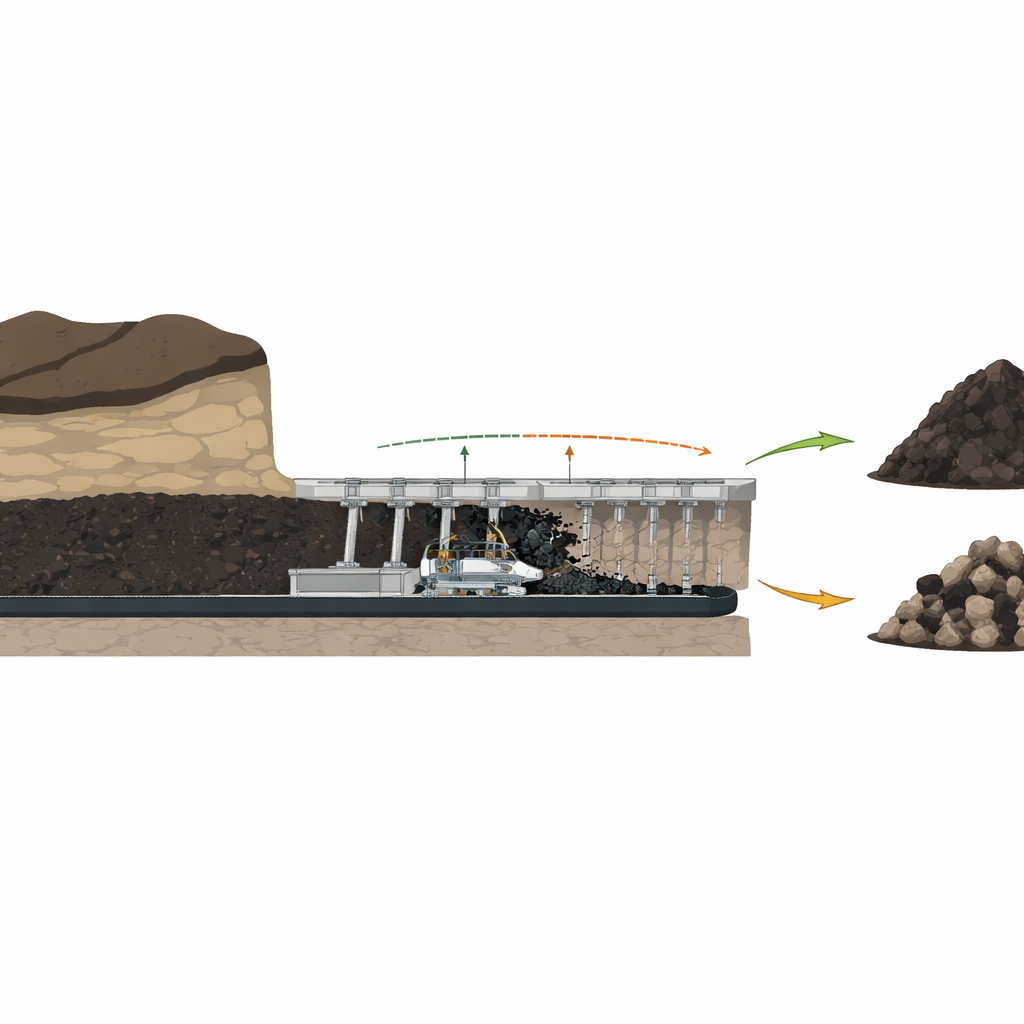
As the easiest coal deposits are exhausted, mines must turn to deeper, thicker seams that are harder and riskier to work. In these settings, a method called longwall top-coal caving can extract far more coal from each slice underground—but only if the broken coal flows smoothly while unwanted rock is kept out. This study looks at a real mine in southwest China and asks a simple but crucial question: how should we time and sequence the drawing of broken coal so that we get the most fuel with the least waste?
The challenge of getting coal without too much rock
In thick seams, modern machines cut only the lower part of the coal. The upper "top coal" is left to collapse and flow through openings behind a line of heavy hydraulic supports. Ideally, this broken coal pours into chutes and onto conveyors, while the overlying rock—known as gangue—stays put. In reality, the flow behaves more like sand and gravel in a tilted hourglass: if the openings are too big, too far apart, or opened for too long, rock rushes in, diluting the coal and raising processing costs. If they are too small or closed too early, much of the coal is stranded overhead and lost forever.
Probing coal flow with models and scaled experiments
The researchers focused on Working Face 11508 in the Xiejiagou Coal Mine, where the main seam is about five meters thick and structurally stable. First, they measured how strong and fractured the coal and surrounding rocks are, confirming that the top coal is naturally broken enough to cave and flow readily. They then built detailed computer models made of thousands of particles to mimic coal and roof rock around the longwall face. In these simulations, they could adjust two key levers: how far the cutting machine advanced before each drawing episode (the step distance) and the ratio between the height cut by the shearer and the height of coal drawn from above (the mining-to-drawing ratio).
Finding the sweet spot in timing and proportions
By running many virtual mining cycles, the team compared different combinations of these levers. When mining and drawing were matched one-to-one in distance, coal output from each step was relatively even; when three cutting steps were followed by one drawing step, the amount recovered from each episode swung wildly and more coal was left behind. A more systematic set of twelve simulations showed that the spacing between drawing events had the biggest impact on how much coal was ultimately recovered—about six times more important than the height ratio. Shorter intervals of 0.8 meters, combined with a moderate mining-to-drawing ratio of about 1:1.5, produced the highest simulated recovery, over 85 percent, with stable flow from step to step.
Testing real-world behavior in the lab
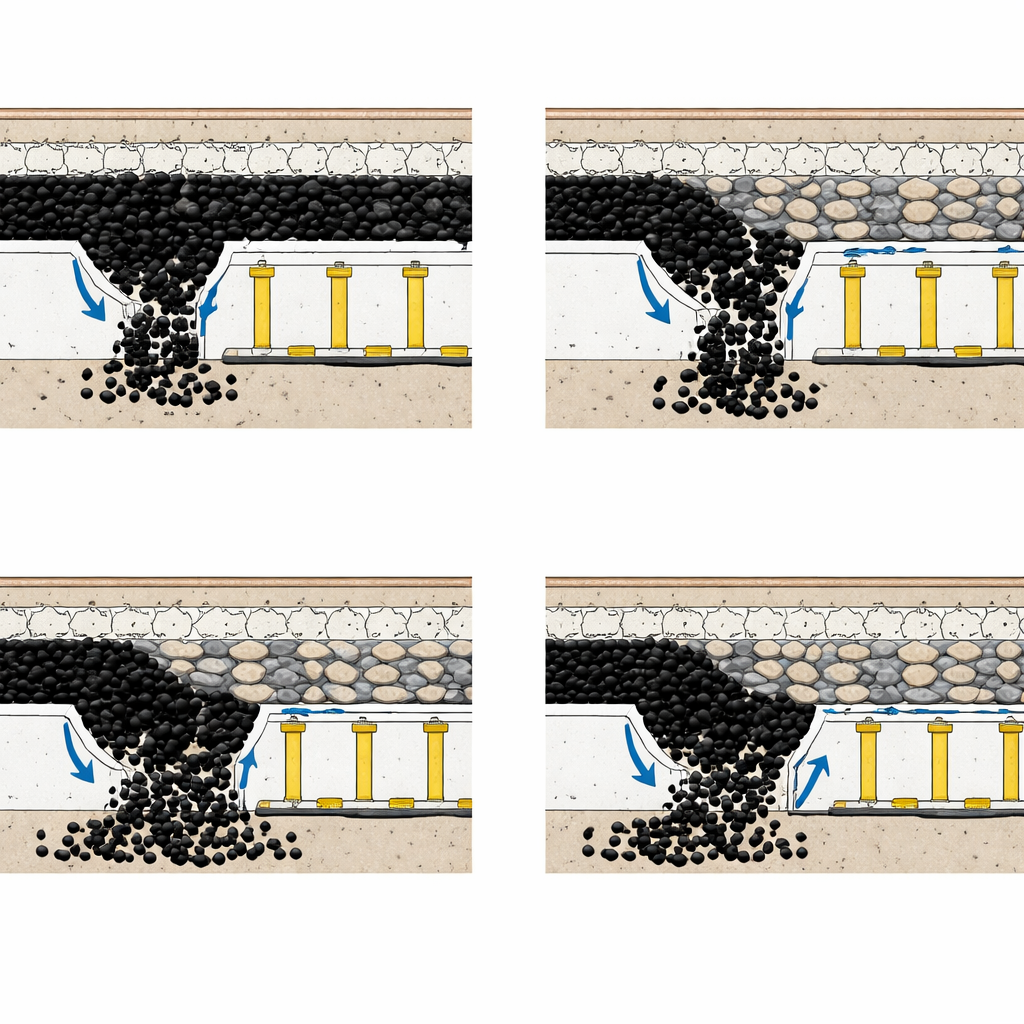
To double-check the virtual results, the authors built a transparent tank filled with black gravel for coal and white gravel for roof rock, scaled to match the geometry of the real seam. Adjustable slots at the bottom stood in for the drawing ports on the supports. By changing step distances and opening patterns and by weighing the materials that came out of each slot, they could see how small changes in timing altered both the amount of coal recovered and the share of rock. Shorter step distances recovered the most coal but also tended to pull more rock once drawing continued too long. Larger step distances reduced rock somewhat but left more coal stranded in the model goaf, the empty space behind the supports.
When to shut the window on flowing rock
Because any real operation must weigh coal price against the expense of removing impurities, the team went further and quantified cut-off rules for stopping each drawing burst. Working with their physical model, they measured how the fraction of rock in the mixture rose as drawing continued after the first appearance of gangue. From this they proposed practical "window-closing" principles: in early drawing, one option is to allow rock to reach roughly one-fifth of the volume to achieve nearly complete coal recovery, or to stop earlier when rock is closer to one-eighth if coal quality is paramount. In repeated cycles, they suggest looser limits—about one-sixth of the volume—because less coal remains and the economic trade-off shifts.
From simulation to mine face
Applying these optimized settings at the actual 11508 working face—cutting 1.96 meters, drawing 2.94 meters, and moving the face every 0.8 meters with a disciplined "close when rock is seen" rule—the mine achieved a measured top-coal recovery of about 91.5 percent while bringing rock content down to around 30 percent, far better than earlier practice. For non-specialists, this means more usable coal from the same underground volume, less waste to haul and wash, and less disturbance of the surrounding rock for each tonne produced. The work shows how a subtle understanding of how broken coal flows can translate into concrete rules that make deep thick-seam mining both more efficient and more economical.
Citation: Wu, S., Xu, X., Wang, J. et al. Optimization of drawing parameters based on top-coal flow law in thick-seam caving mining. Sci Rep 16, 12078 (2026). https://doi.org/10.1038/s41598-026-35742-9
Keywords: longwall top coal caving, coal recovery, mining optimization, gangue control, thick coal seam