Clear Sky Science · en
Dynamics of household water use determinants in selected Local Government Areas in Oyo Zone of Oyo State Nigeria
Why Water Choices Matter for Everyday Life
For millions of families, getting water is not as simple as turning on a tap. This study looks closely at how households in two parts of Oyo State, Nigeria—one largely rural, the other more semi-urban—find and use water each day. By following how far people walk, which sources they trust, and what they use water for, the research reveals why some communities can barely meet basic needs while others use water for small businesses and gardens. The findings help explain why safe, reliable water remains out of reach for many, even in regions that are not naturally dry.
Two Neighbourhoods, One Shared Challenge
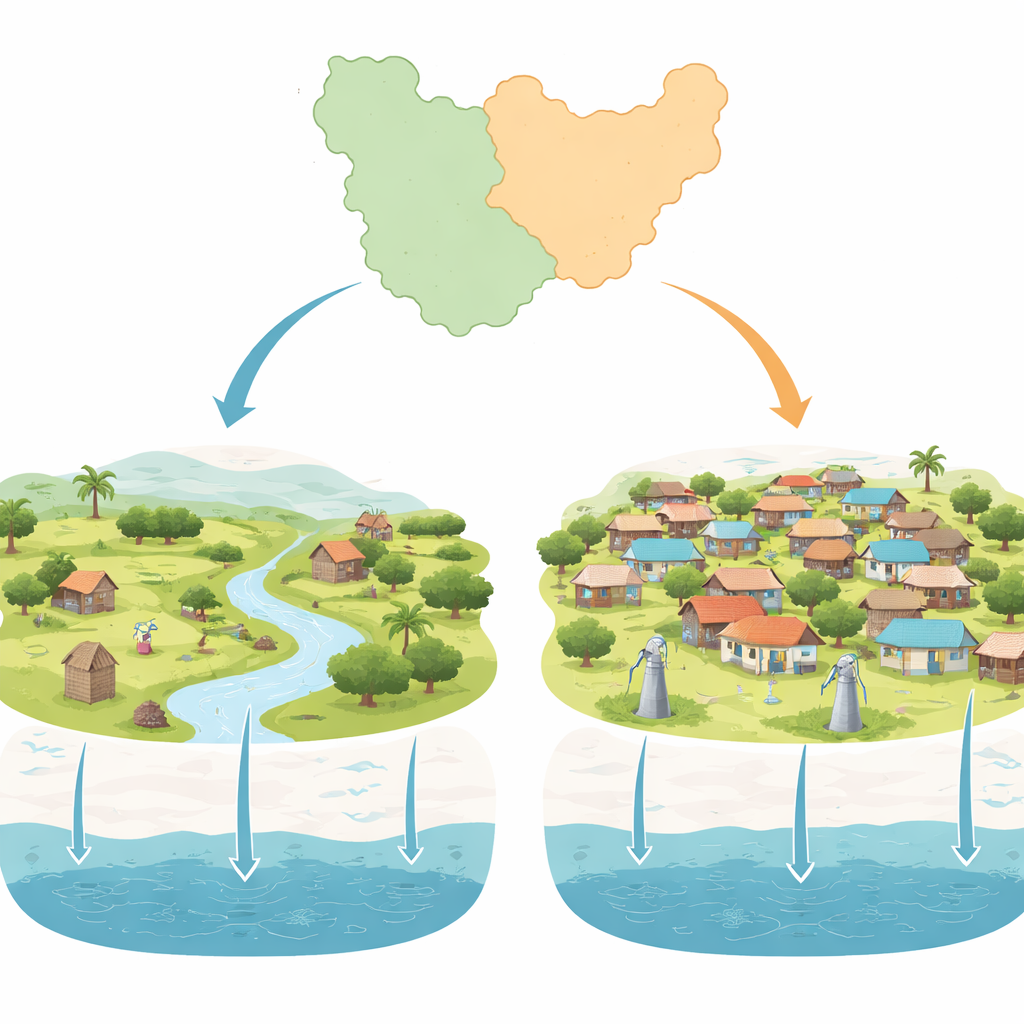
The researchers compared Afijio, a mainly rural area with scattered homes and farms, to Oyo East, a denser, semi-urban district that includes parts of Oyo town. They surveyed 575 households, capturing details such as age, family size, income, and where people get their water. In both places, the population is mostly young adults living in small to medium-sized households, and women play a central role in managing water at home. Despite these similarities, the two areas differ sharply in how water fits into daily life and local livelihoods.
Where the Water Really Comes From
In both Afijio and Oyo East, household taps connected to a central network are almost nonexistent. Fewer than one in two hundred households report using piped water. Instead, people rely heavily on groundwater, especially hand-dug wells: about 96% of households in Afijio and 93% in Oyo East use them. Deeper boreholes are an important backup, serving nearly half of Afijio households and over half in Oyo East. Surface water such as streams and rivers still matters in Afijio, where about one in eight households use it, but is rarely used in Oyo East. These patterns show a strong dependence on self-provided or community-built sources, with little support from large-scale public systems.
How Households Use the Water They Find
Across both areas, every surveyed household uses water for drinking, cooking, bathing, and washing clothes—basic needs that cannot be skipped. Beyond that, however, water use begins to tell two different stories. In Afijio, water use stays close to essentials, with fewer homes using water for flushing toilets, maintaining lawns, gardening, or running small enterprises. In Oyo East, households more often use water for activities such as vehicle washing, livestock, home gardens, and light processing work done from the home. This broader set of uses reflects both greater economic activity and somewhat better access to water for non‑essential purposes.
What Makes Water Easier or Harder to Reach
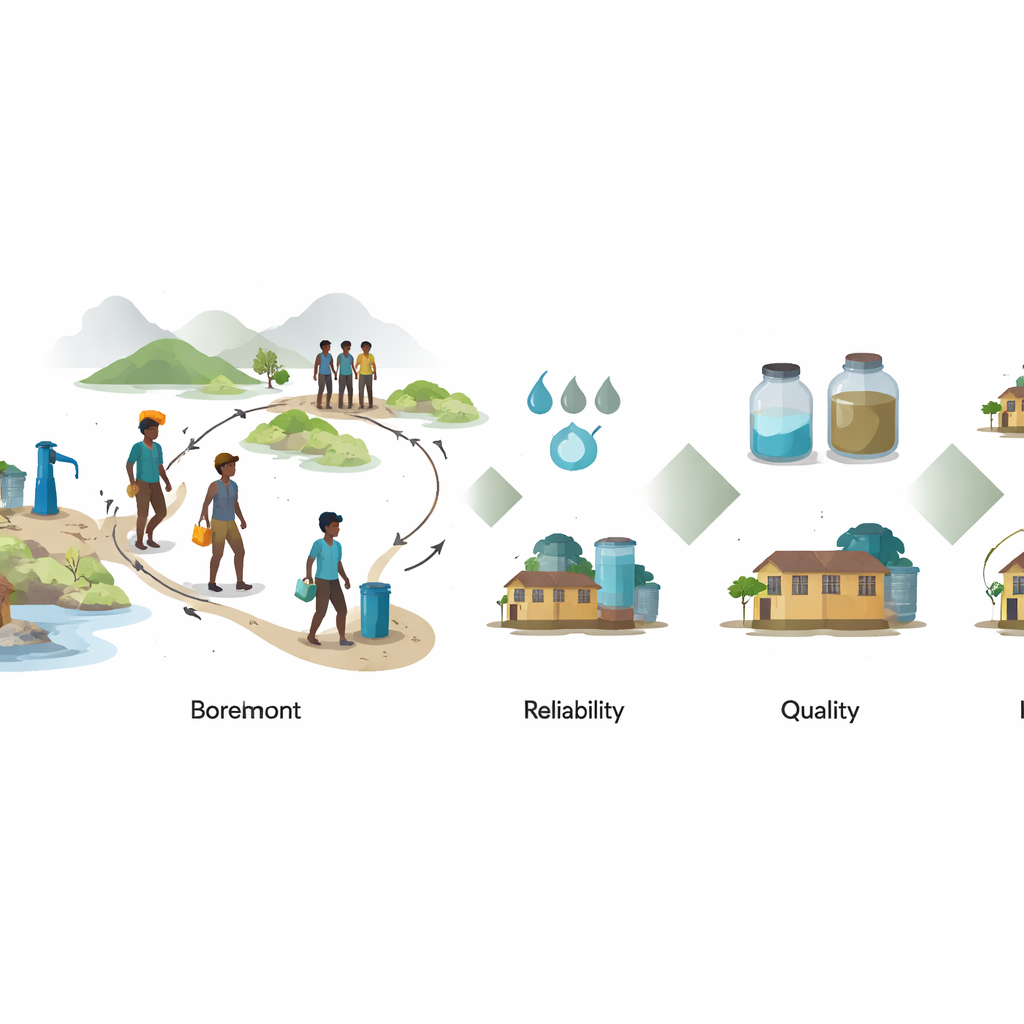
To understand why some households have better access than others, the study grouped many survey responses into a smaller set of underlying influences. Four main ideas emerged: how easy it is to reach the source, how dependable the flow is, whether the water appears safe, and the specific situation and preferences of each household. In Afijio, the distance to a source was the single strongest factor; long walks and difficult terrain turn a bucket of water into hard physical labour. In Oyo East, the most important issue was reliability: even when sources are closer, irregular flow, crowded points, or breakdowns force families to search for alternatives. In both places, worries about water safety and the time or effort needed to collect it strongly shape which sources people actually use.
What These Findings Mean for Communities
The study concludes that improving water access is not just about drilling more wells or adding pipes; it also means shortening walking distances, making supply more dependable, and ensuring that water is safe enough that families are willing to use it. In Afijio, the priority is bringing sources closer to scattered homes and reducing reliance on rivers and shallow, unregulated wells. In Oyo East, strengthening existing systems and keeping boreholes and other sources running smoothly would help households use water more safely and productively. By tailoring solutions to local conditions and everyday behaviour, the authors argue, communities can move closer to a future where clean, reliable water is truly a basic service rather than a daily struggle.
Citation: Oyelami, A.A., Ogunbode, T.O. & Owoeye, M.O. Dynamics of household water use determinants in selected Local Government Areas in Oyo Zone of Oyo State Nigeria. Sci Rep 16, 9613 (2026). https://doi.org/10.1038/s41598-025-33339-2
Keywords: household water use, rural semi-urban Nigeria, water access, groundwater wells, water security