Clear Sky Science · en
Key role of oxidizing species driving water oxidation revealed by time-resolved optical and X-ray spectroscopies
Why this research matters for clean energy
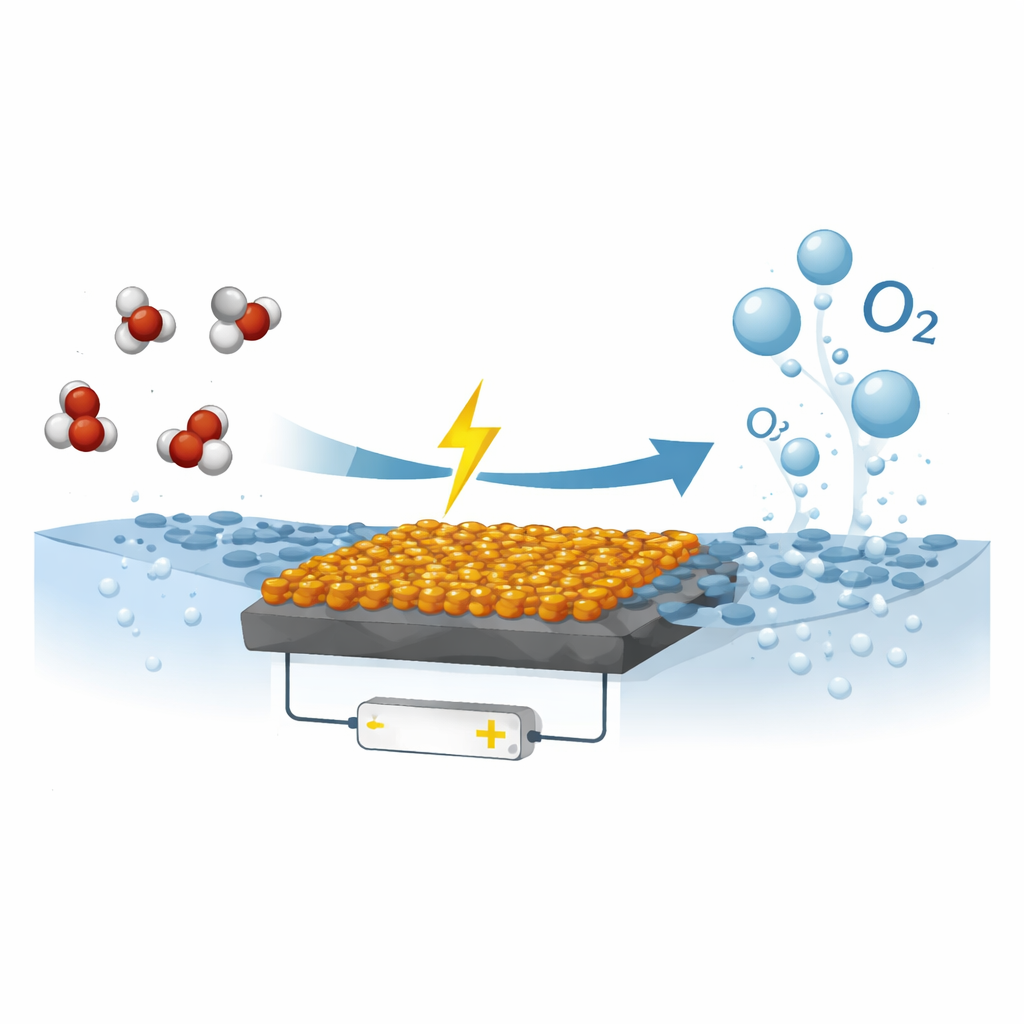
Splitting water into oxygen and hydrogen is central to many clean energy technologies, from green hydrogen production to carbon free fuels. A key step in this process, turning water into oxygen gas on a catalyst surface, is surprisingly hard to understand at the atomic level. This study looks closely at iridium oxide, one of the best known oxygen forming catalysts, to uncover which atoms actually do the hard oxidizing work and how they behave while the reaction is running.
Looking beyond simple charge labels
In chemistry class we learn neat rules for oxidation states, where atoms are assigned tidy charges that help explain reactions. Real materials are less tidy. In solids like metal oxides, electrons are shared between metal and oxygen, blurring the line between where charge sits. This is especially true at wet, working interfaces where water is being split by electricity. For iridium oxides, scientists have long debated whether highly charged metal atoms or special oxygen sites are the true drivers of oxygen release. Earlier studies using single techniques gave conflicting answers, leaving a major gap in how we design better catalysts.
Watching a catalyst in action from many angles
The authors tackled this problem by combining several tools at once while the catalyst was operating in water. They used theoretical calculations to predict how electron density shifts between iridium and oxygen atoms as the voltage is raised. In parallel, they measured changes in light absorption, hard X rays sensitive to iridium atoms, and soft X rays tuned to oxygen atoms, all under working conditions. They also detected oxygen gas with a highly sensitive mass spectrometer and tracked how signals changed in real time when the applied voltage was stepped or briefly turned off.
From metal focused changes to oxygen focused changes
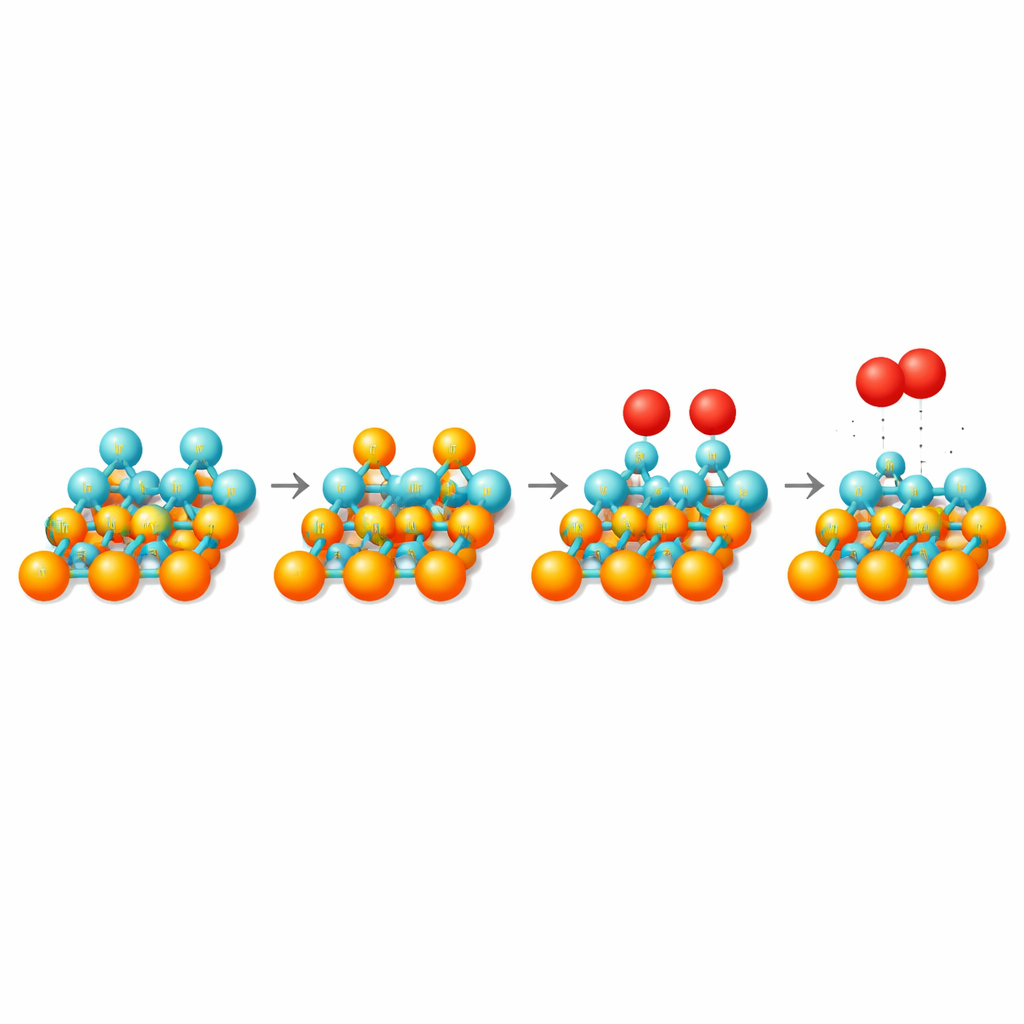
The results reveal a clear sequence as the voltage increases. At lower voltages, most of the electron loss occurs on the iridium atoms, which move through different charge like states while the surface gradually deprotonates water into bound hydroxyl and oxygen species. As the voltage climbs further, the situation shifts. The average charge on iridium stops increasing, but new signals appear in the oxygen sensitive X ray region and in the optical spectra. Theory shows that at this stage the energy levels of iridium and oxygen states line up so that removing additional electrons mainly affects oxygen atoms at the surface, creating very electron poor oxygen sites the authors denote as O−1.
Following short lived oxygen hotspots
Time resolved measurements show that these electron hungry oxygen sites behave very differently from the oxidized iridium. Once formed at high voltage, iridium in its more oxidized form remains comparatively stable, barely changing when the voltage is switched off. The O−1 species, by contrast, decay quickly, on a timescale that closely matches the rate at which oxygen gas is produced. During open circuit periods, the decay of the optical and oxygen X ray signals is accompanied by a burst of oxygen detected by mass spectrometry. Quantitative analysis indicates that about four of these O−1 sites are consumed for each oxygen molecule released, consistent with them being directly involved in forming the O–O bond between two oxygen atoms on the surface.
What this means for better catalysts
By tying together theory, multi type spectroscopy and gas detection, the study concludes that the most reactive oxidizing species on iridium oxide are not the metal atoms themselves but these highly electron deficient surface oxygen atoms. The metal still plays a key supporting role by bonding strongly to oxygen and tuning energy levels so that O−1 can form and be stabilized under high voltage. This picture resolves long standing disagreements about metal centered versus oxygen centered activity and suggests that future catalyst design should focus on controlling metal oxygen bonding and band alignment to favor such reactive oxygen configurations. More broadly, the approach of mapping how oxidation states evolve with applied potential offers a roadmap for understanding other important reactions at solid liquid interfaces, from carbon dioxide reduction to oxygen reduction in fuel cells.
Citation: Liang, C., Garcia Verga, L., Moss, B. et al. Key role of oxidizing species driving water oxidation revealed by time-resolved optical and X-ray spectroscopies. Nat. Mater. 25, 799–807 (2026). https://doi.org/10.1038/s41563-026-02514-9
Keywords: water oxidation, iridium oxide, oxygen evolution, electrocatalysis, reactive oxygen species