Clear Sky Science · en
Millennial-scale Atlantic overturning circulation led by the Southern Ocean
Why this ocean story matters
Far below the ocean surface, slow moving currents quietly move heat, carbon and nutrients around the globe, helping to set the climate we live in. This study looks back more than a thousand years to see how those hidden currents have changed over time. By reading chemical clues locked inside deep sea corals, the authors show that shifts in waters around Antarctica have helped steer the strength of a key Atlantic current that affects weather patterns, sea levels and ecosystems on both land and sea.
Reading climate history from deep sea corals
Instead of relying only on modern instruments, which have watched the oceans for just a few decades, the researchers turned to ancient bamboo corals collected from seamounts in the southwest Pacific and from a deep basin near Antarctica. These corals grow slowly, laying down calcite skeletons that store information about the temperature, saltiness, age and acidity of the water they live in. By carefully dating coral skeleton layers and measuring ratios of magnesium to calcium, oxygen and carbon isotopes, radiocarbon and boron isotopes, the team reconstructed the history of a mid depth water mass known as Antarctic Intermediate Water over the past 1,300 years. 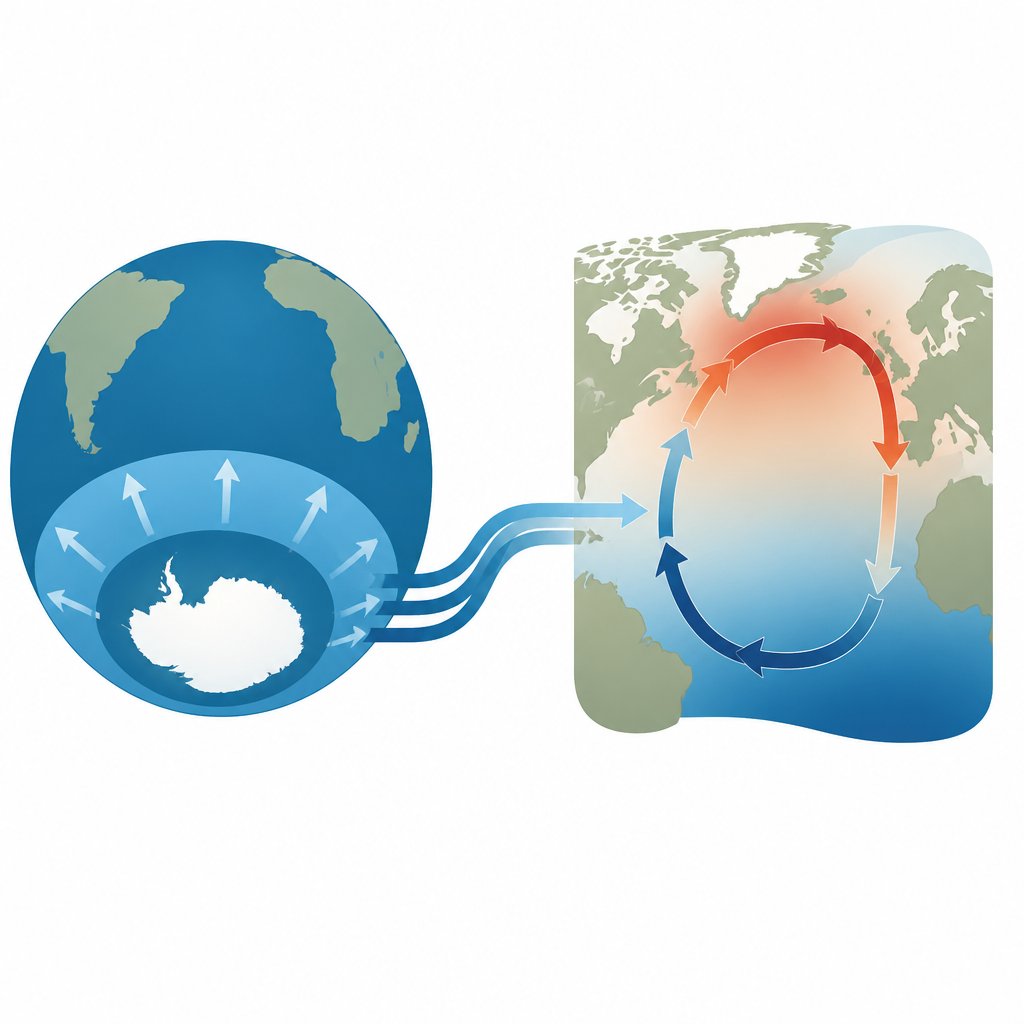
A long decline in southern waters
The coral records reveal that these southern mid depth waters were relatively warm until about the mid fifteenth century. Since then, they have slowly cooled and become fresher. Additional chemical clues show that the water has also become slightly younger in radiocarbon age and more alkaline over the past few centuries. Together, these shifts suggest that less deep, old and carbon rich water from around Antarctica has been rising to the surface and mixing into the intermediate layer. Instead, a greater share of cooler, fresher water appears to be feeding this part of the ocean. The authors argue that this points to a gradual weakening of the overturning circulation in the Southern Ocean, the system of upwelling and sinking that helps drive global deep currents.
Southern changes felt in the Atlantic
When the team compared their coral based record with existing reconstructions of the Atlantic Meridional Overturning Circulation, they found that changes in the Southern Ocean show up in the Atlantic several decades later. Periods when Antarctic Intermediate Water cooled matched later slowdowns in the Atlantic overturning strength, with a typical delay of about 50 years. A coral from the Bransfield Strait, a basin influenced by water that feeds the deepest parts of the Atlantic, told a similar story: since the mid 1800s, these deep southern waters have cooled and freshened in step with the intermediate waters, and their variations also line up with later changes in Atlantic overturning. This pattern supports model results that suggest the Atlantic responds to changes in the properties of southern sourced waters carried northward over many decades.
Two way traffic between poles
The links are not purely one way. Statistical tests show that on shorter timescales of years to decades, southern waters and the Atlantic overturning can both lead and lag one another. The authors interpret this as evidence for quick wave like signals that can travel rapidly around the ocean basins, layered on top of the slower, advective movement of water masses. They also identify two periods when the Atlantic overturning was weaker than expected given the state of southern waters: during the Medieval Warm Period around 1260 to 1450, and again since the mid twentieth century. In those times, local factors in the North Atlantic, such as changes in surface freshwater input, appear to have pushed the system further than southern influences alone would suggest. 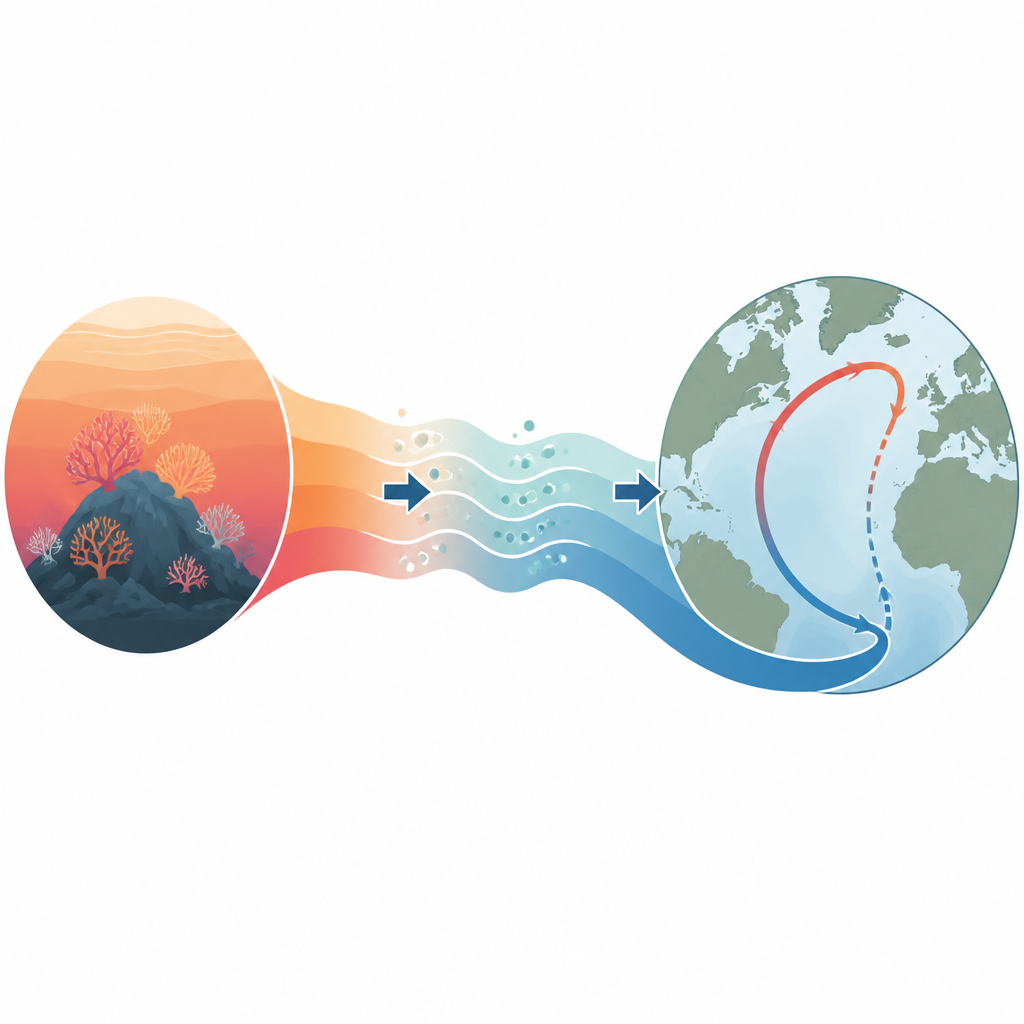
What this means for our future climate
To a non specialist, the key message is that the Atlantic current system now attracting attention for its recent weakness has a long history of being shaped by what happens around Antarctica. The coral archives indicate that overturning in both hemispheres is currently weaker than at any time in the past millennium, and that the Atlantic has recently been further weakened by local changes in the north. Rather than acting in isolation, the great ocean currents behave like a linked, slowly responding network. Understanding that the Southern Ocean can precondition the Atlantic current to stay weak helps explain present trends and will improve efforts to predict how the climate system might evolve in a warming world.
Citation: Thresher, R.E., Rintoul, S.R., Fallon, S.J. et al. Millennial-scale Atlantic overturning circulation led by the Southern Ocean. Nat. Geosci. 19, 520–525 (2026). https://doi.org/10.1038/s41561-026-01959-6
Keywords: Atlantic overturning circulation, Southern Ocean, deep sea corals, paleoclimate, ocean circulation change