Clear Sky Science · en
Hyperpyramidalized alkenes with bond orders near 1.5 as synthetic building blocks
Why bending bonds can matter in real life
Chemists usually learn that a double bond between two carbon atoms is a flat, sturdy link, a bit like a rigid plank in a building. This article explores what happens when that plank is forced to bend and buckle inside tiny carbon cages. The work reveals new types of “spring‑loaded” molecules whose built‑in stress makes them unusually eager to snap together with other pieces, opening fresh ways to design compact, three‑dimensional structures that could be useful in drug discovery and energy research.
From ordinary double bonds to bent ones
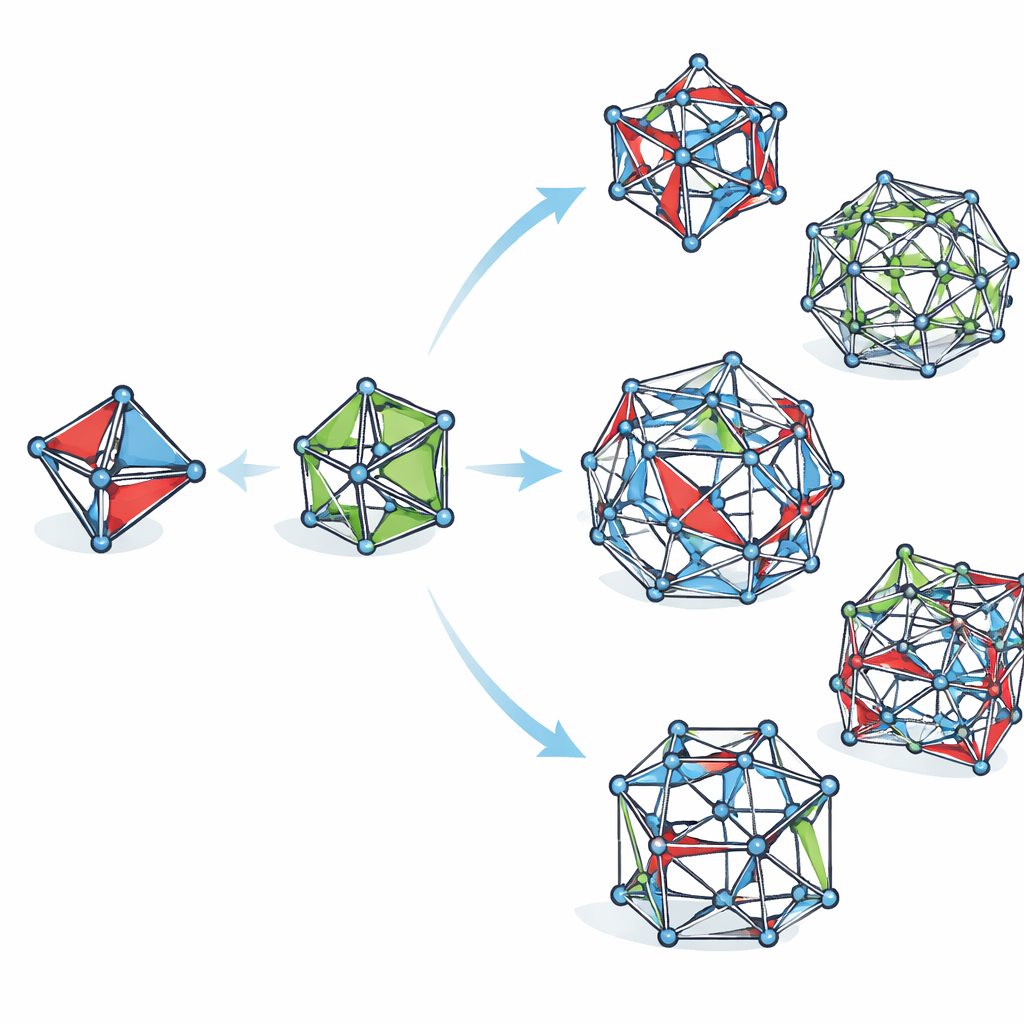
In familiar molecules, a carbon–carbon double bond keeps the attached atoms in a flat arrangement, which maximizes the sharing of electrons and gives the bond a strength associated with a “bond order” of about two. Chemists have long known that this geometry can be distorted if the double bond is trapped inside a small ring, tilting the atoms out of the usual plane. This tilting, called pyramidalization, weakens part of the bonding and nudges the bond order below two. Until now, such distorted double bonds were mostly curiosities, with only a few practical uses.
Introducing ultra‑bent cage molecules
The authors revisit two striking but neglected molecules, called cubene and 1,7‑quadricyclene. Each hides a double bond inside a rigid cage of carbon atoms, forcing the bond into an extreme bent shape the team calls hyperpyramidalization. Calculations show that in these cages the angles around the double bond are pushed far from normal, and the electrons that usually form a strong “pi” link become misaligned and partly reoriented. As a result, the effective bond order drops to around 1.5, halfway between a single and a double bond, and the bond becomes both weaker and more reactive than in standard molecules.
Building practical pathways to these cages
Earlier attempts to make cubene and 1,7‑quadricyclene required harsh conditions and gave limited products. The researchers now develop gentler, more flexible routes using so‑called Kobayashi‑type precursors. These precursors carry a silicon group next to a good leaving group. When fluoride is added, the cage‑like reactive species appears briefly and can be caught in place by another molecule. This strategy allows the team to generate both kinds of cages under mild conditions and to trap them immediately in reactions before they fall apart.
Snapping cages together to form complex shapes
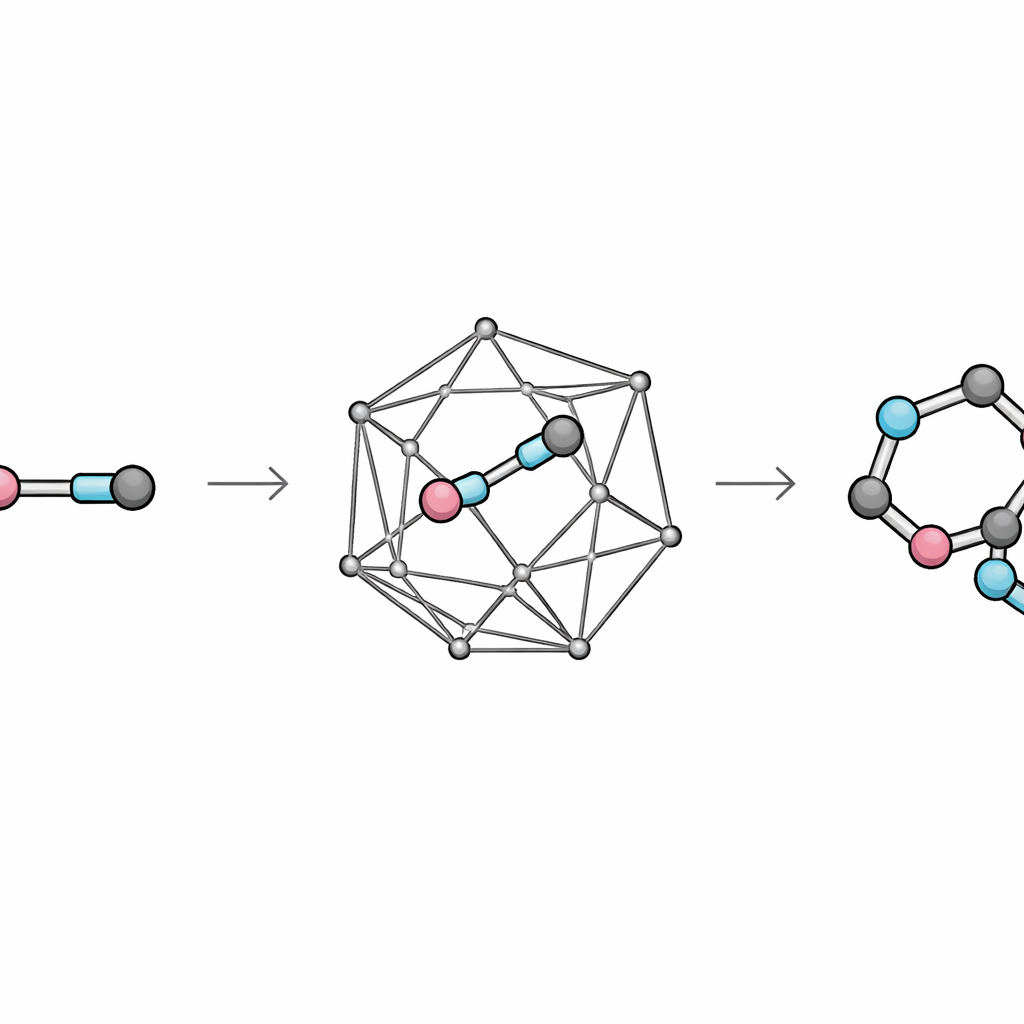
Once the reactive cages are available on demand, the team puts them to work as “connectors” in bond‑forming reactions called cycloadditions. In these processes, the distorted double bond in the cage snaps together with a partner such as a flat aromatic ring or a small ring rich in electrons, forming new fused frameworks. Remarkably, many of the resulting products contain four newly formed, crowded carbon centers in a row, all anchored on the rigid cage. By varying the trapping partners, the chemists build an assortment of five‑ and six‑membered rings fused onto the cages, as well as more elaborate bicycles and bridged systems that would be very difficult to construct by other means.
How distortion boosts reactivity
Computer simulations help explain why the bent double bonds are such powerful building blocks. When the bond is pushed out of plane, its electron orbitals twist and mix in a way that weakens the pi portion of the bond and raises its energy. At the same time, the whole cage structure is highly strained, like a compressed spring. When the cage reacts in a cycloaddition, this stored strain is released, making the reaction strongly energy‑releasing and lowering the barrier to reaction compared with a normal flat double bond. The authors show that these effects together make cubene and 1,7‑quadricyclene react rapidly with partners such as anthracene to give intricate products.
Why these tiny cages matter
The study demonstrates that deliberately bending a double bond inside a rigid framework is not just a geometric oddity but a powerful design principle. Hyperpyramidalized bonds act as controllable hot spots that can stitch together dense, three‑dimensional shapes full of closely packed carbon atoms. Such shapes are attractive in medicinal chemistry, where compact, saturated frameworks can improve how drug candidates behave in the body, and in areas like solar energy storage that rely on strained molecules. By mapping how distortion lowers bond order and boosts reactivity, the work points the way toward many other “spring‑loaded” molecules that chemists might design and use as versatile synthetic building blocks.
Citation: Ding, J., French, S.A., Rivera, C.A. et al. Hyperpyramidalized alkenes with bond orders near 1.5 as synthetic building blocks. Nat. Chem. 18, 913–922 (2026). https://doi.org/10.1038/s41557-025-02055-9
Keywords: strained molecules, hyperpyramidalized alkenes, cubene, quadricyclene, cycloaddition chemistry