Clear Sky Science · en
A complete set of canonical nucleobases in the carbonaceous asteroid (162173) Ryugu
Why space rocks matter for our own beginnings
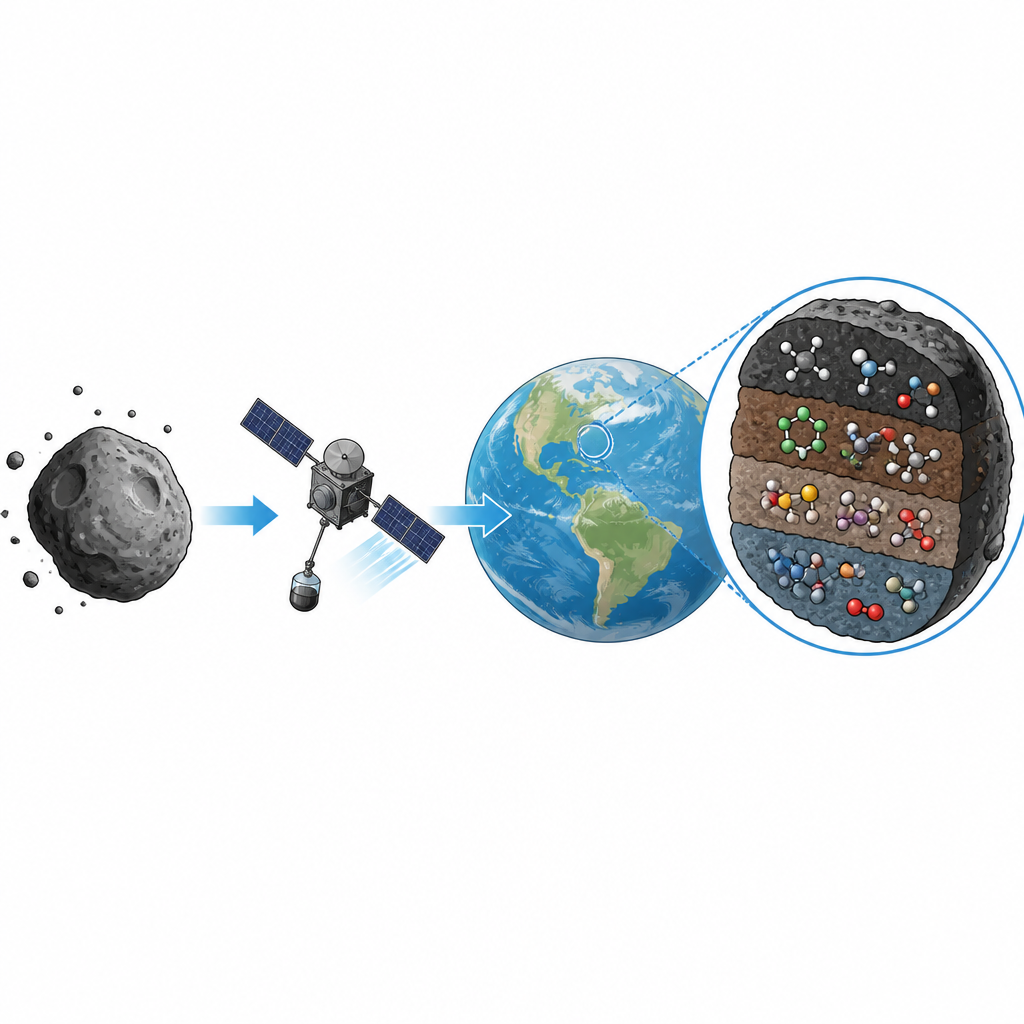
Every living thing on Earth relies on a small family of molecules that store and read genetic information. These same molecules may not have started out on our planet at all. This study looks at samples from the asteroid Ryugu, brought back by Japan’s Hayabusa2 mission, and finds that this small, dark world carries a complete set of the genetic building blocks used in DNA and RNA. The work helps answer a deep question: did some of life’s key ingredients rain down from space in the Solar System’s early days?
The alphabet of life
Our genetic code is written with five main “letters,” called nucleobases: adenine and guanine on one side, and cytosine, thymine and uracil on the other. On Earth they are essential parts of DNA and RNA, and they also appear in energy and helper molecules that power cells. Because they are so central to biology, scientists have long wondered how easily such compounds can form without life, and whether they exist on other worlds that never grew plants or animals.
Bringing an asteroid into the lab
To explore this, the researchers studied two tiny rock samples from different landing points on Ryugu, named A0480 and C0370. These grains were collected in space and sealed before ever touching Earth’s air, which makes them far cleaner than meteorites that fall to the ground. The team gently soaked the samples in water and acid to draw out soluble organic material, then used sensitive separation and weighing techniques to hunt for nucleobases and related compounds, comparing the results to those from the Orgueil and Murchison meteorites and from the asteroid Bennu.
Finding the full set of letters in a space rock
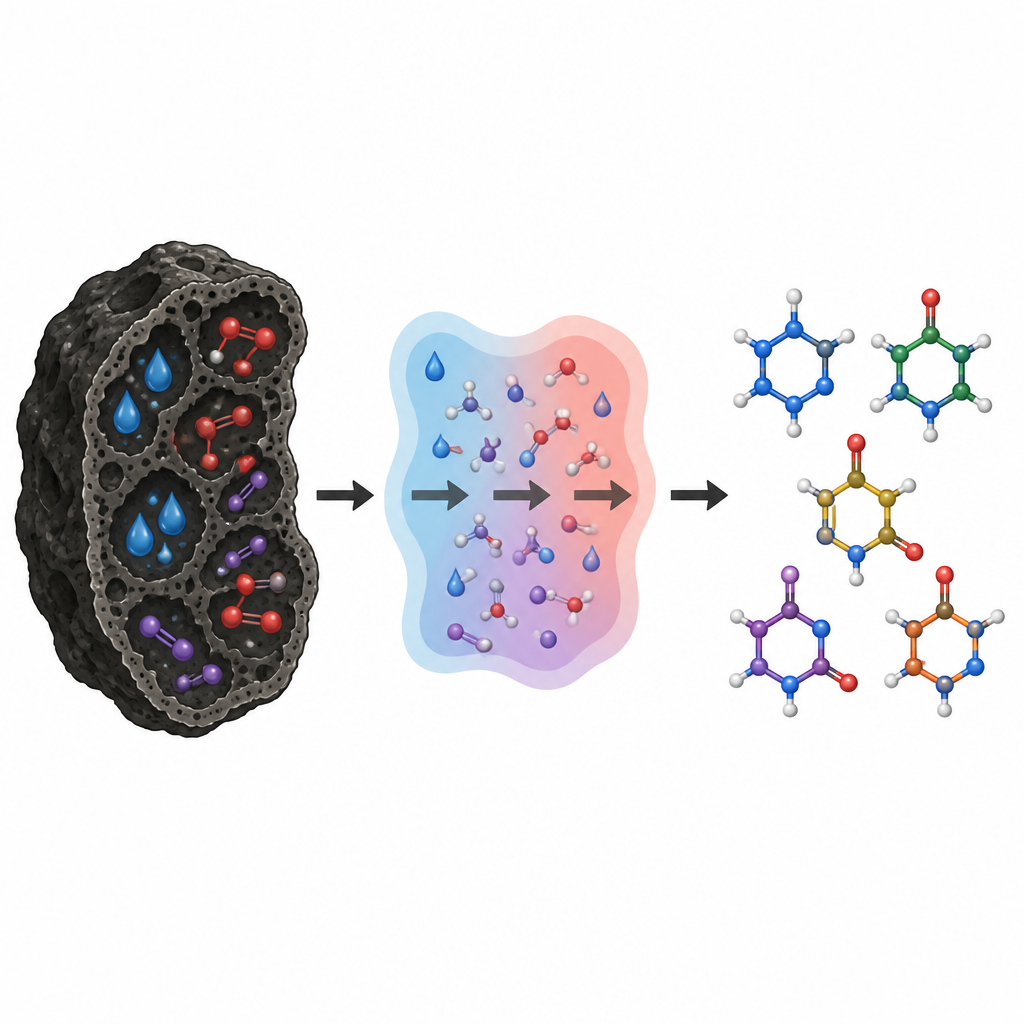
The analyses revealed clear signatures of all five canonical nucleobases in Ryugu: adenine, guanine, cytosine, thymine and uracil. The team also detected closely related molecules such as hypoxanthine, xanthine and 6-methyluracil, along with vitamin-like compounds, amino acids, urea and other nitrogen-rich species. Careful checks against blank samples showed that these signals do not come from modern contamination. Interestingly, Ryugu’s two samples contained similar total amounts of nucleobases but differed in detail, reflecting small chemical variations across the asteroid’s surface.
Comparing space laboratories
When the scientists compared Ryugu with Bennu and the Orgueil and Murchison meteorites, they found that each object has its own “recipe” of nucleobases. Ryugu holds roughly equal amounts of the two main nucleobase families, while Murchison is richer in adenine- and guanine-like compounds, and Bennu and Orgueil lean toward uracil and its cousins. These ratios line up with how much ammonia each body seems to have hosted in its ancient water-rich interiors. Experiments and models suggest that different balances of simple ingredients such as ammonia, carbon-oxygen molecules and cyanides can steer chemistry toward one family of nucleobases or the other.
What this means for life’s raw ingredients
The presence of a full suite of nucleobases, plus many related compounds, in Ryugu and Bennu shows that the raw alphabet of genetics arises naturally in small, icy-rocky bodies scattered through the Solar System. The specific mix on each asteroid appears to record the conditions in its parent body rather than any trace of biology. These findings strengthen the idea that early Earth was showered with a varied stock of organic building blocks from carbon-rich asteroids, providing some of the materials that later chemistry needed to assemble the first RNA and DNA based systems.
Citation: Koga, T., Oba, Y., Takano, Y. et al. A complete set of canonical nucleobases in the carbonaceous asteroid (162173) Ryugu. Nat Astron 10, 655–663 (2026). https://doi.org/10.1038/s41550-026-02791-z
Keywords: asteroid Ryugu, nucleobases, origins of life, carbonaceous meteorites, prebiotic chemistry