Clear Sky Science · en
Localized or diffusive: insights into the source and geochemical dynamics of dissolved mercury contamination in groundwater of the mid-Gangetic Plains
Why hidden mercury in groundwater matters
For millions of people across northern India, groundwater pumped from handpumps and tube wells is the main source of drinking water. This study shows that in the industrial city of Kanpur, along the middle stretch of the Ganges, that water quietly carries dissolved mercury and other metals. Because mercury is poisonous even at very low levels and can change into more toxic forms in nature, understanding where it comes from and how it behaves underground is vital for protecting communities, especially children.
Mercury in a working river plain
The researchers sampled 39 groundwater wells and 11 sites on the Ganga River in and around Kanpur. Mercury was detected in every groundwater sample, and about one in five wells exceeded India’s drinking water guideline of 1 microgram per liter, while the river samples stayed below this level. Unlike a clear spill from a single factory pipe, the pattern looked patchy and diffuse. The groundwater also showed higher electrical conductivity and dissolved solids than the river, signs that water spends more time underground, evaporates, and interacts with minerals before being pumped to the surface. Together, these clues suggested that the aquifer behaves less like a fast-flowing pipe and more like a slow trap that can store and concentrate contaminants carried in from above. 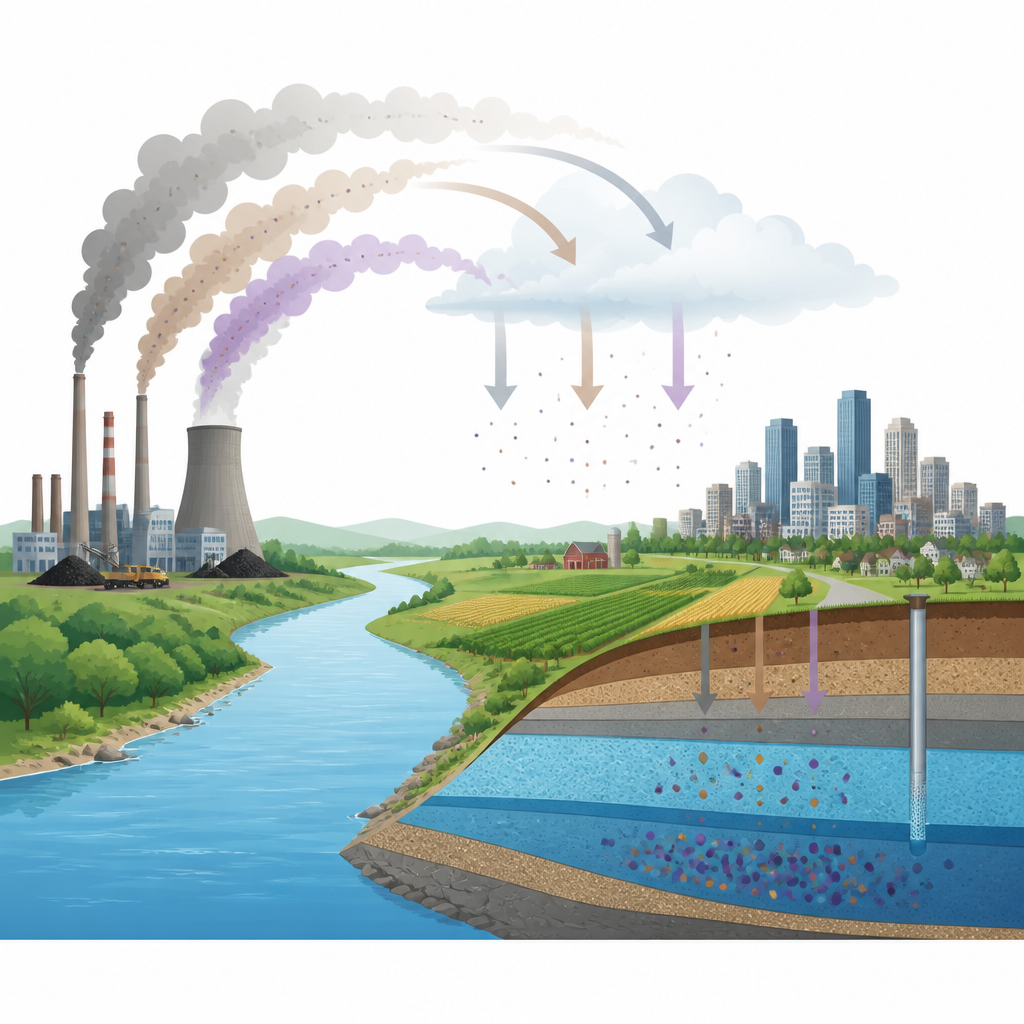
Smoke, rain, and farming as key players
Kanpur sits in a belt of coal-fired power plants, brick kilns, and other industries that release mercury and sulfur into the air. Earlier regional studies and the new data indicate that much of the mercury first reaches the area through the atmosphere: smokestacks send tiny particles into the sky, winds spread them, and monsoon rains wash them back down onto fields, soils, and water surfaces. The team found a common groundwater type rich in calcium, magnesium, and sulfate, a signature of sulfur-laden inputs from such emissions. Intensive irrigation further shapes the chemistry. Water applied to fields dissolves salts and trace metals in the soil, then returns downward. As this return flow evaporates, it leaves behind more concentrated dissolved material, including mercury, and helps move it deeper into the aquifer.
Underground chemistry that holds on to mercury
Beyond just measuring total amounts, the authors examined how the underground chemical environment controls mercury’s form and movement. By combining field measurements of acidity and redox state with theoretical diagrams, they showed that many groundwater samples sit in a zone where reduced, dissolved mercury species are stable. Under these mildly alkaline, low-oxygen conditions, mercury tends to stay dissolved rather than locking up in solid minerals. At the same time, iron and chromium mostly form less mobile solid phases, while arsenic often sticks to iron oxides. This helps explain why iron and arsenic behave differently from mercury, and why mercury can remain widespread in groundwater even when other metals are flushed out or immobilized.
A mix of natural rock and human fingerprints
The team used statistical tools to untangle overlapping influences. One cluster of elements, including sodium, calcium, magnesium, sulfate, fluoride, uranium, and boron, pointed toward natural rock weathering and salt dissolution enhanced by recharge and evaporation. Another group, dominated by metals such as chromium, lead, and iron, reflected the impact of tanneries, metal works, and other industries, especially on surface water. Mercury showed limited ties to these direct industrial discharges, strengthening the idea that it mainly arrives as a widespread atmospheric input and is then concentrated underground. Co-contaminants such as arsenic, uranium, and chromium raise additional concern, because they can interact with minerals and each other, affecting how easily they move and how people are exposed. 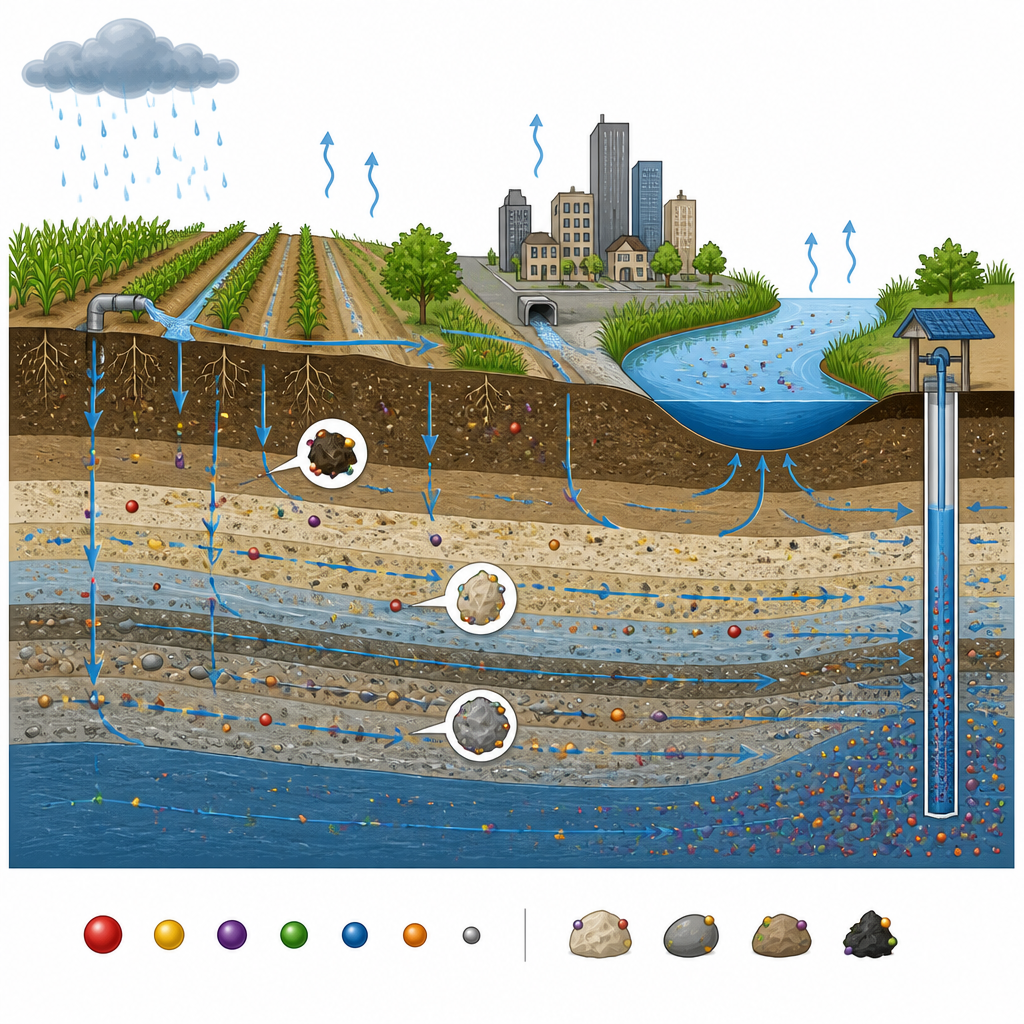
Health risks and what they mean for people
To judge how this chemistry might affect residents, the authors calculated several pollution and health indices using national and international guidelines. Most metals in groundwater stayed within limits when considered one by one, yet arsenic in river water and mercury in some wells stood out. Non-cancer health risks, expressed as hazard quotients, were highest for arsenic in river water, and overall risk was consistently greater for children than for adults because of their lower body weight and higher intake per kilogram. Cancer risk estimates, driven mainly by arsenic and chromium, were close to or above commonly accepted thresholds, particularly for people exposed to river water. While mercury was not the largest contributor in these metrics, its persistence, ability to transform into more toxic forms, and tendency to co-occur with other metals make it a serious long-term concern.
What the study concludes for everyday life
In simple terms, the study shows that mercury contamination in Kanpur’s groundwater is not a rare accident but a steady, widespread input from smokestacks, farming, and regional air pollution that the aquifer then concentrates. The river tends to carry and flush many metals downstream, but the groundwater quietly stores dissolved mercury and other contaminants where people tap it for daily use. The authors argue that managing this risk will require more than checking a single metal: regulators should monitor mercury routinely in groundwater, track multiple metals together, and focus on cutting emissions and improving wastewater and irrigation practices. For families depending on wells across the mid-Gangetic Plains, these findings highlight the need for regular testing and better oversight to keep their drinking water safe over the long term.
Citation: Kumar, M., Saxena, A., Tripathi, S. et al. Localized or diffusive: insights into the source and geochemical dynamics of dissolved mercury contamination in groundwater of the mid-Gangetic Plains. npj Clean Water 9, 40 (2026). https://doi.org/10.1038/s41545-026-00566-7
Keywords: mercury in groundwater, Ganga basin pollution, Kanpur water quality, heavy metal contamination, aquifer health risk