Clear Sky Science · en
Sleep and wake markers of thalamocortical functioning in early-course psychosis and first-degree relatives
Why Sleep and Senses Matter in Psychosis
When we sleep, our brains are far from idle. They replay memories, filter out noise, and prepare us to think clearly the next day. A key “gatekeeper” in this process is a deep brain structure called the thalamus, which routes sensory information to the thinking parts of the brain. This study explores how the thalamus and outer brain work together during sleep and wakefulness in people early in the course of psychotic disorders and in their close relatives, asking whether simple brain signals could serve as early warning signs and treatment targets.
A Brain Relay Station Under Strain
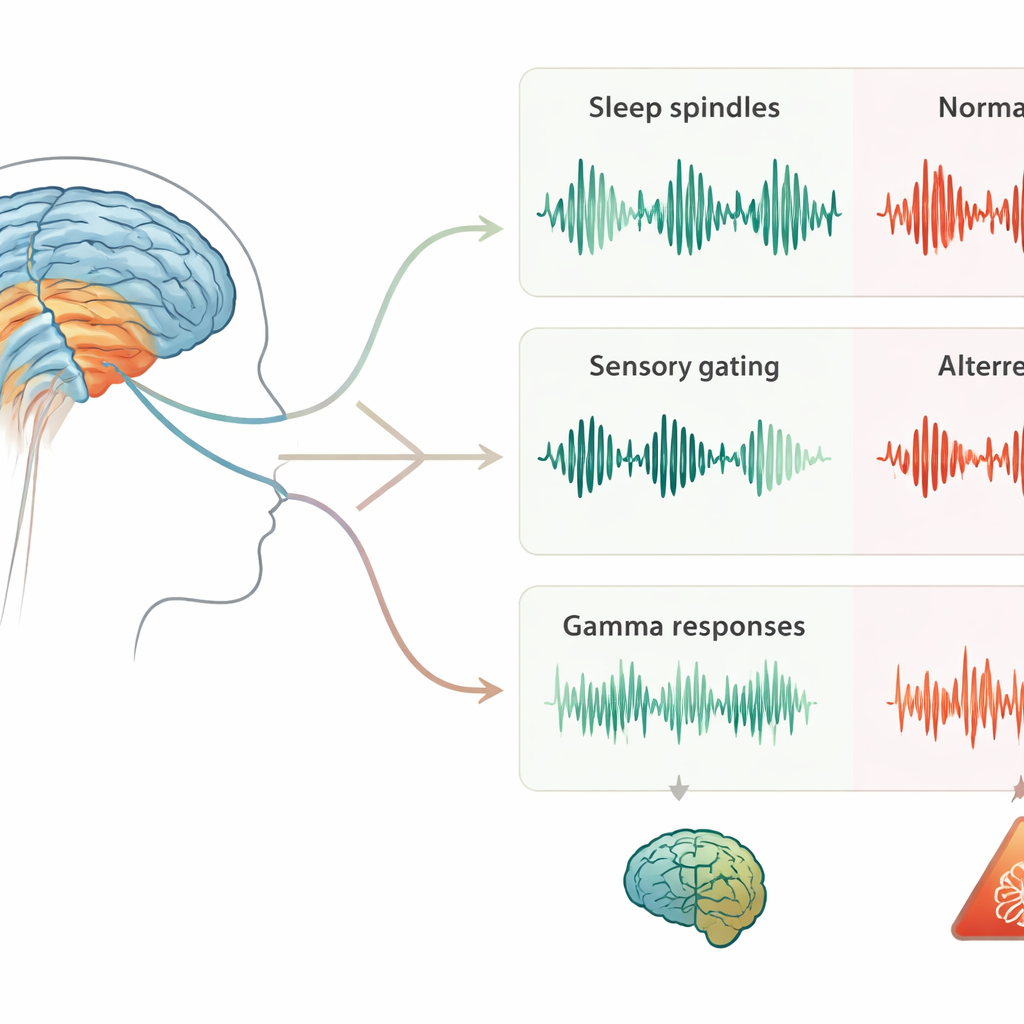
Psychotic disorders such as schizophrenia are increasingly linked to problems in the wiring between the thalamus and the cortex, the brain’s outer layer for thought and perception. The researchers focused on the thalamic reticular nucleus, a thin shell of inhibitory cells that helps the thalamus decide which sights, sounds, and internal signals to let through and which to damp down. Earlier work showed that these circuits help generate sleep spindles—brief bursts of brain waves during deep, dreamless sleep that support memory—and also help block out repetitive, irrelevant sounds when we are awake. If this gatekeeping system falters, the brain may become both noisier at night and more easily overwhelmed by incoming information during the day.
Who Took Part and What Was Measured
The team studied three groups of 13- to 35-year-olds: people with early-course psychosis, their first-degree relatives who had never experienced psychosis, and healthy volunteers with no family history of such disorders. Over several weeks, participants completed overnight sleep recordings, daytime brainwave tests, and MRI scans. During sleep, the scientists measured how often and how strongly sleep spindles appeared. While awake, they tested “sensory gating” by playing pairs of clicks and seeing how much the brain’s response to the second click was reduced, and they measured rapid 40 Hz “gamma” responses to trains of sounds. Resting-state MRI scans then mapped how strongly the thalamus was functionally connected to different cortical regions.
Sleep Waves, Sound Filtering, and Brain Wiring
People with early psychosis showed a clear reduction in sleep spindles—both in how frequently these waves occurred and in their strength—across much of the scalp. Their brains also had trouble filtering repeated sounds: the response to the second click in a pair was not as damped down as in healthy volunteers. In contrast, their close relatives did not show these spindle or sensory gating problems. However, both patients and relatives shared a different abnormality: weaker and less consistent 40 Hz gamma responses to sound, and stronger-than-normal connectivity between the thalamus and the primary auditory cortex. Across all participants, fewer sleep spindles went hand in hand with stronger thalamus connections to touch and body-sensing areas, while poorer sensory gating was linked to weaker connections between the thalamus and a key frontal thinking region. 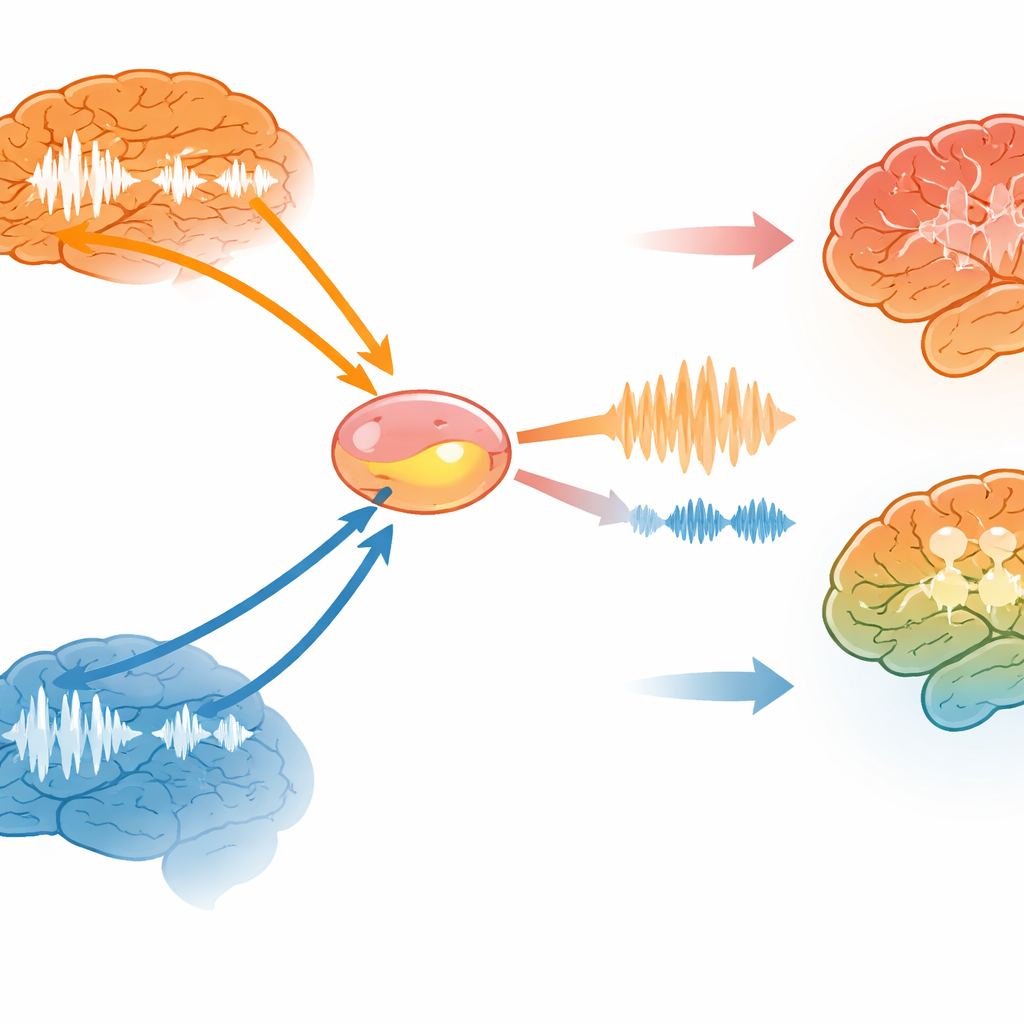
Different Signals Tell Different Parts of the Story
These patterns suggest that sleep spindles and sensory gating tap into partly separate thalamus–cortex pathways. Low spindle activity tracked with an over-tight link between the thalamus and sensorimotor regions, consistent with an overactive relay that is not being properly held in check. Sensory gating, by contrast, related to how well the thalamus communicates with front-of-brain regions involved in attention and control. The shared gamma deficits and auditory thalamus over-connectivity in both patients and relatives point to a broader vulnerability in sound-related circuits that can exist even before psychosis develops. Yet the fact that spindle and gating deficits were seen only in patients hints that these markers may reflect more advanced or severe circuit disruption, rather than inherited risk alone.
What This Means for Risk and Treatment
To a layperson, the main message is that both sleep and simple sound-based brain tests can reveal how well the brain’s internal “filters” and “relays” are working in psychosis. The study supports the idea that abnormal communication between the thalamus and the cortex underlies poor sleep spindles at night and weak sound filtering by day, but in partly different branches of the network. It also cautions that quick daytime EEG measures alone may not fully capture sleep-related brain changes. In the future, combinations of sleep spindles, sensory tests, and brain scans could help identify who is at higher risk, track disease progression, and guide treatments aimed at strengthening these critical circuits.
Citation: Baran, B., Denis, D., Mylonas, D. et al. Sleep and wake markers of thalamocortical functioning in early-course psychosis and first-degree relatives. Schizophr 12, 40 (2026). https://doi.org/10.1038/s41537-026-00735-0
Keywords: thalamocortical connectivity, sleep spindles, sensory gating, early psychosis, auditory gamma