Clear Sky Science · en
Overcoming limitations on gate fidelity in noisy static exchange-coupled surface qubits
Atoms as Tiny Building Blocks of Quantum Computers
Imagine building a quantum computer not from chips you can see, but from individual atoms arranged one by one on a surface. This study explores how to reliably flip and entangle the quantum "spins" of such atoms, which act as the basic units of quantum information. The authors ask a practical question: given that these atoms constantly interact with each other and with their noisy surroundings, how good can their logic operations really become, and how can smart pulse shaping push them closer to ideal performance?
How Surface Atoms Become Qubits
In recent experiments, researchers have learned to position single magnetic atoms on an ultra-thin insulating layer sitting on a metal surface, then probe them with the sharp tip of a scanning tunneling microscope. By sending radio-frequency signals through this tip, they can gently nudge the atom’s spin between its two basic states, effectively forming a controllable qubit. Adding more atoms nearby lets their spins interact through a fixed coupling, so that a local drive on one atom can indirectly control its neighbors. This creates an atomic-scale playground for quantum information, but it comes with headaches: the coupling is always on, the atoms have limited lifetimes, and radio pulses aimed at one qubit can unintentionally disturb others.

Hidden Limits Even Without Noise
To understand the fundamental constraints, the authors first strip away all environmental noise and analyze a pair of coupled spins performing a simple NOT operation on one qubit. Even in this idealized setting, the constant interaction between the spins reshapes how the pulses are felt by the system. Driving the two key transitions with straightforward radio tones leads to mismatched flip rates and small but persistent leakage into unwanted states. The team shows that carefully adjusting the relative pulse strengths can synchronize the flip rates and improve performance, yet a stubborn upper bound on fidelity remains because extra, off-resonant transitions can’t be fully avoided with such simple pulses.
Letting the Computer Design the Pulses
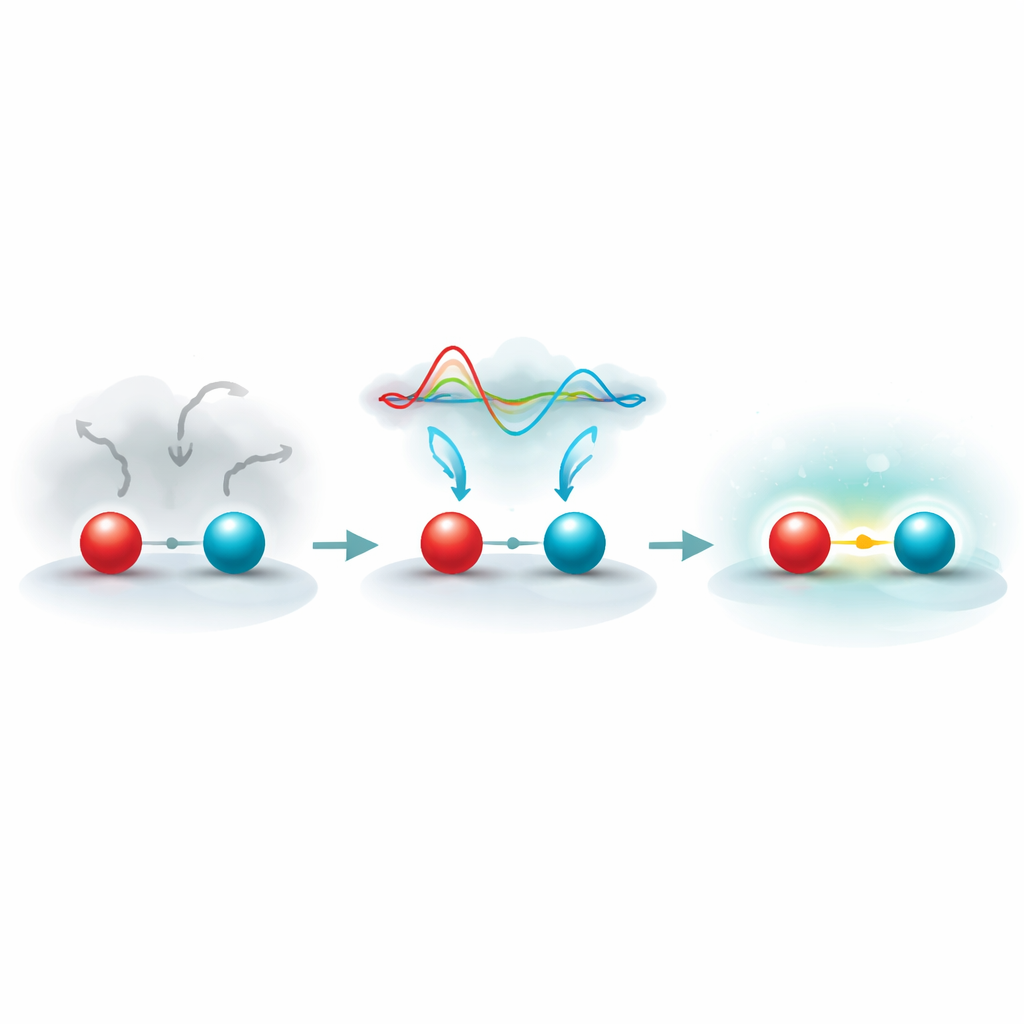
To go beyond hand-crafted pulses, the researchers turn to quantum optimal control, specifically an algorithm known as the Krotov method. Instead of guessing a few pulse frequencies and amplitudes, they feed in a broad initial pulse and let the algorithm iteratively refine its shape, guided by a mathematical measure of how close the final evolution comes to the desired quantum gate. For the same operation time, the optimized waveform naturally concentrates its energy around several key resonances of the coupled system and suppresses harmful paths. In the noise-free case, this approach pushes gate fidelities essentially to perfection, overcoming the coherent errors that limited more naive driving schemes.
Fighting Decoherence and Creating Entanglement
Real atoms on surfaces are never isolated: they lose energy to the substrate and gradually forget their quantum phase, processes captured by two characteristic timescales. The authors extend their optimization to include these effects and find how much fidelity can be salvaged when the environment is taken into account. They also consider the fact that, at finite temperature, the spins do not start in a perfectly pure state but in a thermal mixture. For preparing entangled Bell states, they show that temperature — through the initial population of energy levels — sets a strict ceiling on the achievable entanglement, while the finite lifetime during the pulse plays a surprisingly secondary role as long as it is not too short.
Design Rules for Better Atomic-Scale Quantum Gates
By comparing different control strategies under realistic conditions, the study outlines a roadmap for improving this atomic qubit platform. Noise-aware optimal pulses can adapt their spectral content to the dominant error sources and significantly outperform simple, monochromatic driving, achieving gate fidelities above 90% when remote spins live long enough and temperature is low. The authors show that turning off the measurement current during control, enhancing spin lifetimes with better decoupling from the metal, boosting drive strength to shorten gate times, and cooling the system further can all push performance higher. In plain terms, their work demonstrates that even in a tiny, noisy world of surface atoms, carefully engineered control pulses can coax these qubits into performing high-quality quantum logic, bringing atom-by-atom quantum devices closer to practical reality.
Citation: Le, HA., Taherpour, S., Janković, D. et al. Overcoming limitations on gate fidelity in noisy static exchange-coupled surface qubits. npj Quantum Inf 12, 69 (2026). https://doi.org/10.1038/s41534-026-01214-1
Keywords: surface spin qubits, quantum optimal control, gate fidelity, entanglement generation, decoherence