Clear Sky Science · en
Comparison of musculoskeletal responses and its variability after long-term spaceflight and prolonged bed rest conditions
Why life without gravity matters for your body
Sending people into space for months at a time is no longer science fiction, but our bodies are still built for life under Earth’s pull. This study asks what really happens to leg muscles and bones during long stays in orbit and during long periods of strict bed rest on Earth, and whether simple bed rest experiments can safely stand in for the real thing. The answers matter not only for astronauts on future deep space trips, but also for people who are confined to bed for medical reasons.
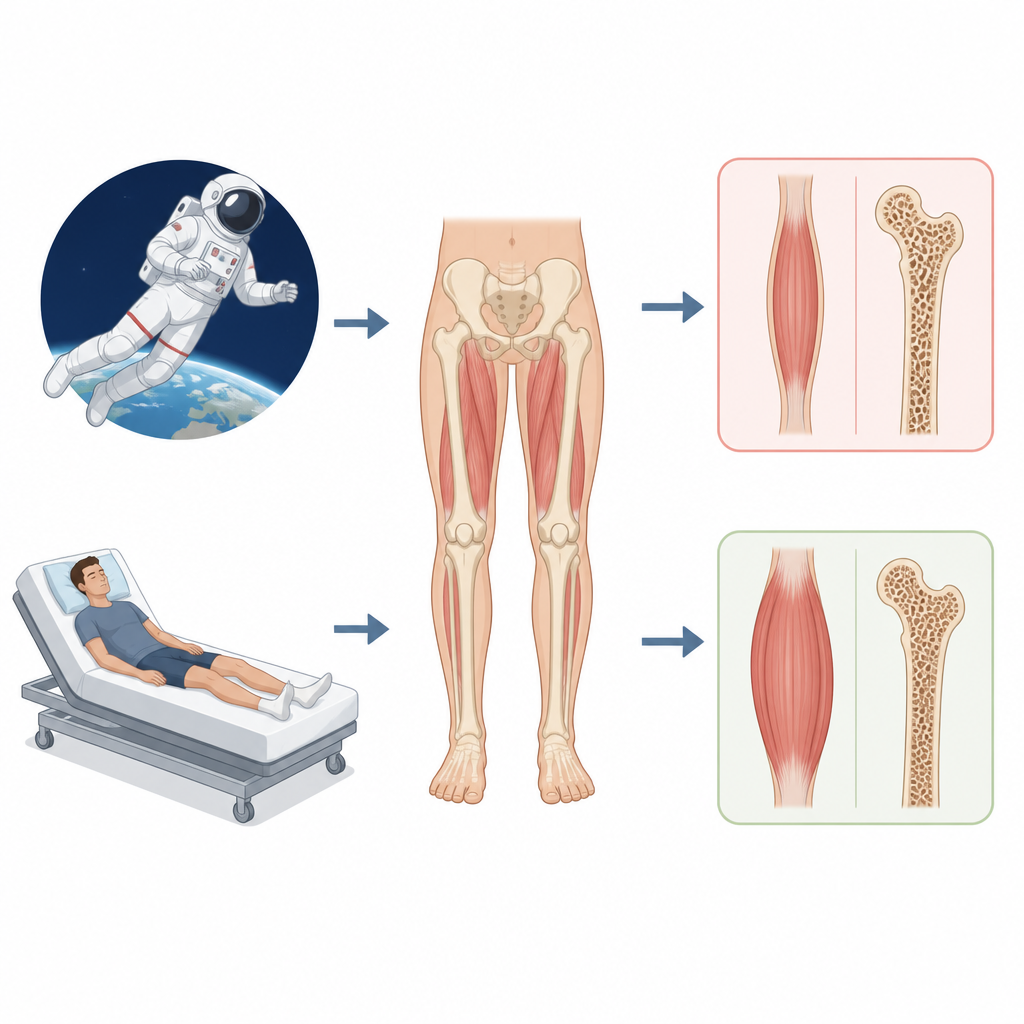
Two ways to mimic life off your feet
The researchers combined data from two projects. One followed 13 male space travelers who lived on the International Space Station for about six months each, exercising almost every day with treadmills and resistance devices. The other followed 11 healthy young men who spent 60 days in strict head down bed rest, a well known way to imitate the lack of weight on the body. In bed rest, volunteers did no protective exercise at all. In both settings, scans of the lower leg were taken before, right after, and up to three months after the period of unloading to see how muscles and the shin bone changed and recovered.
What happens to muscles and bones
The team focused on the calf muscles and the shin bone, which normally carry much of the body’s weight. After spaceflight, the cross sectional area of the calf muscles shrank by about 13 percent, even though the crew worked out regularly in orbit. Muscle size then bounced back to preflight levels within three months on Earth. The shin bone told a different story. Total mineral content dropped at all measured sites, by up to about 4 percent, and this loss was still clear three months after landing. The scans showed that while the overall bone size stayed the same, the tissue inside became less densely mineralized.
Space versus bed rest on Earth
When the same measurements were examined after 60 days of bed rest, a clear pattern emerged. Muscle shrinkage on Earth was only about half as large as in orbit, even though the bed rest volunteers did not exercise at all. In contrast, bone loss in bed rest was surprisingly similar to that seen in space, especially in the central shaft of the shin. Most of the bone loss happened early and then slowed down. The researchers checked whether bone continued to thin in the first two weeks after people stood up again, a pattern seen in some earlier bed rest work, but did not find strong or consistent extra loss in the space group.
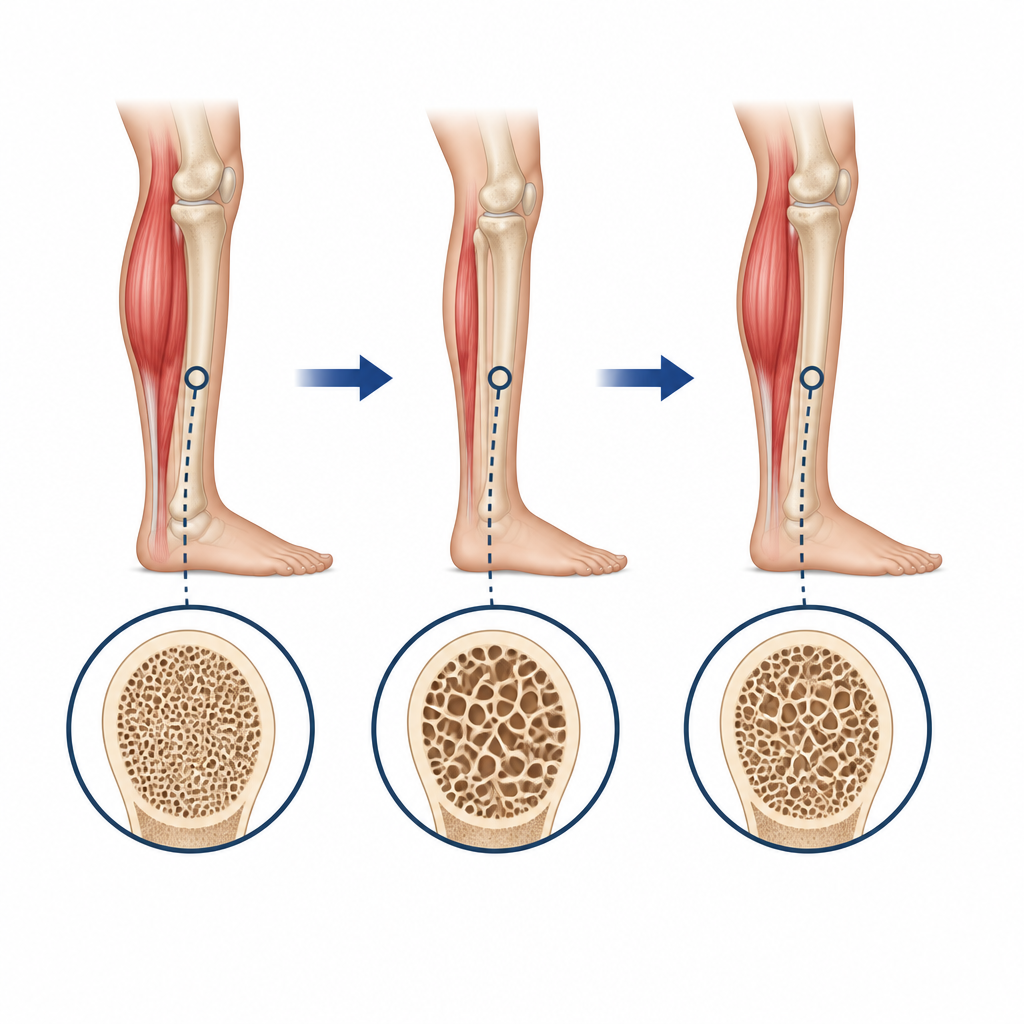
Why people differ from one another
Not every body reacted in the same way. Some crew members and volunteers lost far more muscle or bone than others, and even within a single person, different parts of the shin could weaken to different degrees. Older space travelers tended to lose more muscle and bone at the ends of the shin and recovered more slowly. Three astronauts were studied twice on separate missions, and for them muscle loss was similar on both flights, but their bone recovered less well after the second trip. Using careful statistics, the authors showed that the spread in responses between people and between sites could not be explained by random noise in the scans alone.
What this means for future crews and patients
For space agencies, the key message is that current exercise routines in orbit, while helpful, do not fully shield bones and muscles from the effects of weightlessness, and that some individuals are naturally more at risk than others. For scientists, the findings support the use of long term bed rest as a realistic stand in for spaceflight when studying how and why muscles and bones waste away. In simple terms, about two months of strict bed rest can copy the bone weakening of a six month mission, while around 80 days of bed rest are needed to match the muscle loss. This makes it easier and safer to test new training methods and to identify which people might need extra protection on long journeys away from Earth.
Citation: Böcker, J., Lau, P., Mittag, U. et al. Comparison of musculoskeletal responses and its variability after long-term spaceflight and prolonged bed rest conditions. npj Microgravity 12, 43 (2026). https://doi.org/10.1038/s41526-026-00611-2
Keywords: spaceflight, microgravity, bed rest, bone loss, muscle atrophy