Clear Sky Science · en
Microkinetic modeling of acidic corrosion from first principles and machine-learning molecular dynamics
Why metal rusts faster in harsh liquids
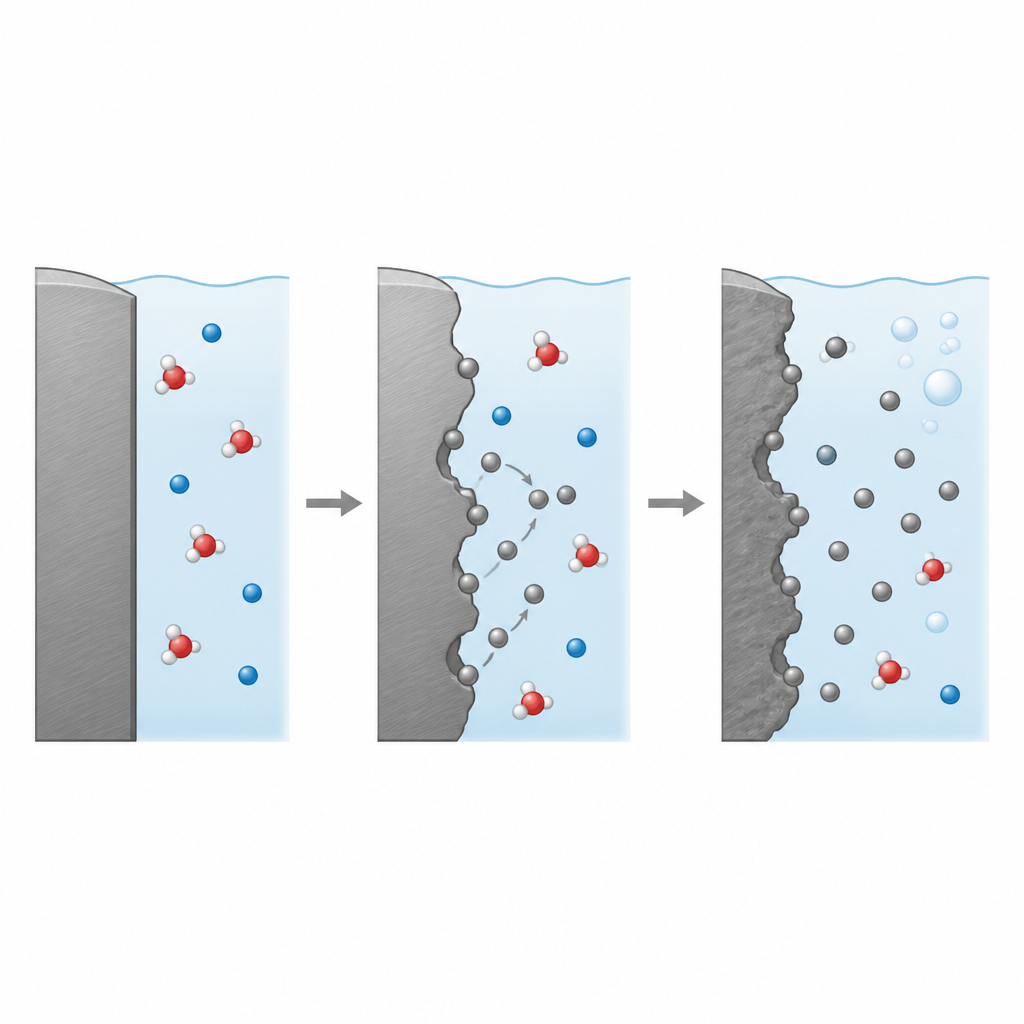
From oil pipelines to cars and ships, many vital structures are made of steel, which can quietly dissolve when exposed to acidic water. This paper tackles a long-standing challenge: how to predict, from the atomic level upward, how quickly iron will corrode in such environments and how alloying elements like manganese change that rate. The authors combine quantum calculations and machine learning to build a detailed, physics-based picture of how metal atoms leave a surface and how hydrogen gas is produced alongside this loss.
Building a bridge from atoms to corrosion rates
Engineers have long used empirical formulas to estimate corrosion, but these often gloss over the true atomic steps involved. Existing models tend to guess energy barriers, ignore how the surface is covered by water and reaction species at different voltages and acidity levels, and lump metal loss into a single many-electron step. In contrast, this study constructs a framework that starts with first-principles electronic-structure calculations and then uses machine-learning molecular dynamics to follow atoms and water molecules in motion at a realistic metal–liquid interface. This allows the team to compute how hard it is for key reactions to proceed and to connect those barriers directly to measurable currents and corrosion rates.
How iron atoms escape the surface
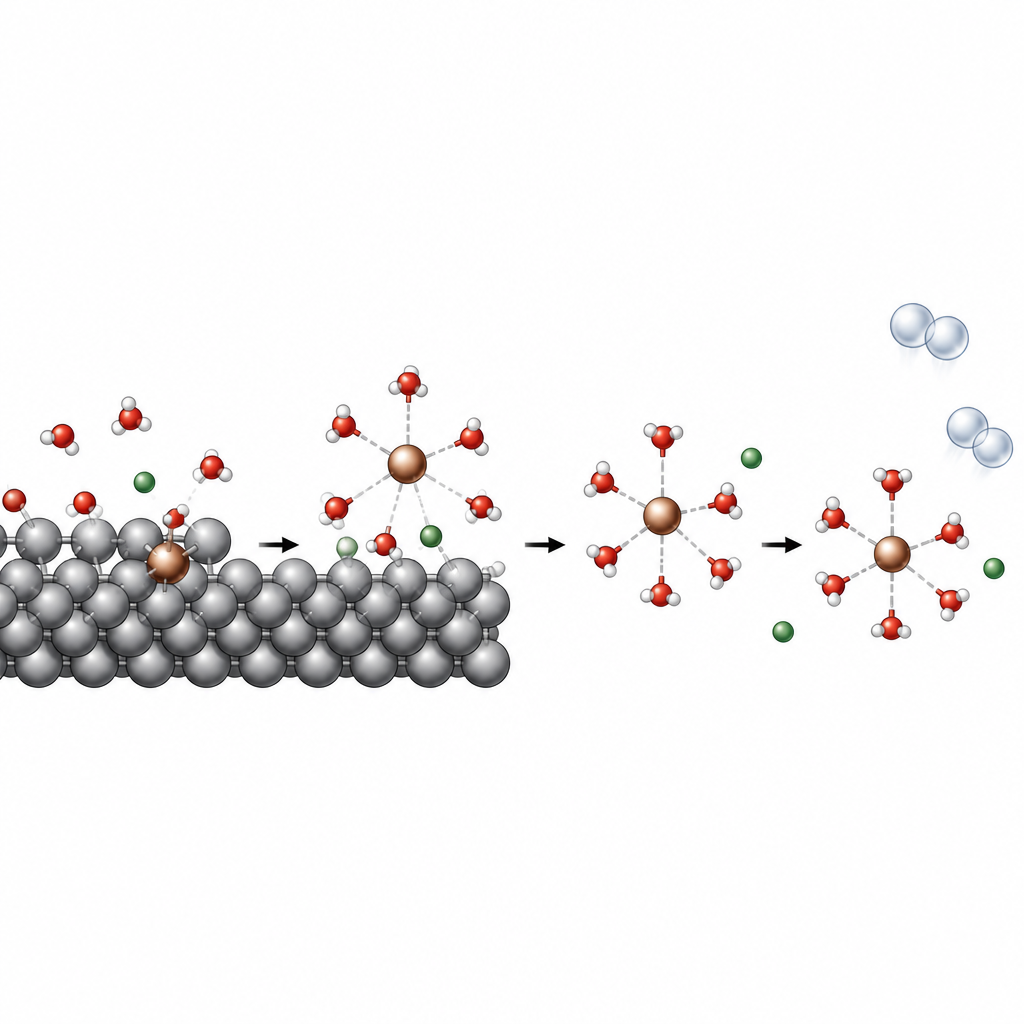
The authors first dissect how an iron atom leaves a flat iron surface in acidic solution. Under these conditions, water molecules land on the surface, split, and form a short-lived iron–oxygen–hydrogen unit. The study shows that the slowest and thus controlling step is when this adsorbed FeOH unit gives up an electron and detaches into the solution, on its way to becoming a fully hydrated iron ion surrounded by water molecules. By tracking the free-energy landscape using enhanced sampling and a machine-learned interaction model, they find a rate-controlling barrier of about 0.76 electron volts. With this barrier and carefully computed surface coverages, their model reproduces experimental measures such as the slope of the current–voltage curve and the apparent activation energy for iron dissolution in strong acid.
Following hydrogen bubbles from protons to gas
Corrosion in acid is not only about metal loss; it also produces hydrogen gas. The study therefore analyzes the sequence of steps by which protons from the solution pick up electrons at the surface to form adsorbed hydrogen atoms and then combine into hydrogen molecules. Using the same machine-learning molecular dynamics approach, the authors compute energy barriers for three classic steps: initial proton reduction, a mixed electrochemical step where a proton reacts with an adsorbed hydrogen, and a purely chemical step where two adsorbed hydrogen atoms join. Their calculations point to a pathway where the first step, proton reduction, is rate-controlling in the relevant voltage window. Intriguingly, the simulations reveal that protons do not simply drift from the bulk fluid to the surface; instead, they hop along chains of water molecules in a relay-like fashion, echoing the well-known Grotthuss mechanism in liquid water.
What happens when manganese is added
Steels often contain manganese to improve mechanical properties, but its influence on corrosion can be subtle. To explore this, the authors introduce a single manganese atom into the outer layer of the iron surface and repeat their analysis. Near this manganese site, both the barrier for an iron atom to dissolve and the barrier for the key hydrogen step are lowered. When the local behavior around manganese is combined with that of the surrounding iron in an area-weighted fashion, the overall corrosion current rises by several orders of magnitude and the corrosion potential shifts to more negative values. These trends match experimental observations that manganese-rich steels tend to corrode faster in acidic media.
From detailed models to safer alloys
By showing that atomic-level energy barriers and realistic surface coverages can accurately reproduce measured corrosion currents and voltages for iron, this work demonstrates a powerful way to predict how metals degrade in acid. The same workflow can, in principle, be applied to other metals, surface orientations, and alloying elements, and to different acidity levels. For non-specialists, the key message is that corrosion need not be treated as a purely empirical problem: with modern computation and machine learning, it becomes possible to virtually test how design choices in alloy composition and environment will influence the lifetime of critical infrastructure.
Citation: Bao, E., Xu, W., Ma, H. et al. Microkinetic modeling of acidic corrosion from first principles and machine-learning molecular dynamics. npj Comput Mater 12, 185 (2026). https://doi.org/10.1038/s41524-026-02047-4
Keywords: acidic corrosion, iron dissolution, hydrogen evolution, machine learning molecular dynamics, alloy design