Clear Sky Science · en
Interpretable deep learning for atomicity classification of platinum nanoclusters in STEM images
Why tiny metal clusters matter
Platinum is a workhorse metal in clean energy technologies, from fuel cells to electrolyzers, but it is rare and expensive. At the tiniest scales, adding or removing just one atom from a platinum cluster can dramatically change how well it drives chemical reactions. To use every atom wisely, scientists need a reliable way to count how many atoms sit in each nanosized clump directly from microscope images. This paper shows how a carefully designed form of artificial intelligence can learn to do that counting from electron microscope pictures, and even explain what it is looking at, paving the way toward smarter, more efficient catalyst design.
Seeing atoms with an electron microscope
Modern scanning transmission electron microscopes (STEM) can image individual atoms, revealing how metal nanoclusters sit on a support surface. In principle, this should let researchers read off how many atoms are in each cluster. In practice, the job is much harder. The brightness and shape of a cluster in an image depend not only on its size, but also on how it is oriented, how the beam passes through it, and on noise and subtle contrast changes in the instrument. Traditional analysis methods rely on measuring the apparent diameter of each particle and assuming bigger means more atoms. But for platinum clusters containing a few dozen to about seventy atoms, the size distributions overlap strongly, so clusters with different atom counts can look almost the same by simple diameter alone, making this approach unreliable.
Building a trusted image library
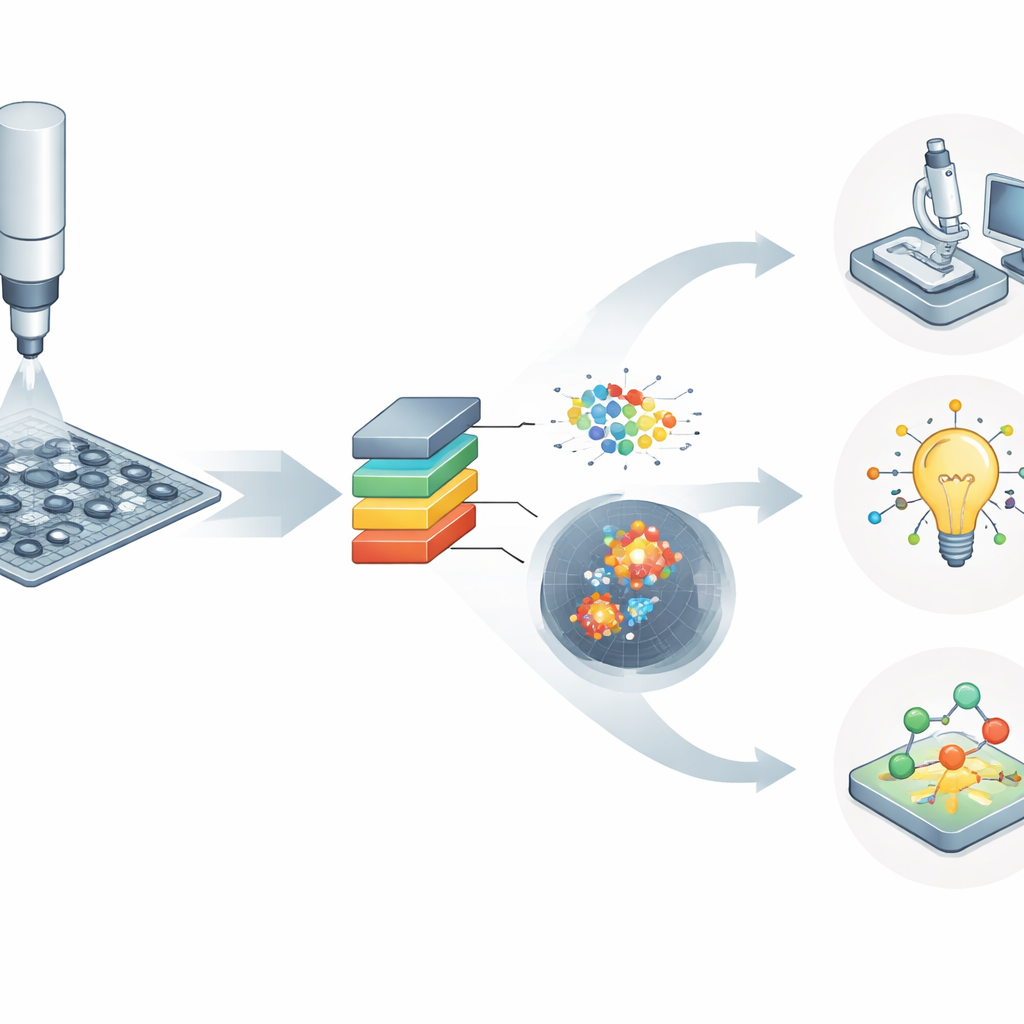
To tackle this, the authors first built an unusually clean and trustworthy dataset. They used a specialized ion-beam system to prepare beams of platinum clusters whose atom counts were precisely selected: 19, 30, 41, 55, or 70 atoms. These "size-selected" clusters were then gently landed onto electron microscope grids at very low energy so that they would stick without breaking apart or rearranging. This careful preparation produced high-fidelity STEM images where the number of atoms in each cluster was known ahead of time. Such a dataset, free from many of the usual ambiguities, provided an ideal training ground for a deep learning system that could learn the subtle visual cues linked to atomicity rather than just crude size.
Teaching a neural network to count atoms
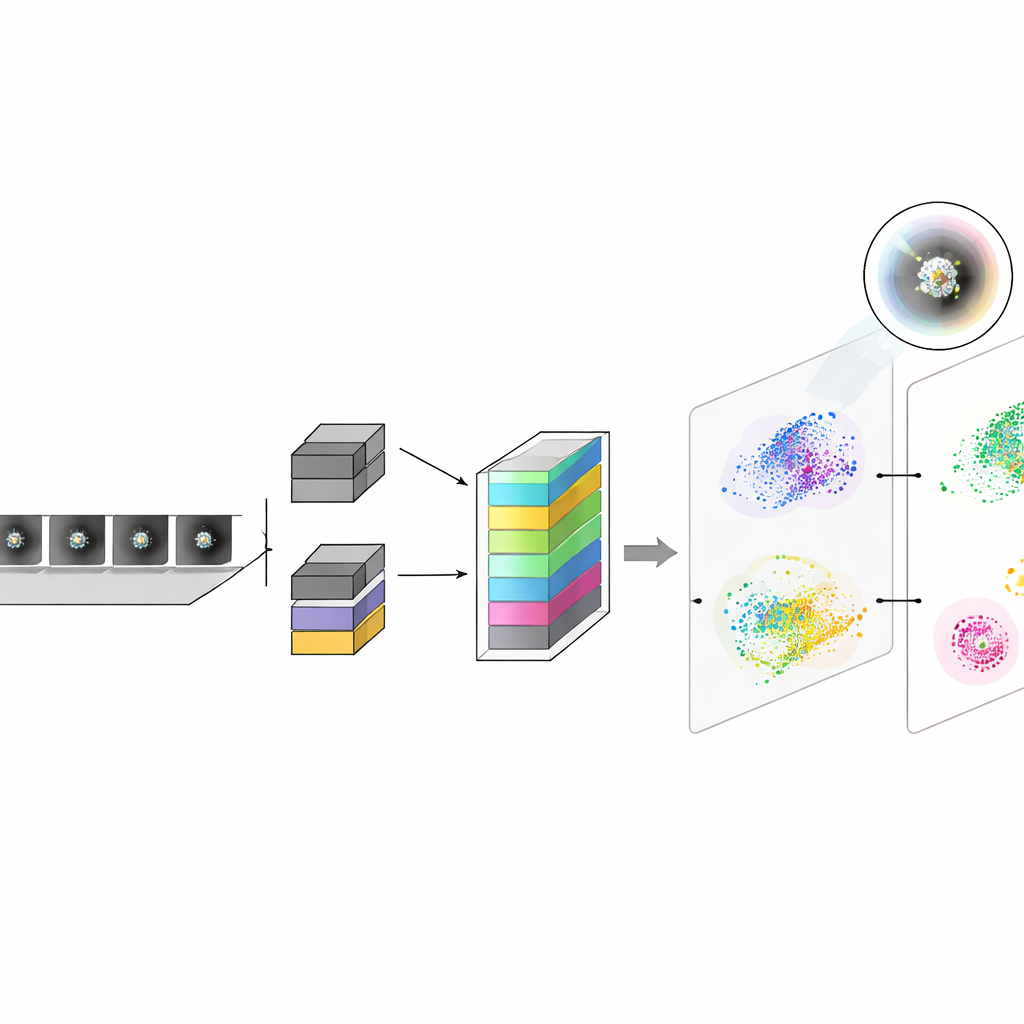
The team designed a compact convolutional neural network, a type of deep learning model that excels at recognizing patterns in images. Each platinum cluster was cropped into a tiny image patch and fed to the network, which learned to assign it to one of the five known atom counts. Two versions of the model were compared. One used the raw STEM images as a single input channel. The other added a second channel that passed the same images through a local contrast normalization filter, emphasizing edges and local variations. Despite the clusters’ overlapping diameters, both models distinguished the five atomicities far better than size alone, and the dual-channel version achieved a coefficient of determination close to 0.94 when estimating overall class ratios, meaning its predictions almost matched independent physical measurements of how many clusters of each size were deposited.
Making the machine’s reasoning visible
Beyond raw accuracy, the authors wanted to understand what the model was actually paying attention to. They used a visualization method that highlights image regions most responsible for each decision, producing heatmaps over the clusters. These maps revealed that the network focuses differently on central and edge regions depending on cluster size, and that the raw and contrast-normalized channels complement one another. For smaller clusters, the raw images mainly guided decisions via the bright center, while the filtered channel spread attention toward the outer contour. For the largest clusters, this balance flipped. They also projected the model’s internal numerical descriptions of each particle into two dimensions, showing distinct, color-coded islands corresponding to different atom counts. After a brief fine-tuning step on new images from different microscope conditions, these islands became cleaner and more separated, mirroring the recovered classification performance.
Adapting to changing imaging conditions
Real experiments rarely take place under perfectly stable conditions: background textures, noise, and focus can all drift from one session to the next. The authors showed that these shifts can confuse a model trained under one set of conditions, causing it to favor the wrong class. To fix this without exhaustive retraining, they introduced a light-touch adaptation step. A small subset of clusters whose diameters fall in clearly separated ranges—where the likely atom count is known with high confidence—are used to gently update the model on each new image. This fine-tuning, which can run in seconds, pulls the feature clusters in the model’s internal space back into alignment and restores accurate predictions, even for mixed samples where multiple cluster sizes coexist on the same grid.
What this means for future catalysts
For a non-specialist, the key result is that the authors have turned raw atomic-resolution images into a reliable, explainable tool for counting atoms in individual platinum clusters, even when simple size measurements fail. By combining precise sample preparation with interpretable deep learning, they show that machines can automatically extract and visualize structural details that matter for catalytic performance. This capability could be embedded directly into microscopes, providing real-time feedback during experiments and guiding the design of catalysts that use precious platinum more sparingly and effectively. The same strategy should extend to other metals and alloys, helping materials scientists link nanoscale structure to function in a more data-driven and resource-efficient way.
Citation: Tsukamoto, K., Hirata, N., Tona, M. et al. Interpretable deep learning for atomicity classification of platinum nanoclusters in STEM images. npj Comput Mater 12, 143 (2026). https://doi.org/10.1038/s41524-026-02014-z
Keywords: platinum nanoclusters, electron microscopy, deep learning, catalyst design, materials informatics