Clear Sky Science · en
Carrier mobilities and electron-phonon interactions beyond DFT
Why wiggling atoms matter for electronics
Every solid is full of restless atoms that vibrate, even at room temperature. These subtle jitters constantly bump into the electrons that carry electric current, setting a fundamental speed limit for how fast devices can operate and how efficiently they use energy. This paper presents a new way to calculate, from first principles, how these atomic vibrations slow down electrons and holes in important semiconductors like silicon and gallium arsenide, using some of the most accurate electronic structure methods available today.
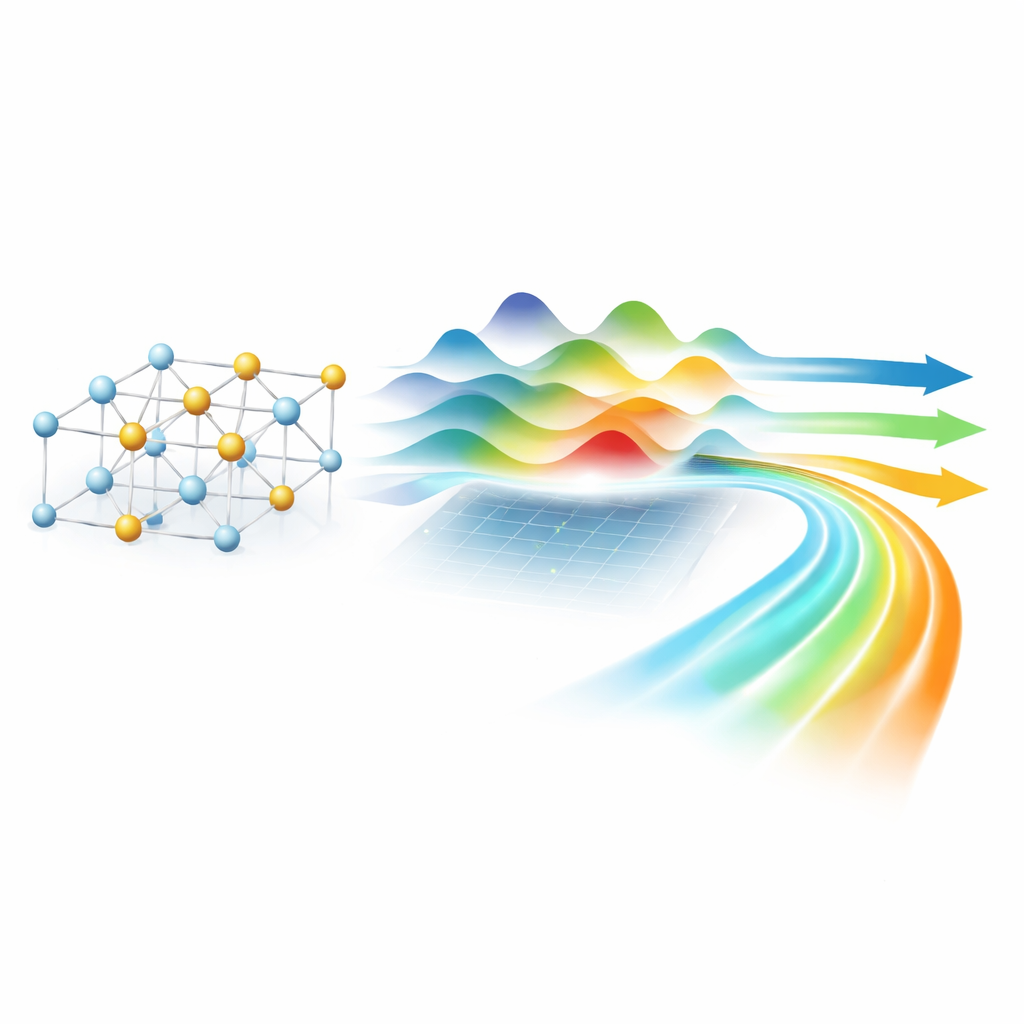
How electrons and vibrations talk to each other
Inside a crystal, electrons move through a periodic landscape created by the atoms, while the atoms themselves vibrate in collective patterns called phonons. When the two interact, electrons can scatter, changing their energy and direction. This electron–phonon coupling governs key properties such as how easily charge flows (mobility), how strongly light is absorbed, and even whether a material becomes a superconductor. Traditional calculations of this coupling rely on density-functional theory (DFT), a highly successful but approximate method. While DFT-based tools have become very mature, they still struggle to match experiments for some materials, especially when more accurate descriptions of electronic excitations are needed.
Going beyond standard electronic recipes
To improve on standard DFT, researchers use more advanced electronic structure methods, including hybrid functionals, Koopmans-compliant functionals, and GW many-body techniques. These approaches correct long-standing DFT shortcomings, such as underestimated band gaps and overscreened electron interactions, and generally provide better quasiparticle energies. However, directly combining them with existing electron–phonon techniques is difficult. Their effective potentials are more complex, can depend on individual orbitals, and are often non-local and frequency-dependent, making standard perturbative schemes hard to implement and very costly in terms of computer time and memory.
A new route using energy shifts instead of potentials
The authors introduce a finite-difference framework that sidesteps these difficulties by focusing on energy levels and wavefunctions rather than on the full microscopic potential. They compute how the electronic energies change when atoms in a supercell are slightly displaced, and then reconstruct the electron–phonon matrix elements using a “projectability” scheme based on overlaps between perturbed and unperturbed states. Clever use of symmetry drastically reduces how many independent atomic displacements must be calculated. The workflow is designed to plug into widely used codes such as Quantum ESPRESSO, KOOPMANS, and YAMBO, and then passes the resulting couplings to the EPW code, which uses Wannier functions to interpolate them onto extremely fine momentum grids needed for accurate transport calculations.
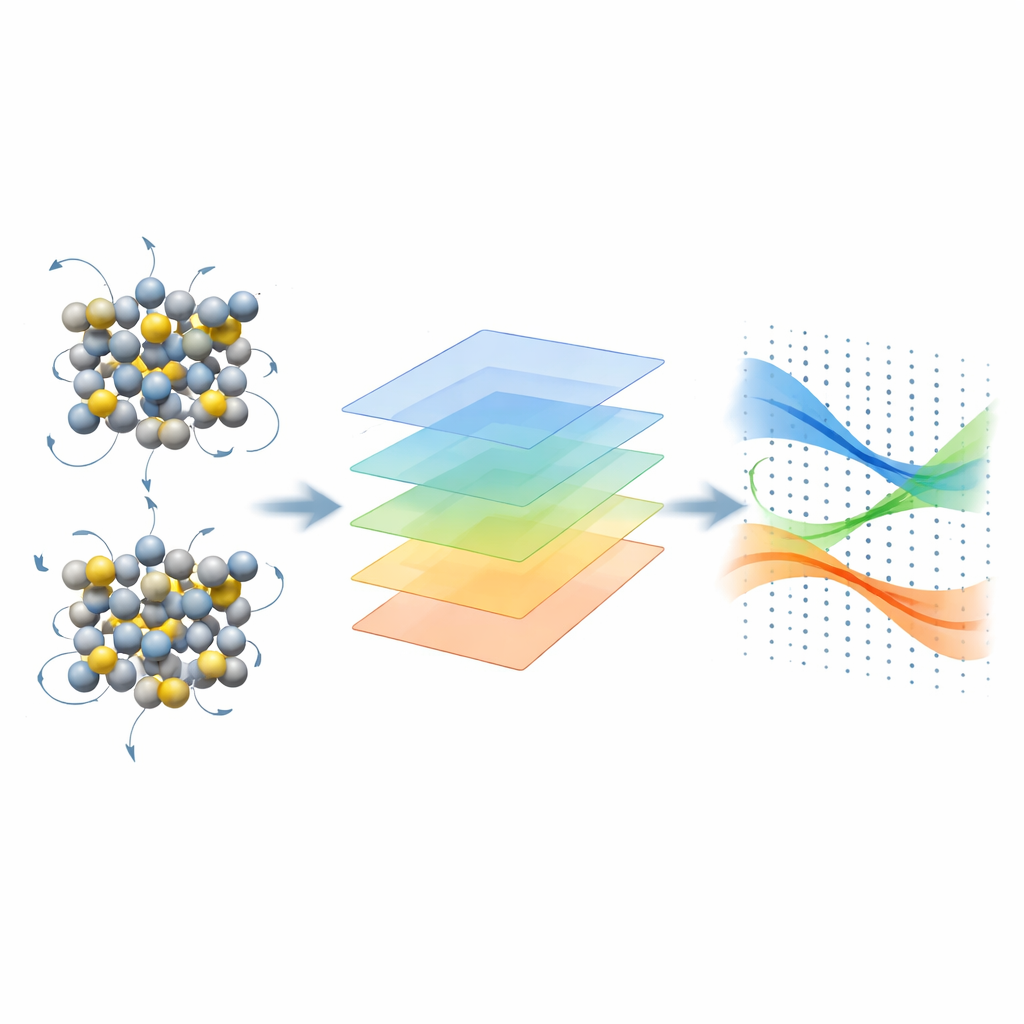
What changes when electrons are treated more realistically
With this machinery in place, the team examines silicon and gallium arsenide, two workhorse semiconductors. They compare standard DFT with advanced methods for computing electron–phonon coupling, the curvature of the energy bands (which sets the effective mass), and the resulting drift mobility obtained from a detailed solution of the Boltzmann transport equation. In silicon, the more refined methods slightly increase the strength of electron–phonon coupling and adjust the band curvature, leading to modest reductions of both electron and hole mobilities—on the order of 10%—that bring theory into even closer agreement with measurements. In gallium arsenide, where DFT is known to underestimate the electron effective mass and overestimate mobility, hybrid and Koopmans functionals correct the band curvature and moderately enhance the coupling, cutting the predicted electron mobility down from unrealistically high values to numbers that align well with experiments over a broad temperature range.
A clearer picture for designing better materials
For non-specialists, the key message is that accurately predicting how well a material conducts electricity requires getting both the electrons and the atomic vibrations right—and, crucially, how they influence each other. This work delivers a general and practical framework to do exactly that, using state-of-the-art electronic structure methods without bespoke implementations for each new approach. Packaged in a new code named ElePhAny and interfaced with established tools, the method opens the door to routine, high-accuracy calculations of mobility and other electron–phonon-driven properties across a wide range of materials. That, in turn, can guide the discovery and optimization of electronic and optoelectronic materials before they are ever grown in the lab.
Citation: Poliukhin, A., Colonna, N., Libbi, F. et al. Carrier mobilities and electron-phonon interactions beyond DFT. npj Comput Mater 12, 151 (2026). https://doi.org/10.1038/s41524-026-02011-2
Keywords: electron-phonon coupling, carrier mobility, semiconductors, beyond DFT, first-principles transport