Clear Sky Science · en
Evidence for Eocene aridification of the Atacama Desert’s hyperarid core
Why an ultra-dry desert matters
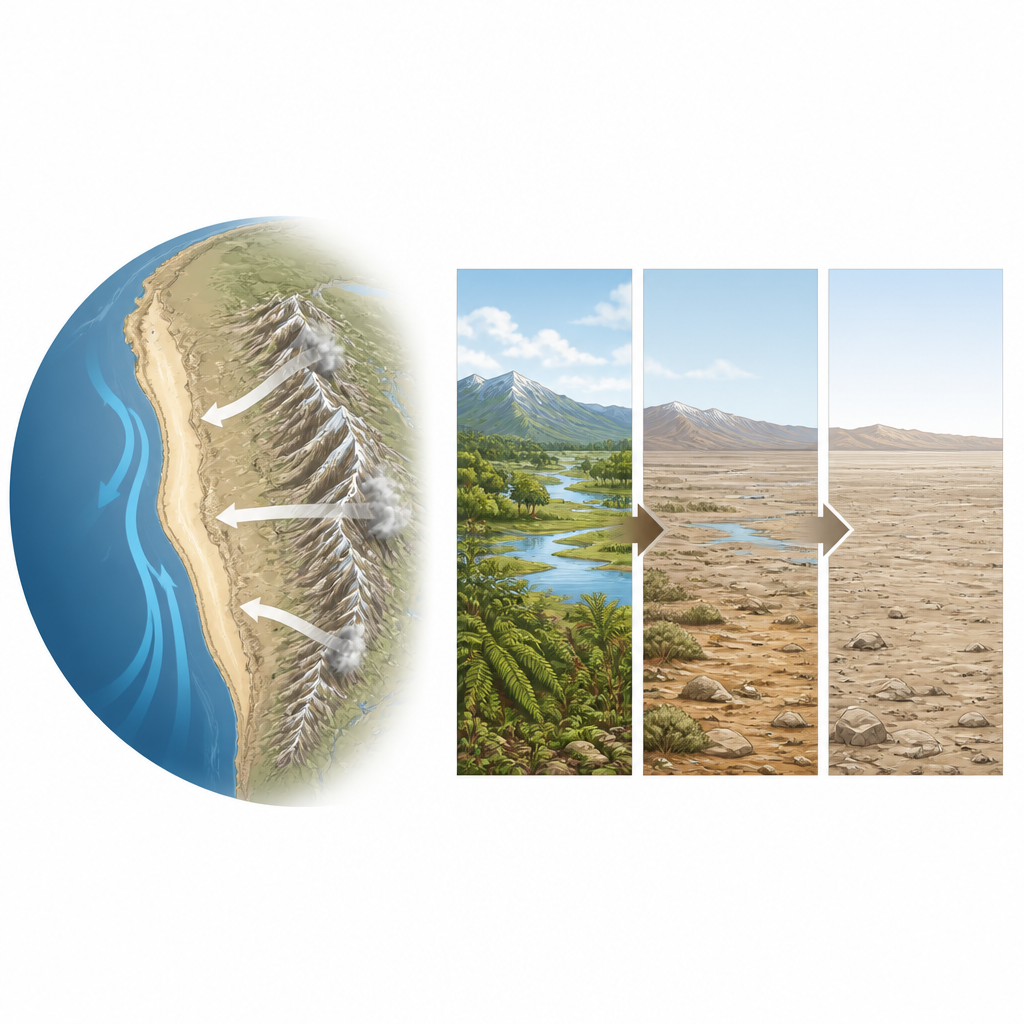
The Atacama Desert in northern Chile is one of the closest natural analogues we have to the surface of Mars. It is so dry that parts of it receive less than two millimeters of rain a year, and landscapes can remain almost unchanged for millions of years. Yet scientists have long argued about when this extreme dryness began and what caused it. This study uses tiny mineral clues locked inside quartz pebbles to show that the heart of the Atacama has been extremely dry since at least the Eocene, tens of millions of years earlier than many previous ideas suggested.
Reading the desert’s stone timekeepers
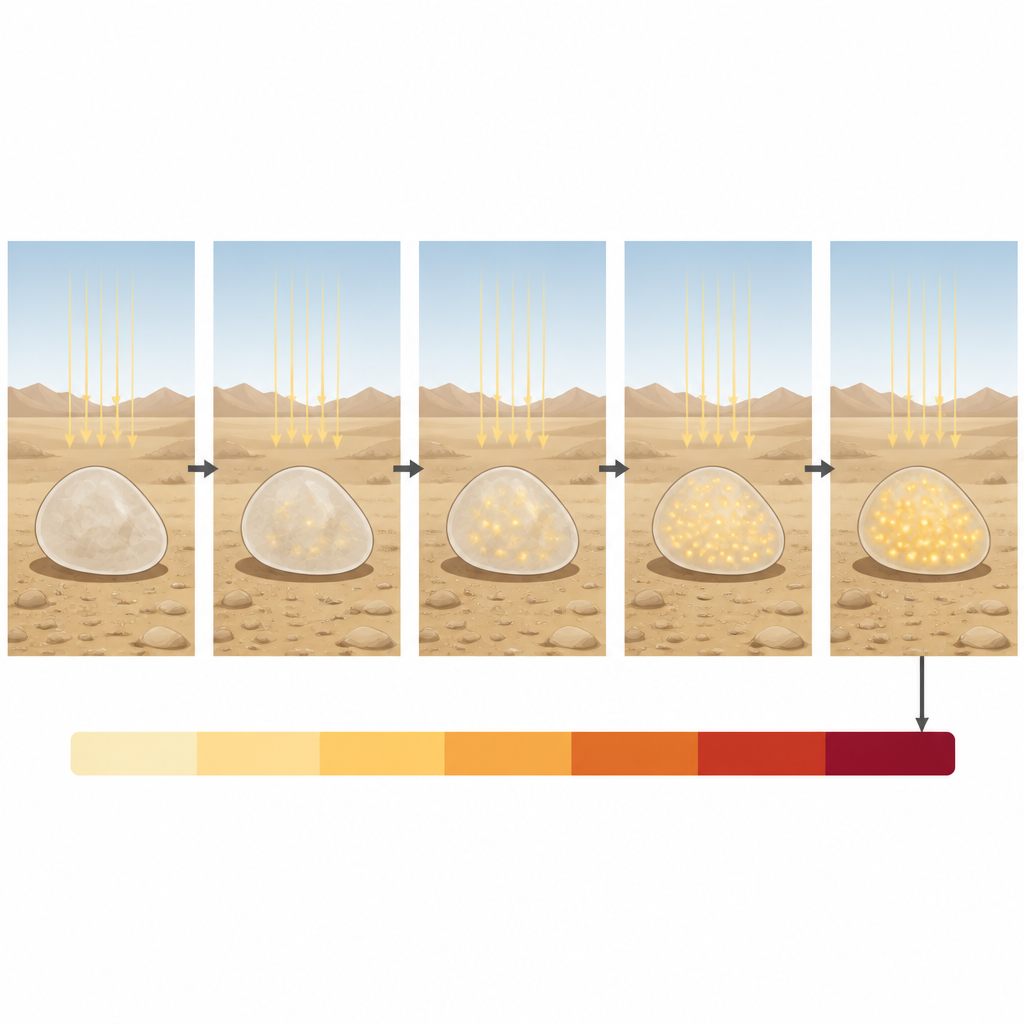
The researchers focused on the Coastal Cordillera, a low mountain range between the Pacific Ocean and the deeper interior of the Andes. Here, broad, almost featureless surfaces are dotted with angular quartz pebbles resting on thin sediments and salt-rich crusts. Because wind and water have done so little work for so long, these pebbles can act as natural timekeepers. High-energy particles from space gradually alter atoms inside minerals at the surface, so the longer a pebble sits exposed, the more of these special atoms it accumulates. By measuring the amount of cosmogenic neon and beryllium in 135 quartz clasts from several surfaces, the team could estimate how long each pebble has effectively been exposed to the sky.
A landscape frozen in deep time
The results reveal astonishingly long exposure durations. Many pebbles show signals equivalent to 20 to 40 million years at or near the surface, with some reaching back about 60 million years. Crucially, these old clasts were collected from surfaces that themselves formed much later, around the Oligocene–Miocene transition, as shown by dated volcanic ash layers beneath them. This means the pebbles were already long-lived before they arrived at their current resting places. They must have been slowly exhumed from bedrock, moved short distances by rare sheet floods, and then left undisturbed for vast spans of time in an environment with almost no erosion.
Ruling out younger and distant sources
The team tested whether the quartz might have been carried from higher, rapidly rising parts of the Andes, where thinner air would speed up the cosmic-ray clock. However, nearby river gravels that clearly came from the Andes contain only very small amounts of cosmogenic neon, indicating short exposure before burial. Independent studies of Andean deposits also lack similarly ancient exposure ages. Together, these lines of evidence argue against high-altitude, distant sources. Instead, the quartz clasts appear to come from local bedrock in the Coastal Cordillera, where erosion has been remarkably slow, and where salt crusts and gypsum soils further armor the surface, helping preserve stones in place for millions of years.
Linking desert dryness to global cooling
Because the quartz exposure records extend back into the Eocene, they imply that strongly water-limited conditions were already established in the hyperarid core of the Atacama well before the main uplift of the Andes and the full development of the modern Humboldt Current. The authors compare their data with global climate records that track long-term cooling since a warm phase known as the Early Eocene Climatic Optimum. They propose that this cooling, together with early versions of a cold coastal current along South America, likely pushed the region across a threshold into lasting dryness. Later mountain uplift and ocean changes probably expanded and intensified aridity elsewhere, but they did not start the hyperarid state in the coastal core.
What this means for Earth’s dry limits
To a non-specialist, the core message is that the Atacama’s driest heart has been nearly rainless and geologically frozen in place far longer than many scientists thought. Pebbles sitting quietly on the surface record tens of millions of years of exposure, something that would be impossible in a wetter or more active landscape. This pushes back the birth of the Atacama’s hyperarid core to at least the Eocene and ties it to global climate cooling rather than only to local mountain building. The study shows how tiny atoms in common minerals can reveal when Earth’s most extreme deserts crossed the line into near-permanent dryness.
Citation: Ritter-Prinz, B., Binnie, S.A., Stuart, F.M. et al. Evidence for Eocene aridification of the Atacama Desert’s hyperarid core. Nat Commun 17, 4520 (2026). https://doi.org/10.1038/s41467-026-73422-4
Keywords: Atacama Desert, hyperaridity, cosmogenic nuclides, Eocene climate, desert evolution