Clear Sky Science · en
General workflow for localizing hydrides in metal nanoclusters by combining stochastic surface walking with neural-network potentials
Why tiny metal clusters matter
Many modern technologies, from clean energy devices to smart lighting, depend on materials built from clusters of just a few dozen metal atoms. Often these clusters hide hydrogen atoms inside them, acting like tiny storage tanks or reactive sites. Knowing exactly where those hydrogens sit is crucial for understanding and improving how these materials work, but finding such light atoms inside dense metal structures is extremely hard with standard experimental tools.
Finding hidden hydrogen needles in a metal haystack
Hydrogen atoms are nearly invisible to common X-ray techniques, so researchers usually turn to neutron sources to pinpoint them. Yet powerful neutron facilities are rare, which limits routine studies. Earlier work showed that deep learning could guess hydrogen positions in certain copper clusters, but that approach depended on large, specialized training sets and did not generalize well to other metals. The new study introduces a broadly usable computer workflow that can locate hydrogens across many kinds of metal nanoclusters without needing neutron data, making this type of analysis more accessible to laboratories worldwide.
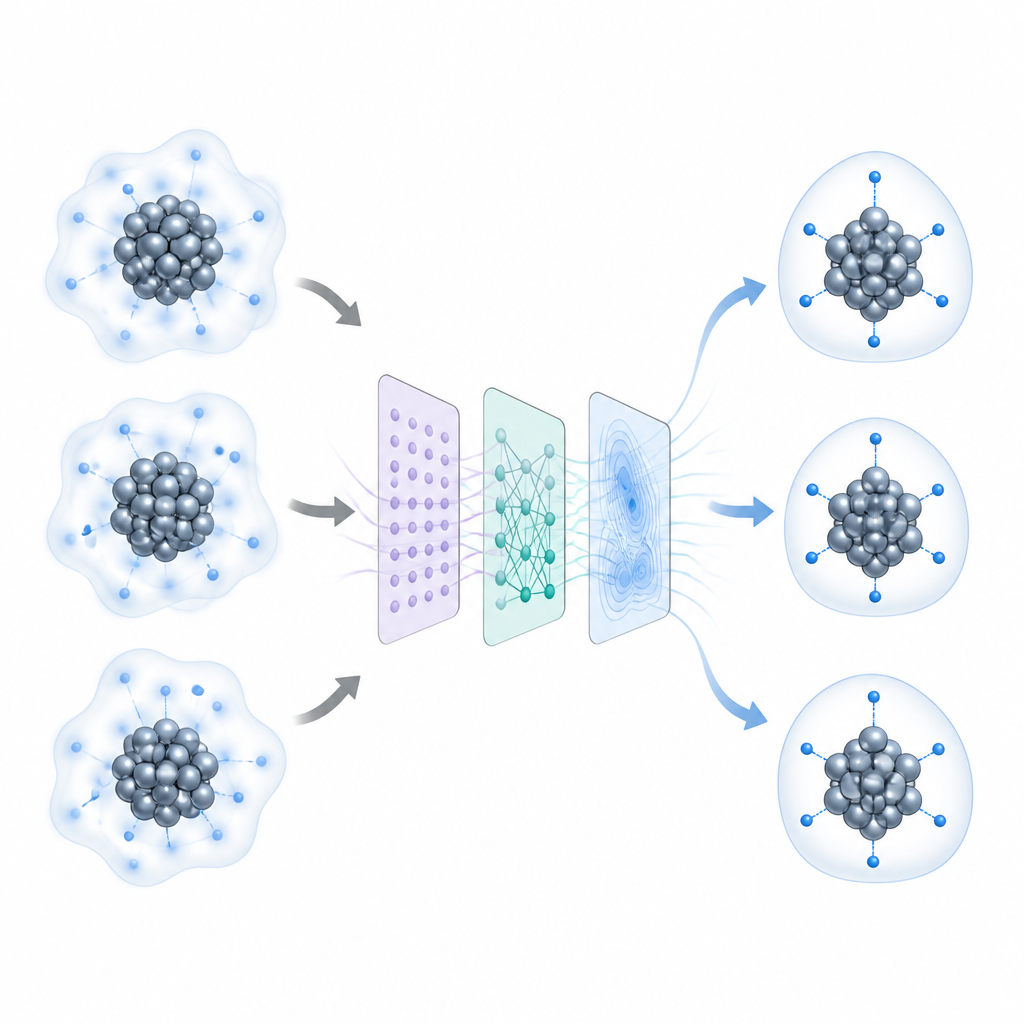
Breaking complex clusters into simpler parts
The researchers treat each nanocluster as a combination of three pieces: a metallic core, the layer where metals meet surrounding molecules, and an outer shell of protective ligands. They use a global search strategy called stochastic surface walking to explore many possible atomic arrangements, while fast neural network models estimate their energies almost as accurately as quantum calculations but far more quickly. To keep the problem manageable and reusable, they simplify the outer ligands into smaller fragments that preserve how they bind to the metal but remove unnecessary detail. Tests on several hydrogen-rich and hydrogen-poor clusters show that this simplification barely changes the predicted hydrogen locations, yet cuts computational time and cost.
Rules of where hydrogen likes to sit
Applying the workflow to 93 reported systems, including copper, silver, gold, alloy clusters, and even very different compounds such as polyoxometalate cages, the team maps thousands of local hydrogen environments. Clear patterns emerge. In copper clusters, hydrogen most often bridges three or four copper atoms, with higher coordination becoming progressively rarer. Silver clusters are dominated by threefold sites, while gold clusters tend to host twofold and occasional onefold hydrogens. Doping the metal core with heavier transition metals such as platinum, iridium, or ruthenium strongly encourages direct metal–hydrogen bonding, whereas swapping copper, silver, and gold among themselves barely shifts the hydrogen positions as long as the overall framework stays intact.
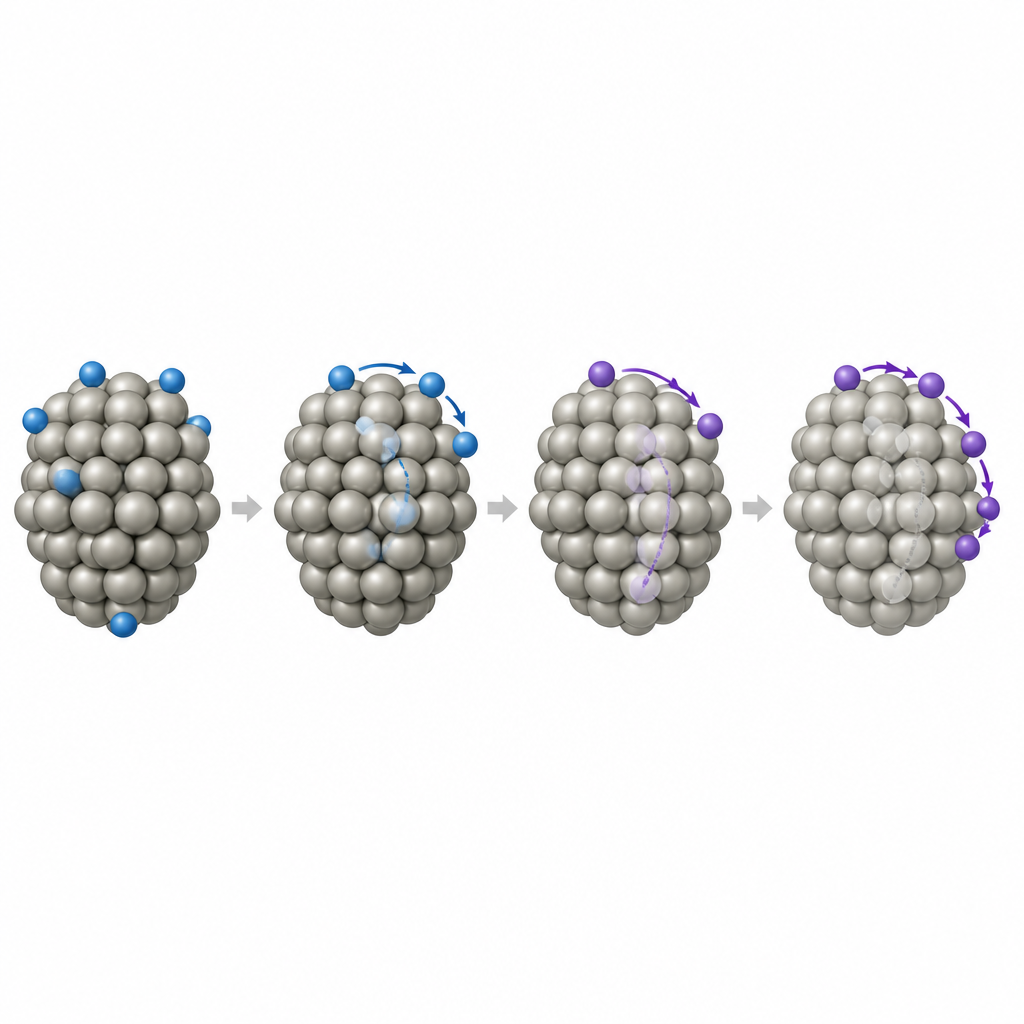
Checking cluster formulas and watching hydrogen move
Because mass spectrometry and nuclear magnetic resonance can miscount hydrogens by a few atoms, the authors test whether their method can also help confirm how many hydrogens a cluster really contains. For a gold cluster with known composition, they run searches assuming too few, correct, and too many hydrogens. Only the correct number produces a low-energy structure that matches the measured metal framework and expected symmetry; incorrect counts force the cluster to distort or lose hydrogens. The team then goes further, using a related technique to track how hydrogens hop between sites. They find that movement along the cluster surface generally requires significantly less energy than passage through the interior, suggesting that most exchanges happen by surface migration.
What this means for future materials
By combining smart global searching with fast neural network potentials, the authors offer a practical recipe for revealing where hydrogens hide in complex nanoclusters and related materials. For non-specialists, the key message is that computers can now reliably fill in the missing hydrogen details that experiments alone often cannot provide. This makes it easier to interpret measurements, design new catalysts, and understand how tiny metal clusters store and move hydrogen, ultimately supporting better materials for catalysis, energy conversion, and chemical sensing.
Citation: Wang, Z., Fang, C., Zhang, L. et al. General workflow for localizing hydrides in metal nanoclusters by combining stochastic surface walking with neural-network potentials. Nat Commun 17, 4513 (2026). https://doi.org/10.1038/s41467-026-72966-9
Keywords: metal nanoclusters, hydride localization, neural network potentials, stochastic surface walking, hydrogen migration