Clear Sky Science · en
Modeling attention and binding in the brain through bidirectional recurrent gating
How the Brain Knows What to Look At
Every moment, your eyes bombard your brain with far more information than you could ever consciously notice. Yet you can effortlessly pick out a friend in a crowd, follow a moving car, or search for your keys on a cluttered table. This ability to focus on what matters, link the right features together, and ignore distractions is called attention. The article described here introduces a new brain-inspired computer model that aims to explain how such a wide variety of attentional tricks might arise from a single underlying mechanism.
A Single Model for Many Kinds of Focus
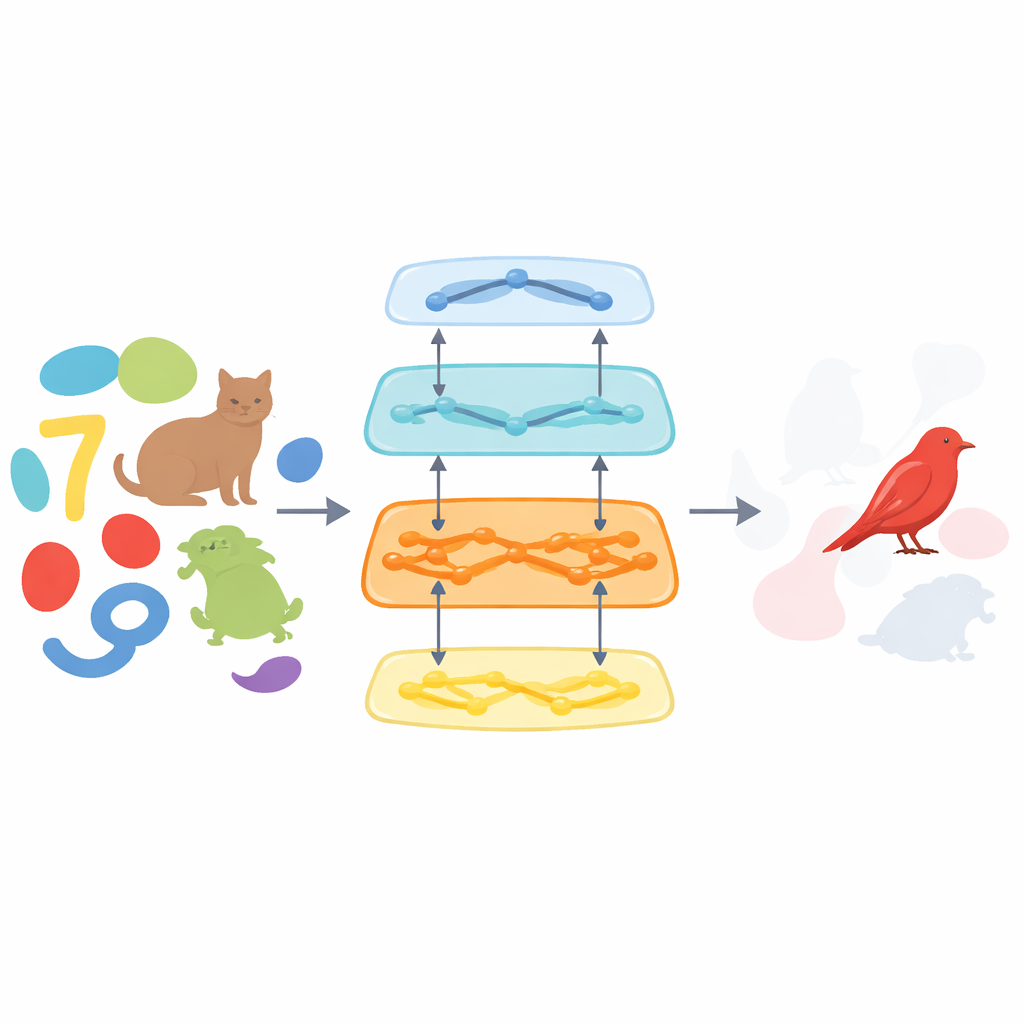
Attention is not just one thing. Sometimes we focus on a place in space, like a spotlight. Sometimes we tune into a feature, such as a particular color, and sometimes we lock onto whole objects, keeping their parts together even when they move or are partly hidden. The authors argue that instead of separate, special-purpose systems, all these forms of attention may emerge from a common circuit pattern in the brain’s visual pathway. They build a model that mimics the ventral visual stream, the set of brain regions that turns raw pixels on the retina into recognizable objects. In their design, one pathway moves information upward, extracting visual features, while another pathway sends signals back down, deciding which features should be strengthened or weakened.
Gates That Talk Both Ways
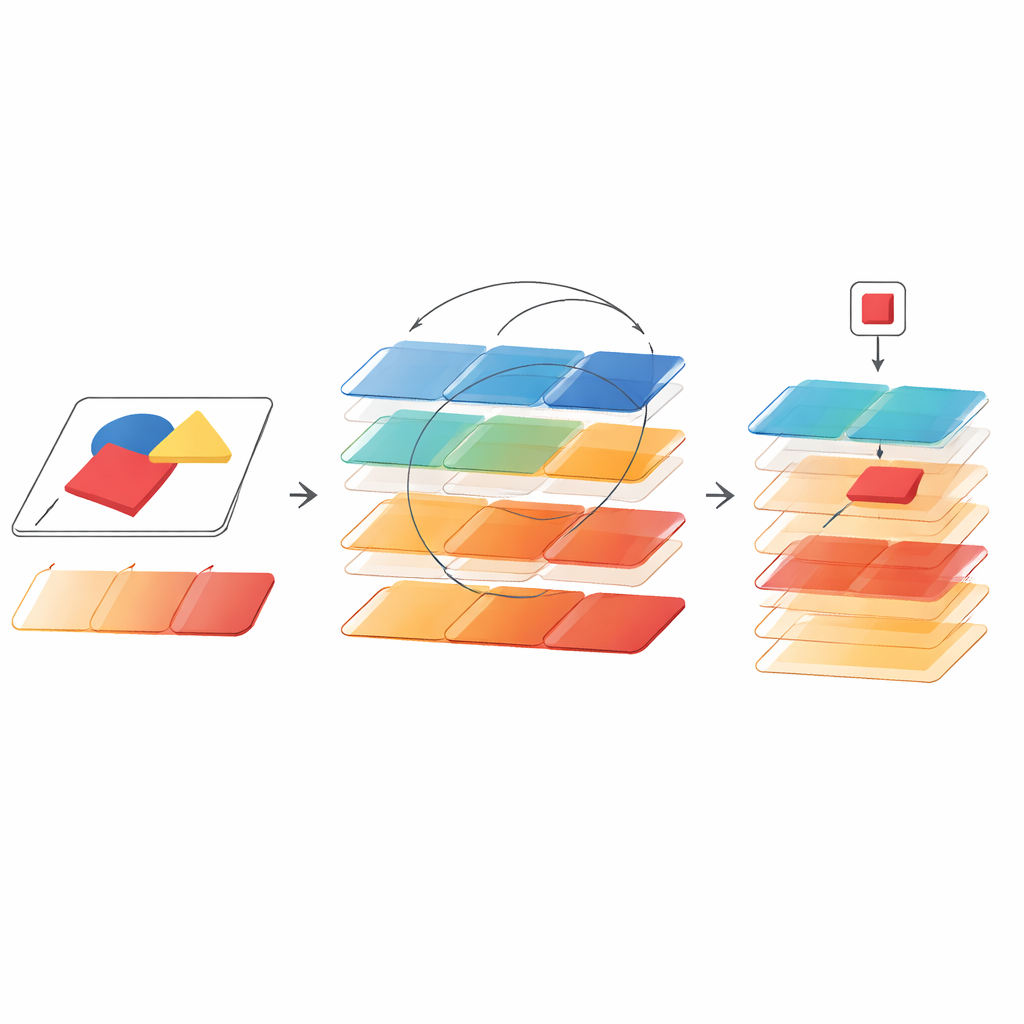
The heart of the model is something the authors call bidirectional recurrent gating. Imagine a stack of visual processing stages, from simple edges to complex shapes. At each stage, the forward-moving signal carries what is in the image, while a backward and sideways signal carries what is currently relevant for the task. These signals meet at “gates” that multiplicatively turn feature activity up or down over several time steps. Because the connections are recurrent, the model can refine its focus over time, much like you do when you first glimpse a messy scene and then gradually home in on a target. This architecture is trained with standard machine-learning techniques on two basic goals—classifying what is present and segmenting where it is—yet it is not explicitly told how to implement attention.
Learning to Search, Track, and Ignore Distractions
Once trained, the model is tested on a battery of classic attention tasks usually given to humans and animals. Using images built from handwritten digits and from natural photographs of animals, it learns to recognize objects in clutter, group elements that are cued, follow moving items, and perform visual search based on either visual hints or symbolic cues like arrows. It can highlight a single odd item in a grid, switch attention from one object to the next without getting “stuck” on the same one, and track a target over time while ignoring distractors. Remarkably, many of these behaviors appear even when the model only receives feedback about the final answer, not about where it should have looked, suggesting that attentional strategies can arise as a side effect of learning to solve relevant tasks.
Mirroring Human Perception and Brain Signals
The authors then ask whether the model behaves like humans in more subtle ways. In controlled tests using simple patterned patches, the model shows improved sensitivity when a cue points to the correct location, and its performance drops when many distractors are present—paralleling human findings on contrast sensitivity and perceptual load. It also “falls for” a classic perceptual illusion in which a visible occluder makes a fragmented shape easier to recognize, hinting that it represents figure and background in a brain-like way. Looking inside the network, units in deeper layers show response boosts when their preferred object is attended, without changing their basic tuning, similar to neurons in primate visual cortex. Distinct groups of units behave like feature detectors and “border ownership” cells that help decide which side of an edge belongs to the figure and which to the background.
Why This Matters for Brains and Machines
The work suggests that many hallmark features of biological attention—orienting to cues, filtering out irrelevant clutter, searching for targets, binding features into coherent objects, and even some failures of awareness—can all arise from a single architectural principle: recurrent gating between a feature pathway and an attention pathway. In plain terms, the model shows how a system that repeatedly re-weights what it sees, based on current goals and context, can learn to “pay attention” without being explicitly programmed to do so. This offers neuroscientists a concrete, testable framework for understanding attention and binding in the brain, and gives artificial intelligence researchers a biologically inspired alternative to today’s largely feedforward designs.
Citation: Salehi, S., Lei, J., Benjamin, A.S. et al. Modeling attention and binding in the brain through bidirectional recurrent gating. Nat Commun 17, 4072 (2026). https://doi.org/10.1038/s41467-026-72146-9
Keywords: visual attention, feature binding, recurrent neural networks, computational neuroscience, brain-inspired AI