Clear Sky Science · en
Habitat-specific trends in taxonomic, functional, and phylogenetic diversity in European plant communities over a century
Why this story about plants matters
Across the world, people worry that we are living through a quiet crisis of disappearing species. Yet when scientists look closely at small patches of land, such as meadows or forest plots, they often see a confusing picture: sometimes plant diversity goes down, sometimes it stays the same, and sometimes it even rises. This study pulls together more than a century of records from across Europe to ask a simple but profound question: how are local plant communities actually changing, and does the answer depend on the kind of habitat we look at?
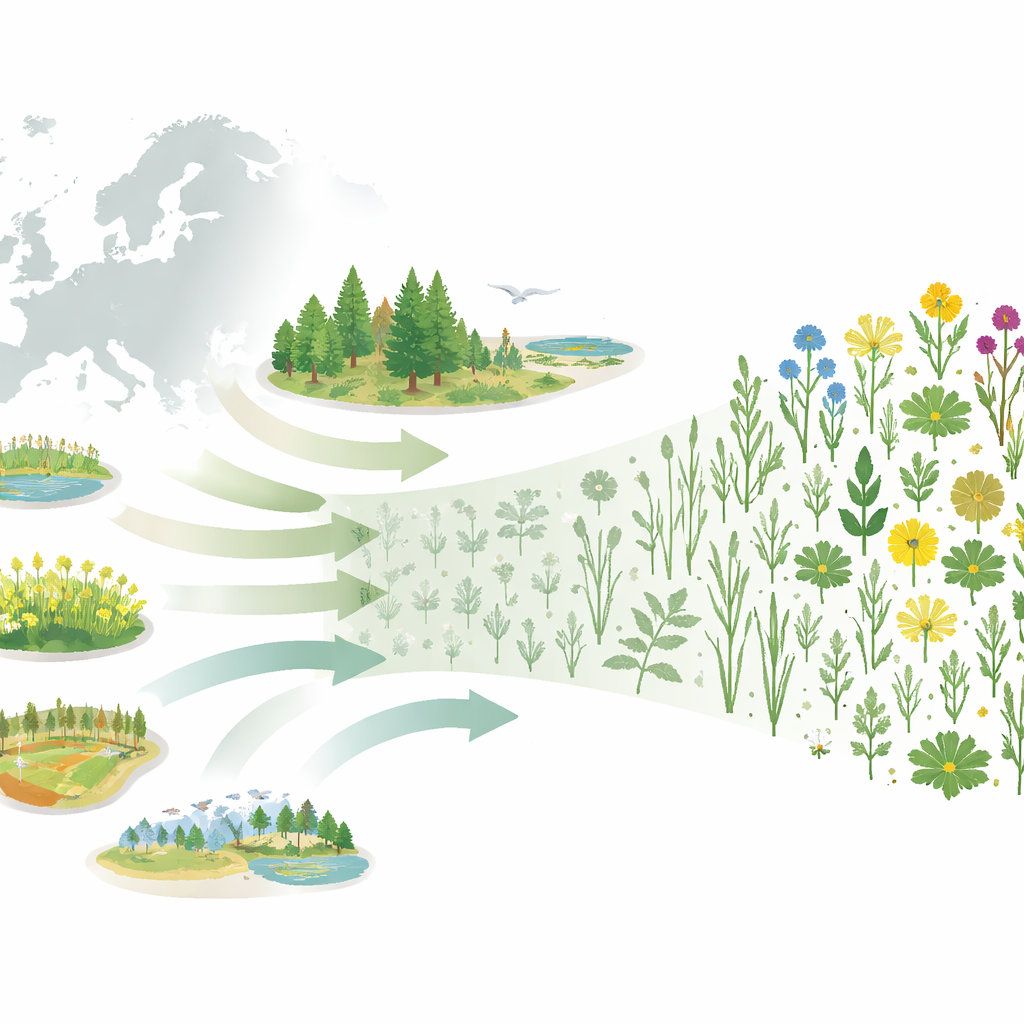
Watching the same places for a hundred years
Instead of relying on scattered snapshots, the researchers focused on repeated surveys of the same vegetation plots over time. These permanent or semi-permanent plots span almost 200,000 observations from more than 57,000 time series across Europe, covering marshes, grasslands, forests, rocky slopes, and human-made habitats like roadside verges. For each plot, botanists recorded not only which plant species were present and how much ground they covered, but also information about their traits, evolutionary relationships, and whether they were rare, threatened, or introduced from elsewhere. Sophisticated classification tools then assigned each plot to a standard set of habitat types and tracked whether those habitats remained stable, followed a natural succession from open land to shrub and forest, or were disturbed and simplified over time.
More kinds of plants, but not always for good reasons
When all plots were considered together, the study found that local plant communities tended to gain both cover and species at a slow but steady pace over the last century. On average, the number of species in a given plot increased by around a fifth of a percent per year, while overall vegetation cover rose even faster. Measures that capture how different plants are from one another—whether in their traits, such as height or leaf structure, or in their evolutionary history—also generally increased. At the same time, the cover of non-native species, habitat generalists that tolerate many conditions, and even plants listed as threatened all tended to rise. Only a few indicators, such as the evenness with which traits are distributed and the abundance of habitat specialists, failed to show clear overall trends.
Different habitats, different stories
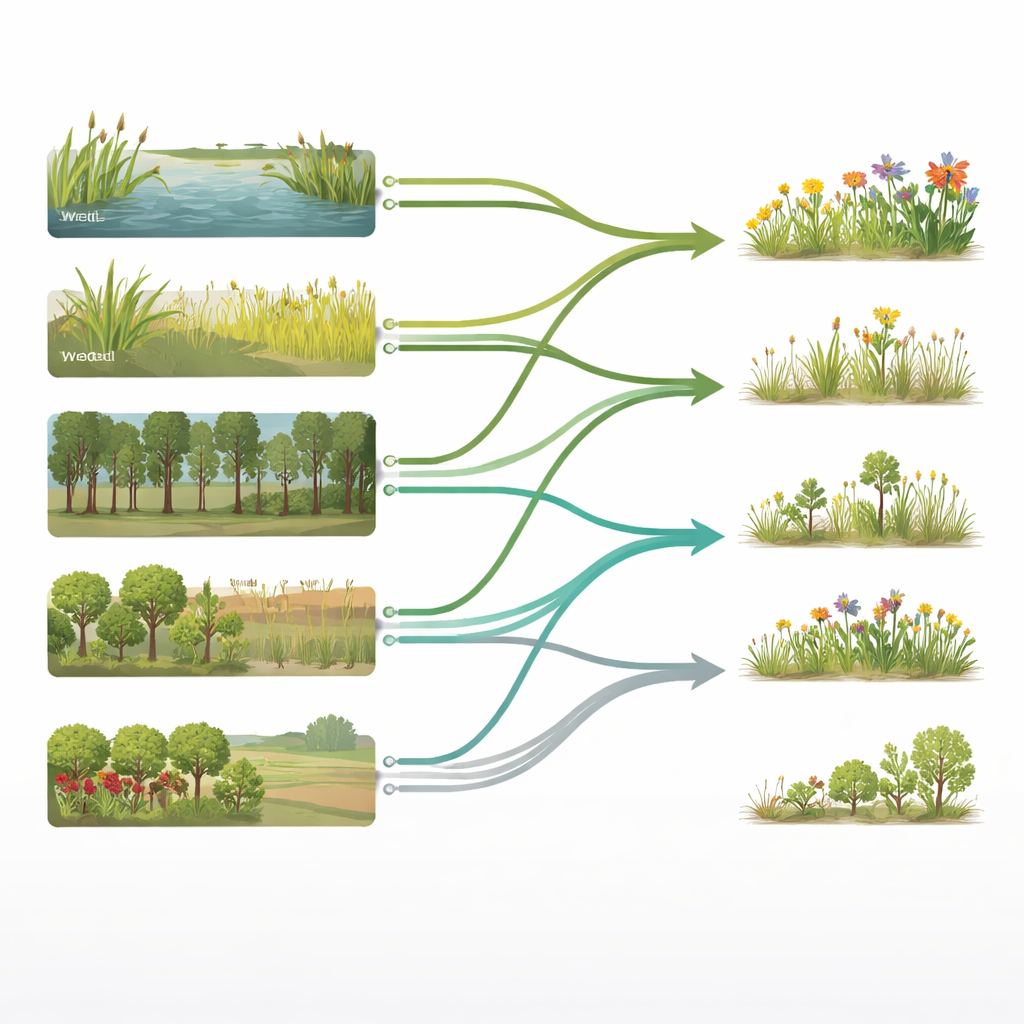
This broad picture hides strong contrasts among habitats. Wetlands and mires showed some of the most pronounced changes, with rising species numbers and functional variety, especially where these sites were disturbed or undergoing succession. Grasslands and forests often gained threatened species when they naturally grew denser, but stable shrublands and forests sometimes lost them. Non-native species increased most strongly in changing wetlands, but actually declined in some sparse or human-made habitats. In many settings, specialist species that are tightly tied to particular conditions declined, while adaptable generalists became more common, particularly in wetlands and some grasslands. Overall, differences among habitat type, how that habitat was changing, and the time period examined together explained only a modest share of the variation, underscoring how context-specific local biodiversity trends really are.
No simple boom in Europe-wide richness
The team also asked whether the total number of plant species recorded across Europe, within each habitat type, has climbed over the decades. Surprisingly, there was no clear continent-wide trend. Only stable grasslands and rocky, sparsely vegetated sites that were naturally filling in showed clear increases in this broader “gamma” diversity. In many forests, the signals even hinted at possible large-scale species losses that were not obvious when looking only at individual plots. Rather than a uniform thinning out of species, Europe appears to be undergoing a complex reshuffling: some species spread and others retreat, often trading places rather than simply adding to the total count.
What this means for conservation
To a casual observer, rising numbers of plant species in local plots might sound like good news. This study shows why that impression can be misleading. In many European habitats, increases in local diversity are linked to the spread of generalist and non-native plants, which can mask the quiet decline of specialists that give each habitat its unique character. The authors argue that understanding biodiversity change requires looking beyond simple species counts and paying attention to habitat type, land-use history, and the balance between specialists and generalists. Their century-long view suggests that conservation efforts must protect not just the quantity of plant life, but also the distinctive species and communities that are most at risk of being replaced.
Citation: Kambach, S., Jandt, U., Acosta, A.T.R. et al. Habitat-specific trends in taxonomic, functional, and phylogenetic diversity in European plant communities over a century. Nat Commun 17, 4208 (2026). https://doi.org/10.1038/s41467-026-72112-5
Keywords: plant biodiversity, European habitats, species turnover, wetlands and grasslands, generalist versus specialist species